
Electronic Components IQC: Verify Identity, Authenticity, and Condition
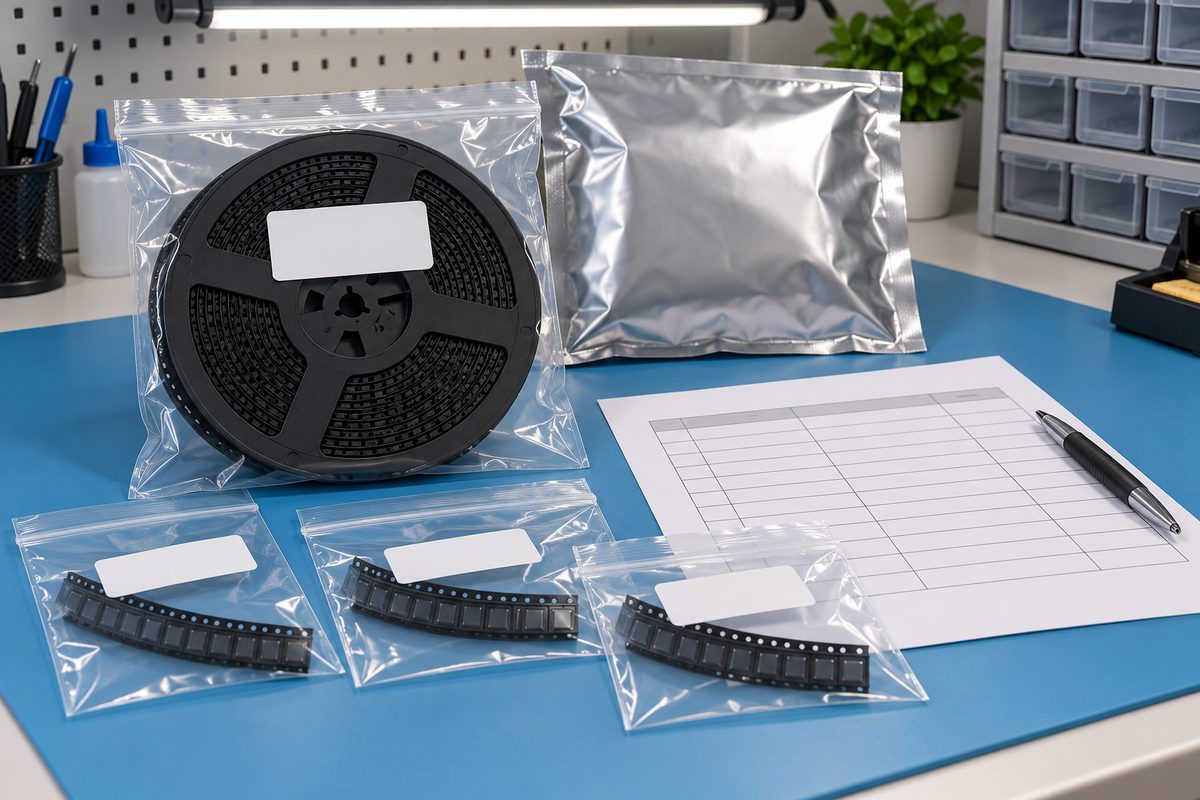
Table of Conent
Table of Conent
Electronic components incoming quality control (IQC) is a risk-based receiving process that confirms the delivered parts match the approved purchase requirement, retain usable condition, and carry the traceability required for the product. IQC does not make an unknown-source component authentic by inspection alone. It combines purchase-channel evidence, label and document review, packaging and moisture controls, visual or dimensional checks, and selected electrical or analytical tests according to risk.
For a PCB assembly program, the objective is practical: prevent the wrong, damaged, mishandled, or suspect part from reaching a feeder while preserving enough evidence to investigate any later failure. The inspection plan should be defined before purchasing, scaled to the component and application risk, and tied to clear accept, hold, and escalation rules.
What should component IQC verify?
A complete IQC review answers four separate questions: Is this the approved item? Is its supply-chain pedigree acceptable? Is the received material in suitable physical and handling condition? Does the lot require further testing before release? Keeping these questions separate prevents a clean-looking reel from being mistaken for proof of identity or authenticity.
| Control objective | Typical evidence | Decision supported |
|---|---|---|
| Identity | Manufacturer part number, package, value, grade, lot and date code | Matches the released BOM and purchase order |
| Pedigree | Authorized-channel records, supplier documentation, chain of custody | Source risk and traceability are acceptable |
| Condition | Packaging, seals, labels, leads, terminations, carrier, moisture status | Material can enter storage or production |
| Performance | Approved sampling, electrical tests, dimensional or analytical results | Lot meets the defined verification plan |
Why should IQC begin with the BOM and purchase order?
Receiving cannot verify a component against an ambiguous requirement. The released BOM should identify the exact manufacturer part number or the controlled approved-alternate list, while the purchase order should state source restrictions, traceability, certificates, packaging, labeling, shelf-life, moisture, and test requirements where applicable. A distributor description or internal nickname is not an adequate identity.
Resolve differences before material is released. A changed temperature grade, voltage rating, tolerance, package suffix, lead finish, programmed state, firmware revision, or carrier format may affect the circuit or assembly process even when the base family name appears correct. The BOM alternate approval guide explains how to compare and authorize a substitute without silently changing production data.
For a quotation that includes component sourcing, provide the controlled BOM, approved manufacturers, substitution rules, lifecycle constraints, quantity, target build schedule, and required traceability through the PCB assembly RFQ path. The review can then separate quoted sourcing assumptions from later engineering approvals.
How do source and traceability affect authenticity risk?
Known pedigree is stronger evidence than a larger inspection checklist. SAE AS6171 states that no amount of testing can confirm authenticity in the same way as a known, unbroken chain of custody to the original or authorized manufacturer channel. The standard applies risk-based inspection and test when parts have unknown pedigree or other counterfeit concerns; it does not turn a single visual check into proof.
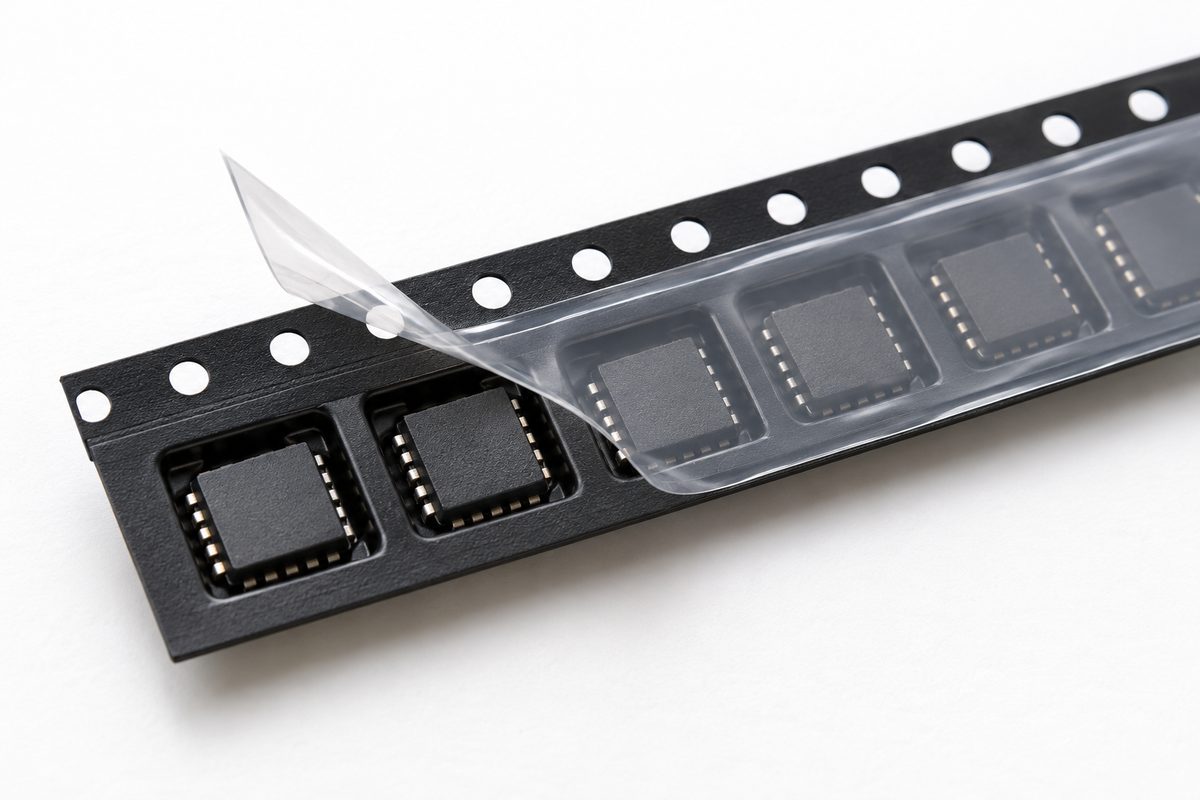
Record the supplier, purchase order, manufacturer, part number, lot and date codes when required, received quantity, packing-list reference, and any certificate identifiers. Link the receiving lot to the storage location and later assembly work order. Preserve original labels when material is split or transferred. If parts are customer-supplied or acquired from an independent distributor, define the extra evidence and tests before shipment instead of improvising after receipt.
Place questionable material in controlled hold status. Do not mix it with accepted stock, relabel it as approved, or return it before evidence has been preserved. Escalation should identify who can authorize testing, concession, return, or destruction and what customer notification is required.
What label and packaging checks are useful?
Label review can expose inconsistencies, but it should be treated as screening evidence. Compare manufacturer name, part number, quantity, lot/date code format, country-of-origin data when required, barcode content, packaging type, and seal condition with purchase documentation and manufacturer information. Watch for conflicting labels, unexpected relabeling, missing traceability, altered print, incompatible reel sizes, or a carrier that does not match the package.
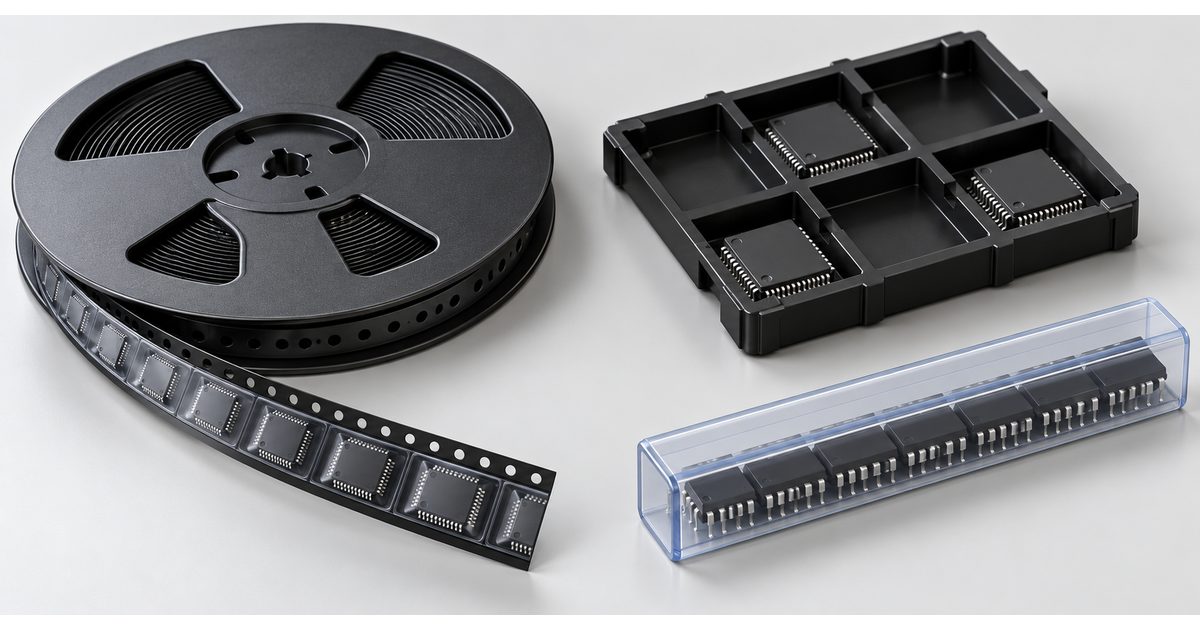
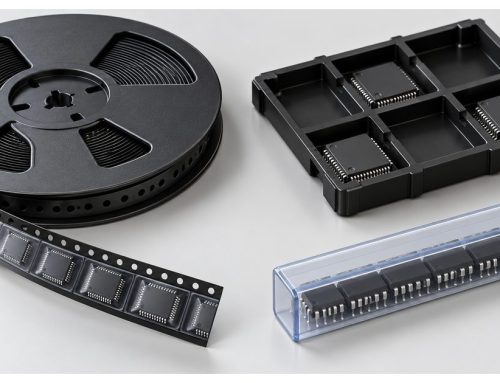
Carrier condition matters to assembly. Damaged pockets, deformed trays, cracked tubes, missing leaders, loose cover tape, contamination, or incorrect pitch can interrupt feeding and damage parts. The component packaging and carrier guide shows why reel, tray, tube, and cut-tape formats need to be specified along with the device.
Count verification also needs a defined method. Reel counters, weight-based estimates, tray counts, and supplier labels have different uncertainty. Use the method appropriate to value, packaging, and shortage risk, and record any discrepancy before the lot is split.
How should moisture-sensitive and ESD-sensitive parts be handled?
Inspection must not create the damage it is intended to prevent. Moisture-sensitive devices need label, bag, desiccant, humidity-indicator, seal, exposure-time, and storage review according to the applicable product and handling requirements. If the moisture barrier bag is damaged or the exposure history is unknown, place the material on hold and follow an approved recovery decision rather than assuming a generic bake is harmless.
Open packages only in the appropriate controlled area and update floor-life records. Baking temperature and duration depend on the package, carrier, sensitivity level, and applicable procedure; unsuitable conditions can deform tape or trays, oxidize finishes, or damage components. ESD-sensitive items similarly require protected handling, grounded equipment, suitable containers, and records consistent with the site’s approved program.
What should visual and dimensional inspection cover?
Visual inspection checks for anomalies that affect identity, handling, or assembly. Depending on package type and risk, reviewers may examine body markings, pin-one indicators, resurfacing signs, lead or termination condition, oxidation, contamination, cracks, chips, bent leads, coplanarity concerns, damaged balls, or inconsistent mold features. Comparison samples and current manufacturer documentation can make observations more meaningful.
Do not infer electrical equivalence from appearance. Marking conventions vary by manufacturer, package size, assembly site, and production date. Some small parts have abbreviated or no top marking. Dimensional checks can compare body, pitch, lead, termination, or package geometry with the datasheet, but a dimensional match alone is not proof of internal die identity or performance.
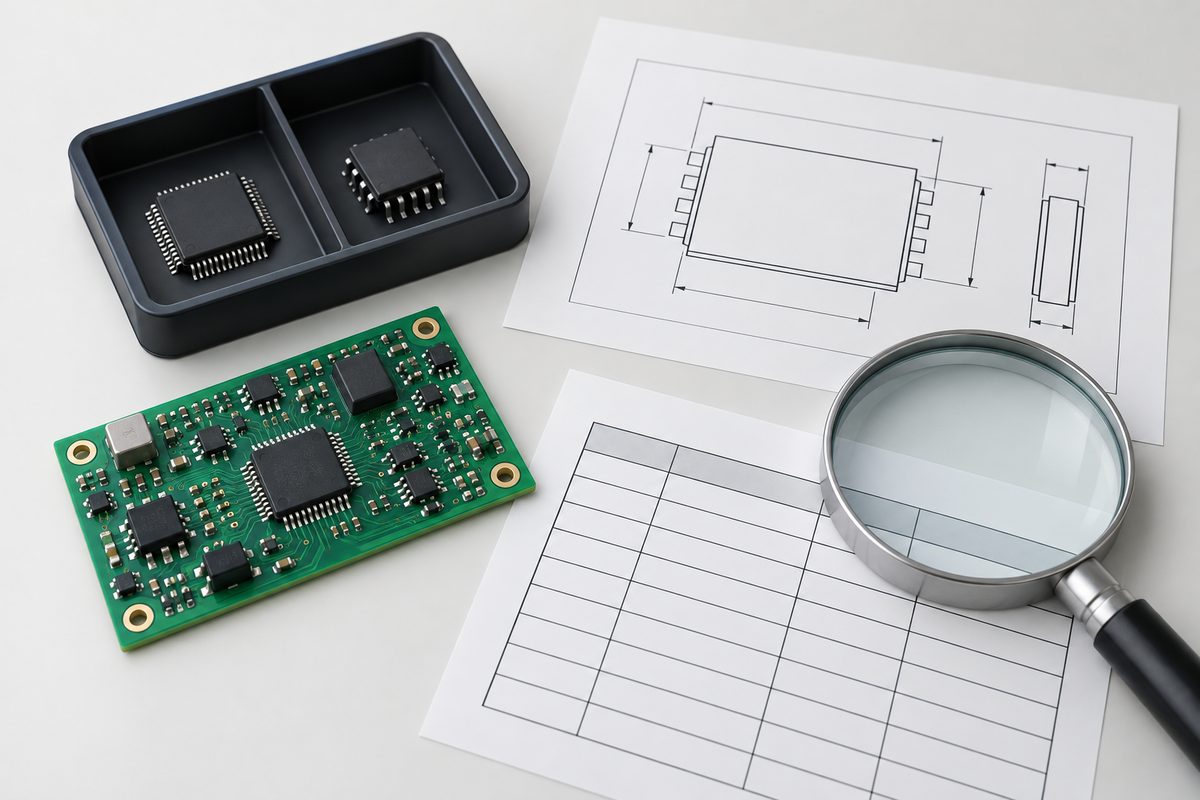
Record inspection magnification, sample selection, equipment identification where needed, images of anomalies, and the acceptance basis. Avoid vague entries such as “looks good.” A useful record says what was checked, how many units were reviewed, what requirement applied, and who released the lot.
When are electrical or analytical tests appropriate?
Additional testing should follow the assessed risk, not a fixed menu used for every component. Simple passives may permit value measurements on a justified sample. Integrated circuits can require device-specific electrical tests, X-ray, XRF, decapsulation, acoustic microscopy, marking permanency evaluation, or other methods performed by qualified personnel and laboratories. Each technique has limitations and may be destructive.
SAE AS6171 and its slash sheets provide standardized methods for suspect/counterfeit electronic-part detection when invoked by contract or risk planning. The base standard emphasizes that tests are selected using application, component, supplier, and other risk factors. A test report should identify the method, sample, equipment, acceptance criteria, results, anomalies, and disposition. Passing one method must not be represented as universal proof.
Define destructive-test sample ownership and replacement before the order. High-value, obsolete, or allocation-constrained parts can create commercial disputes if the quotation omits sample consumption, lead time, or escalation costs.
How should sampling and lot release be controlled?
A sampling plan is meaningful only when the lot definition and acceptance criteria are clear. Identify whether a lot is separated by supplier shipment, manufacturer lot, date code, package, or another controlled unit. Mixing different lots before inspection destroys evidence and can hide a localized problem. Risk factors may justify tightened sampling, 100% screening, or a qualified external laboratory.
- Receive and quarantine: assign a unique receiving lot and prevent unreviewed issue to production.
- Verify documents and identity: compare the purchase order, BOM, packing records, labels, and required certificates.
- Inspect condition and handling status: evaluate packaging, carrier, moisture, ESD, visible damage, and quantity.
- Run risk-based tests: use the approved method and preserve sample traceability.
- Disposition: release, hold, return, or escalate the lot with documented authority.
- Link to production: retain the relationship between accepted lots and assembly work orders.
If a receiving discrepancy could affect a scheduled build, submit the BOM, supplier and part details, photographs, quantity, date/lot codes, packaging condition, and required tests through the quotation and engineering review page. This supports a sourcing and manufacturing decision without bypassing customer approval.
How does IQC connect to the assembly line?
Accepted material still needs identity control at kitting and point of use. Barcode verification, feeder setup, first-article checks, split-reel labeling, and controlled replenishment can prevent a correct receiving lot from becoming a wrong-placement event. The PCB assembly process guide places incoming control within the larger sequence of fabrication, kitting, printing, placement, reflow, inspection, and test.
Nonconformance data should also feed supplier and process decisions. Track repeated shortages, packaging damage, label discrepancies, moisture excursions, dimensional anomalies, and electrical failures by supplier and part. Trend data helps purchasing and engineering decide whether to change source controls, packaging requirements, safety stock, or approved alternatives.
Practical component IQC checklist
- Released BOM and purchase-order revision agree.
- Manufacturer part number, package, grade, and quantity match.
- Supplier pedigree and required traceability are documented.
- Lot/date codes and original labels are preserved as required.
- Carrier, seals, leads, terminations, and packaging are undamaged.
- Moisture and ESD status are controlled before opening.
- Sampling and test methods reflect component and application risk.
- Inspection records state method, sample, criteria, result, and authority.
- Held material is physically and electronically segregated.
- Released receiving lots remain linked to kitting and assembly records.
Electronic components IQC is strongest when sourcing, engineering, quality, and production use the same controlled identity and risk decision. For a one-stop PCB assembly review, send Gerbers, BOM, pick-and-place data, approved-source rules, quantities, traceability needs, and test requirements through the RFQ page. The quotation can then account for PCB fabrication, component sourcing, incoming controls, assembly, inspection, testing, and delivery without treating material quality as an afterthought.
Technical reference: SAE International AS6171, Test Methods Standard for Suspect/Counterfeit EEE Parts.
Latest Blog
Contact Info
Phone: +86-755-82882936
Email: [email protected]
WhatsApp: +86-13570802455
Wechat: +86-13570802455
Address: 2nd floor,D Bldg.,Electric Link Technology Bldg.,Gongming,Guangming New Dist.,518106 Shenzhen, China