
PCB Production Europe: Process, Supplier Criteria, and Cost Factors
Table of Conent
Table of Conent
A search for “PCB production Europe” usually reflects a supplier-selection problem, not only a request for a description of board fabrication. PCB manufacturing in Europe can involve a local fabricator, a regional sales organization, or an international production partner serving a European OEM. The right source depends on the product’s technical requirements, the documents needed for market access, the expected order profile, and the amount of engineering control needed before fabrication begins. A supplier with a low unit price can still create a high-cost program if it produces an incomplete stackup, substitutes material without approval, ships with incomplete documentation, or cannot support a controlled response to a quality issue.
This guide helps European OEM and engineering teams compare PCB suppliers before explaining the fabrication flow that supports the decision. It covers supplier location and communication, technical qualification, compliance records, landed cost, and the RFQ inputs needed for prototypes, low-to-medium-volume production, and assemblies that need clear technical records.
How to Evaluate PCB Suppliers Serving Europe
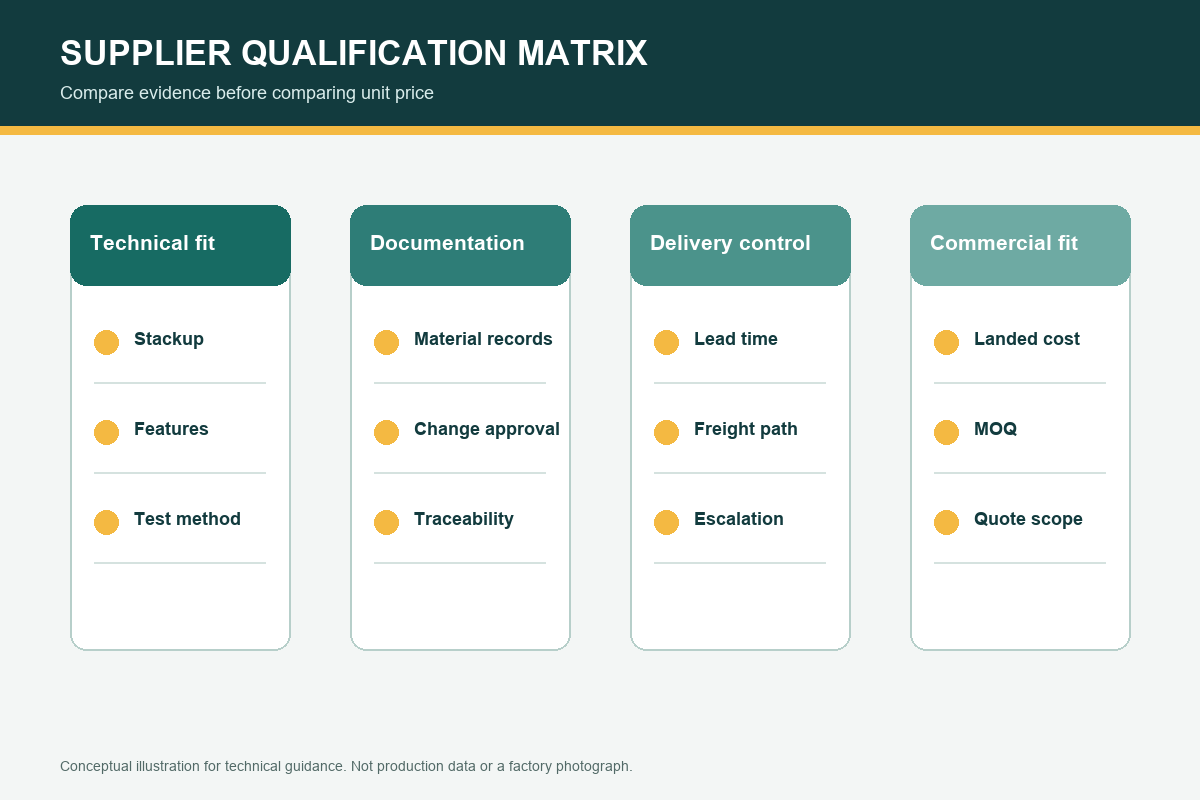
Whether a program uses a European PCB manufacturer or a PCB manufacturer serving Europe, compare the supplier against the same released data package and commercial assumptions. The location label alone does not establish technical fit, documentation quality, or delivery reliability.
Start with the requirements that cannot be corrected after fabrication: layer count, material family, finished copper, impedance, via structure, surface finish, test coverage, and delivery date. Then compare how each supplier handles engineering questions, approved changes, traceability, material declarations, freight, customs, and corrective action. This makes PCB fabrication in Europe a comparable sourcing decision rather than a quote-price exercise.
For teams evaluating PCB manufacturing in Europe across local and cross-border sources, the practical goal is to identify the supplier that can meet the defined specification with the required records and delivery controls. The later sections show which fabrication and cost details should support that comparison.
What PCB Production Includes
PCB production normally refers to bare-board fabrication. The work starts with an engineering data package and ends with electrically tested, inspected boards packed for shipment. If components are mounted, programmed, or tested after fabrication, that is PCB assembly rather than bare-board production.
For a production-ready order, the supplier needs enough information to translate the design into a manufacturable process. At minimum, this usually includes Gerber or ODB++ data, drill files, a fabrication drawing, the required quantity, and the revision level. A controlled stackup, impedance requirements, material constraints, finish, panelization requirements, and test expectations should also be identified when they apply.
The PCB manufacturing capabilities page is a useful starting point for comparing a design’s needs with a fabrication scope. It does not replace a design review. The practical question is whether the supplier can produce the specified board consistently and document any proposed change before release.
PCB Fabrication in Europe: Process and Decision Points
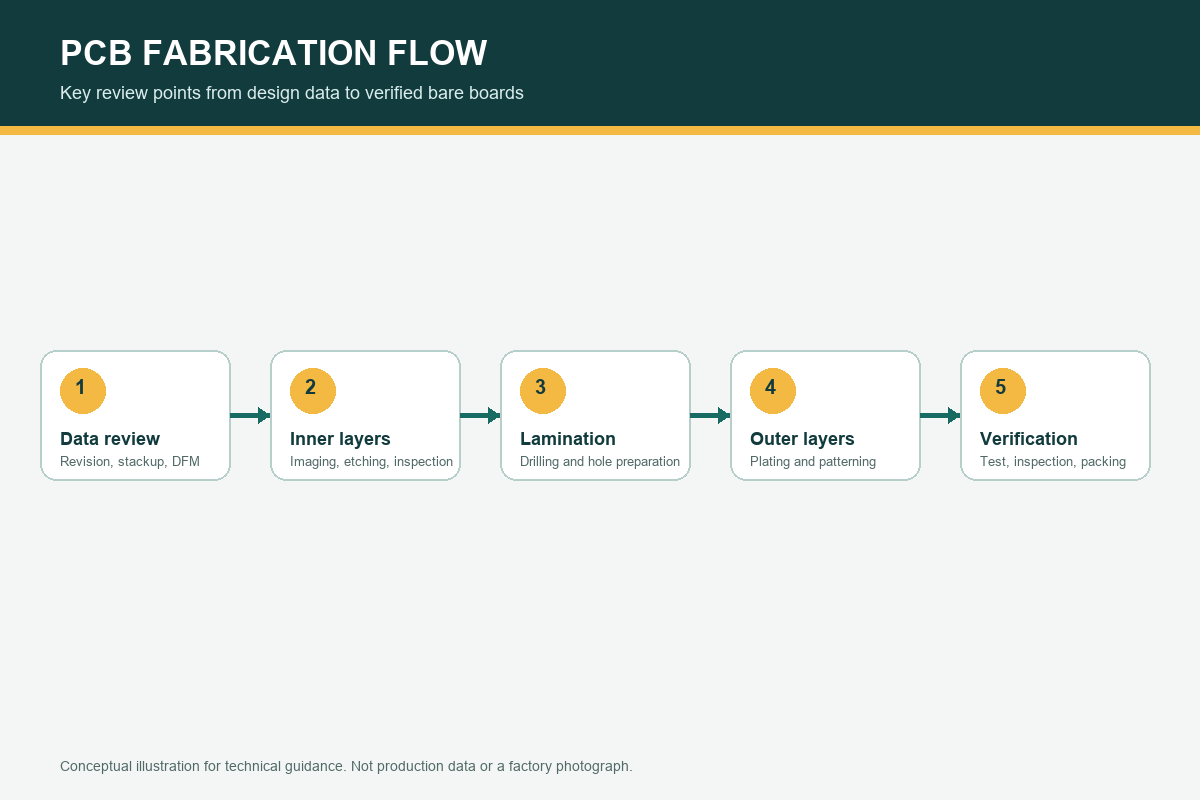
The exact routing changes with layer count, material system, copper weight, surface finish, and special features. The core sequence is still useful because each stage creates a different source of risk.
1. Data review and manufacturing release
The supplier reviews artwork, drill data, fabrication notes, and the requested build. This is where conflicting data should be identified. Common examples include a stackup note that does not match impedance targets, drill sizes that are unsuitable for a specified finish, missing controlled-impedance structures, or solder-mask clearance that does not match fine-pitch assembly needs.
Ask for a documented engineering query when a change is necessary. A supplier should not treat a material, finish, or tolerance change as an administrative detail. Those decisions can affect electrical performance, solderability, reliability, and the subsequent assembly process.
2. Inner-layer imaging, etching, and inspection
For multilayer boards, inner copper layers are imaged and etched before lamination. Registration, trace geometry, and copper balance matter here. A design with dense routing, fine features, or high-speed nets may need more attention to material selection, copper profile, and registration capability than a conventional control board.
Teams planning dense builds should also compare the design against a multilayer PCB production guide. The important production decision is not the nominal layer count alone. It is whether the proposed stackup, dielectric choices, vias, and fabrication tolerances support the design intent.
3. Lamination, drilling, and hole preparation
Inner layers and prepreg are laminated into a panel. Drilling then creates plated-through holes, vias, tooling holes, and mechanical features. Drill aspect ratio, annular ring, via type, and copper thickness affect yield and cost. Buried vias, blind vias, filled vias, backdrilling, and tight registration requirements add process steps and should be called out in the RFQ rather than discovered after quoting.
4. Plating and outer-layer patterning
Electroless and electrolytic copper processes create conductive barrel walls and build copper where required. The outer layers are then patterned and etched. At this point, the fabricator needs to manage plating distribution and final conductor geometry. For fine-pitch parts or high-current paths, the specified finished copper and conductor tolerances should be clear.
5. Solder mask, legend, and surface finish
Solder mask protects copper and defines assembly pads. The surface finish affects storage, assembly compatibility, contact performance, and cost. ENIG, lead-free HASL, OSP, immersion silver, and other finishes are not interchangeable defaults. The selection should reflect component pitch, wire bonding or contact needs where applicable, expected storage conditions, and the assembly process.
6. Profile, electrical test, inspection, and packing
Panels are routed, scored, or otherwise separated according to the drawing. Electrical test confirms the required net connectivity and isolation on the completed bare board. Inspection criteria, coupons, certificates, marking, packaging, and traceability requirements should be agreed before release. A board that passes a continuity test may still fail an OEM’s documentation or cosmetic requirements, so the acceptance basis should not be left implicit.
Supplier Criteria for European PCB Programs
“European PCB manufacturer” can describe a local fabricator, a regional sales organization, or a supplier serving Europe from another production location. A buyer searching for a PCB manufacturer in Europe should verify the actual production and support model rather than assume that a regional label indicates a local factory. Geography alone does not establish whether the supplier is suitable. Evaluate the following controls against the actual program.
Engineering communication and change control
The supplier should provide a clear process for handling engineering questions, revision changes, and manufacturing deviations. Confirm who approves a stackup adjustment, material substitution, panelization change, or surface-finish alternative. For a recurring product, ask how the released revision, customer approvals, and build history are retained.
Technical fit
Qualification should cover the features that actually drive the build: layer count, finished copper, minimum trace and space, drill sizes, via construction, impedance, material family, thermal requirements, and finish. A generic capability table is only a screen. Ask the supplier to identify constraints tied to your design files.
For a straightforward design, this 4-layer PCB design guide can help separate stackup and return-path decisions from a generic layer-count request. For more complex boards, submit the actual stackup and constraints for a fabrication review.
Quality evidence and traceability
Define the records required with the order. Depending on the program, they may include a certificate of conformance, material traceability, test records, first-article evidence, microsection requirements, controlled-impedance results, or nonconformance reporting. Do not assume a document is included because it is common in another supply chain.
The value of traceability is practical. It lets a team link a field concern or assembly issue to the relevant fabrication lot, material lot, test result, and approved revision. It also makes supplier corrective action more actionable than a general quality complaint.
Regulatory and material documentation
European programs may need supplier declarations and material information to support the OEM’s compliance process. The required documentation depends on the finished product and its market, so the buyer should define the document set with its compliance team. Relevant frameworks can include the EU RoHS Directive 2011/65/EU and the REACH Regulation (EC) No 1907/2006.
These references do not mean every PCB has the same declaration requirement. They establish why material declarations, controlled substance information, and revision-controlled evidence should be requested early. A fabricator should state what it can provide and the product or material scope of each document.
Logistics and response time
Compare quoted lead time with the order profile: prototype, bridge build, scheduled release, or production replenishment. The delivery promise should distinguish fabrication time, test, approval hold points, packing, freight, customs handling, and any consolidation step. For imported boards, the buyer should calculate delivery risk from the complete path rather than the factory’s stated production days.
How to Compare PCB Production Cost in Europe
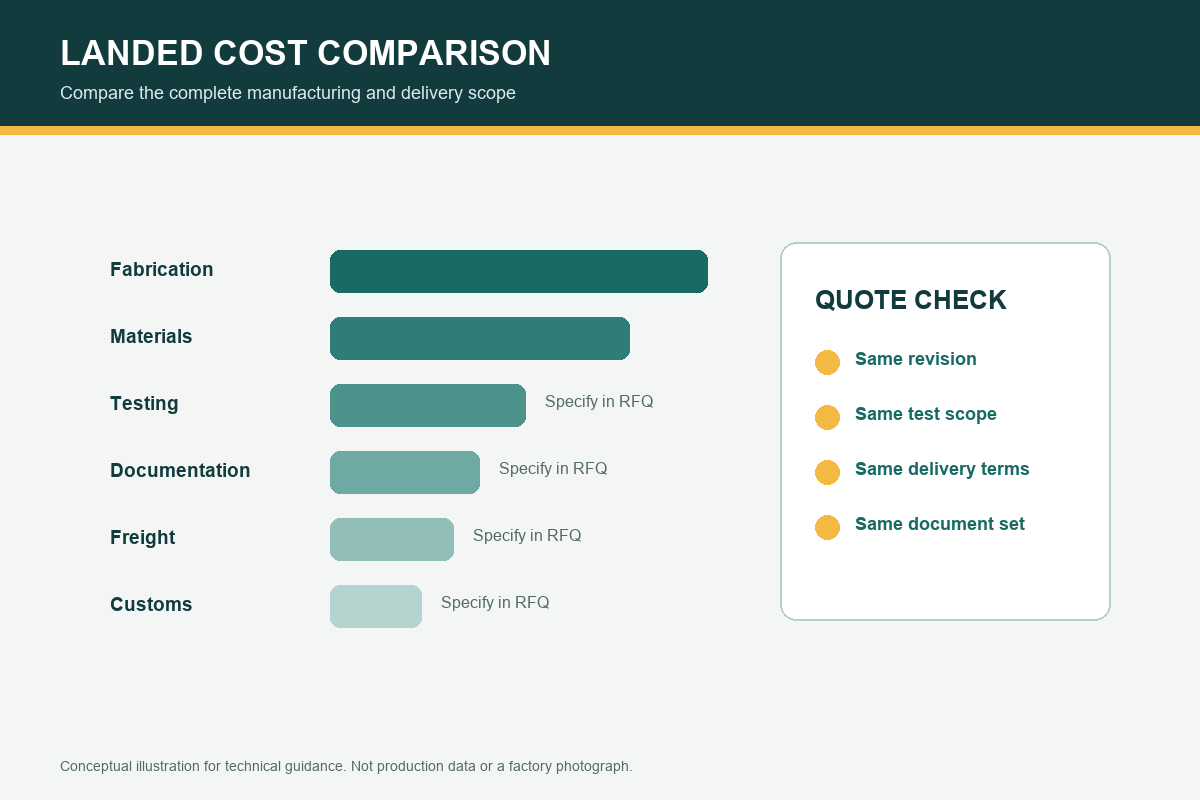
Unit price is useful but incomplete. A comparable quotation identifies the specification and the commercial assumptions behind it. Use a cost model that separates the following inputs.
| Cost driver | Why it changes cost | What to specify in the RFQ |
|---|---|---|
| Board area and panel utilization | Larger boards and poor panel utilization consume more material and process capacity. | Finished dimensions, quantity, routing or V-score requirements, panel preference if any. |
| Layer count and build complexity | More layers add imaging, lamination, registration, and inspection work. | Layer count, stackup, controlled impedance, copper weights, and special via requirements. |
| Material and finish | Laminate family, Tg, halogen-free constraints, copper foil, and finish affect availability and process cost. | Approved materials or performance requirements, finish, and substitution rules. |
| Feature size and tolerances | Fine lines, small drills, tight annular rings, and special profiles can reduce yield. | Minimum trace/space, drill table, tolerances, finished-hole requirements, and edge features. |
| Testing and documentation | Electrical test, coupons, inspection, certificates, and reporting require planning and labor. | Test method, acceptance criteria, records, traceability, and first-article requirements. |
| Delivery and commercial terms | Freight, customs, insurance, packaging, and payment terms change the landed cost. | Ship-to location, requested delivery date, Incoterms, packaging, and delivery split rules. |
Use the same revision and requirements list for every supplier. Otherwise, a low quote may be based on omitted test requirements, a different finish, a relaxed tolerance, or an assumed panelization. The cheapest quote is only comparable when the underlying build is comparable.
For an early cost estimate, distinguish one-time engineering charges from recurring unit cost. Then check where volume changes the economics. Tooling, setup, test fixtures, panel yield, and freight may dominate a small prototype order. Material utilization and process yield may become more important as volume grows.
If the project also requires mounted components, custom PCB assembly should be evaluated as a separate scope. Fabrication and assembly may be purchased together, but the quote should still state the handoff data, component-sourcing assumptions, inspection plan, test responsibility, and treatment of approved substitutions.
RFQ Checklist for PCB Fabrication
An RFQ is easier to compare when it contains a stable technical package. Before requesting pricing, assemble the following items:
- Gerber or ODB++ data and NC drill files.
- A fabrication drawing with dimensions, layer count, finish, mask color if relevant, legend, and mechanical requirements.
- Revision identifier and a list of any superseded files.
- Stackup and impedance table for controlled-impedance designs.
- Required laminate characteristics, copper weights, and approved material constraints.
- Quantity, target delivery date, delivery location, and any scheduled-release requirement.
- Test requirements, inspection criteria, certificates, traceability, and packaging instructions.
- A list of features that need explicit confirmation, such as filled vias, edge plating, castellations, carbon contacts, or backdrilling.
Before releasing a prototype or production build, submit the Gerber package, fabrication drawing, target quantity, delivery location, and testing requirements through the PCB quote form. An engineering and quotation review can then identify missing build details, clarify manufacturability questions, and return a quote based on the defined scope rather than an assumed configuration.
Questions to Ask Before Selecting a Supplier
- Which requirements in the data package create a fabrication risk, cost premium, or lead-time constraint?
- What stackup and material will be used, and how are changes approved?
- What electrical test coverage and records are included?
- Which quality and material documents can be supplied for this specific order?
- What is the escalation path for a nonconformance or a revision change?
- Which delivery assumptions are included in the quoted date and price?
- Which specifications are excluded or assumed in the quotation?
These questions are especially important when comparing local and offshore sources. A local source may simplify communication or delivery control for some programs. An offshore source may be commercially suitable when the specification, documentation, logistics, and escalation process are controlled. The decision should be based on the total program risk and landed cost, not a location label.
A Practical Selection Method
Start with technical eligibility. Remove suppliers that cannot support the required features, documentation, or delivery model. Next, compare quotes against the same released package and identify every difference in materials, tests, tolerances, commercial terms, and included documents. Then assess response quality: a supplier that identifies a real manufacturing issue before release is often providing useful engineering evidence, not merely delaying the order.
For a new or changed design, a prototype build can also serve as a qualification step. Define what will be checked after receipt, including fit, assembly behavior, electrical performance, documentation completeness, and response to any discrepancy. Carry the resulting changes into the production release rather than relying on email history.
Conclusion
PCB production for European programs should be evaluated as a controlled manufacturing and supply process. The fabrication sequence matters, but the strongest supplier decision also considers engineering communication, technical fit, traceability, compliance evidence, delivery assumptions, and total landed cost. A complete RFQ package gives suppliers the information needed to identify risks early and lets the buyer compare like for like.
When the design is ready for review, send the fabrication data, drawing, stackup, quantity, delivery location, and required test or documentation records through the PCB quotation request. The review can confirm manufacturing questions and pricing assumptions before the build is released.
Latest Blog
Contact Info
Phone: +86-755-82882936
Email: [email protected]
WhatsApp: +86-13570802455
Wechat: +86-13570802455
Address: 2nd floor,D Bldg.,Electric Link Technology Bldg.,Gongming,Guangming New Dist.,518106 Shenzhen, China