
4.7k Ohm Color Code: Value, Tolerance, and Identification
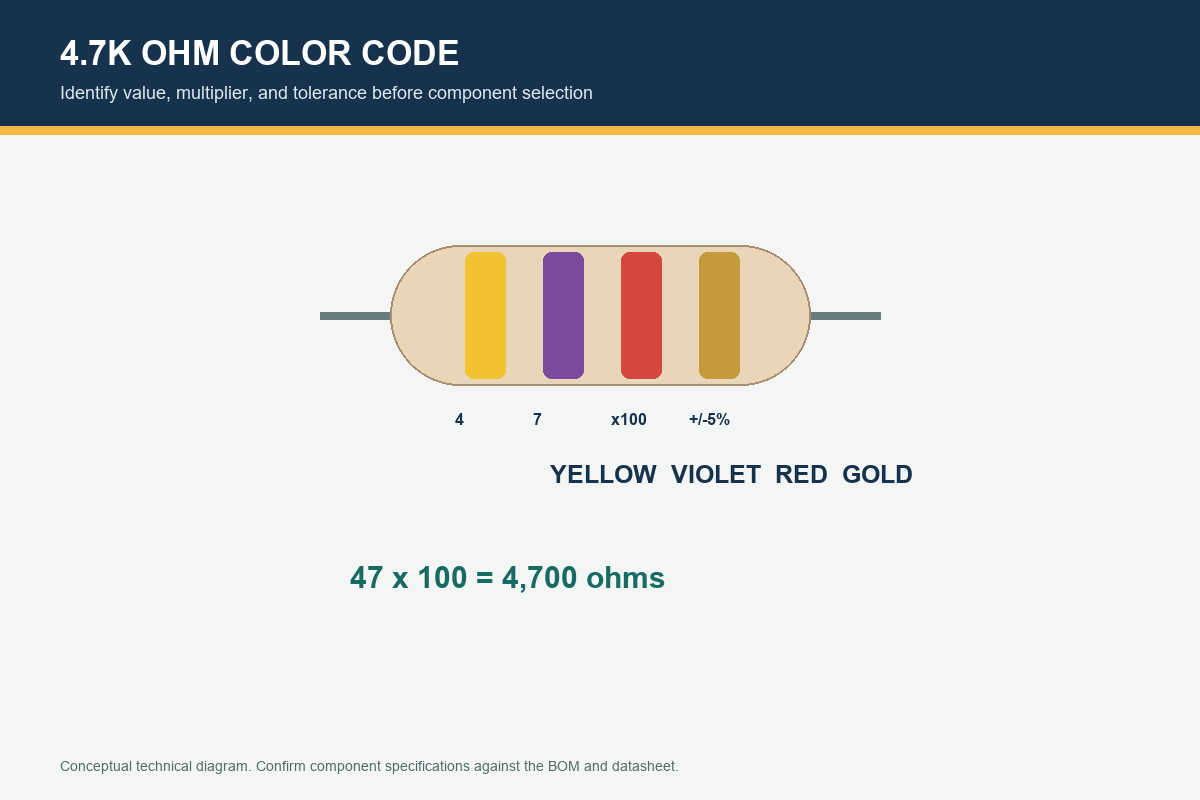
Table of Conent
Table of Conent
The 4.7k ohm color code identifies a resistor with a nominal value of 4,700 ohms. On a common four-band through-hole resistor, the bands are yellow, violet, red, and gold: 4, 7, multiplier x100, and a 5% tolerance. The calculation is simple, but a reversed reading direction, an overlooked multiplier band, or confusion between 4.7k and 4.7 ohms can produce a 1,000-fold error.
For engineers, technicians, and purchasers checking loose components, the color bands are only the first check. The intended value, tolerance, package, power rating, temperature coefficient, and approved manufacturer part number still need to match the BOM and design requirements.
What Does 4.7k Ohm Mean?
The `k` means kilo, or one thousand. Therefore:
4.7 kOhm = 4.7 x 1,000 ohms = 4,700 ohms
The value may also appear as `4K7` on a schematic, BOM, or component marking. In this notation, the letter replaces the decimal point and supplies the multiplier. `4K7` and `4.7 kOhm` both mean 4,700 ohms.
This distinction matters because `4.7 ohm` is not a shortened form of 4.7k ohm. A 4.7 ohm resistor is 1,000 times lower in resistance. In a pull-up network, bias circuit, current limiter, or feedback path, substituting one for the other can change circuit behavior substantially.
Four-Band 4.7k Ohm Color Code
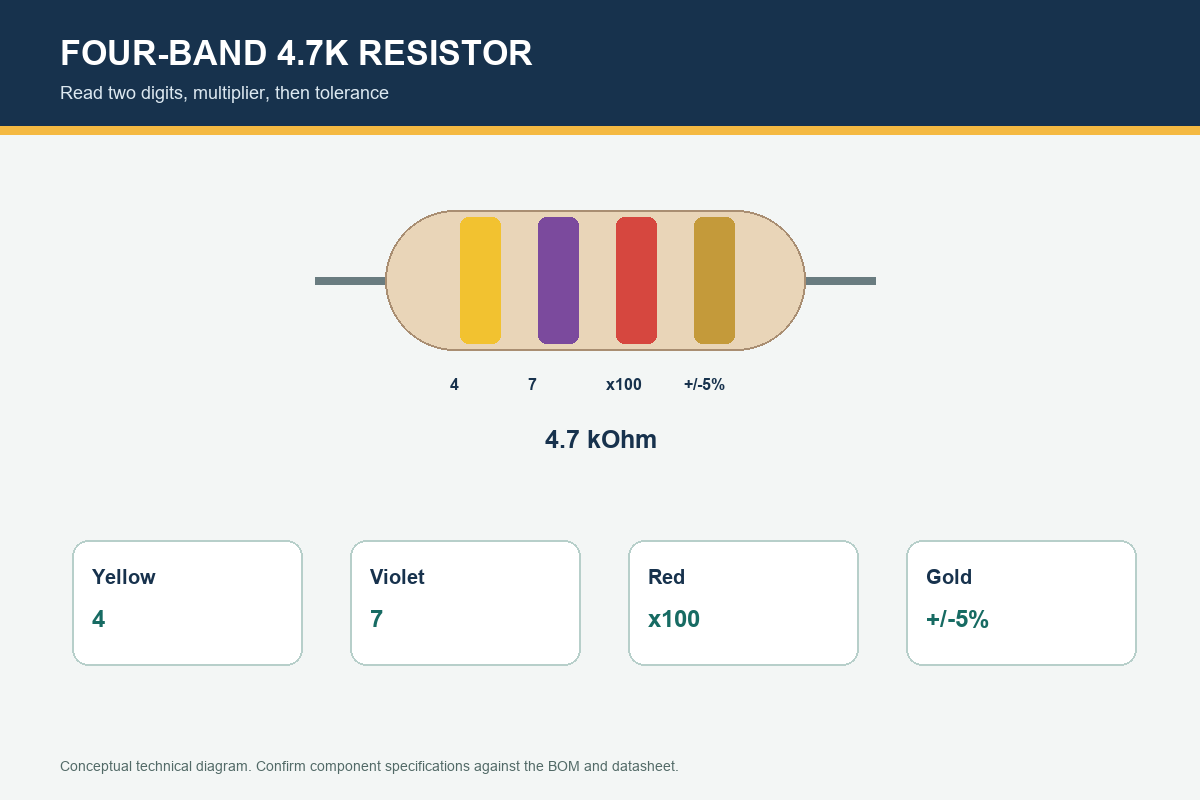
For a four-band resistor, read the first two significant digits, then the multiplier and tolerance.
| Band | Color | Meaning |
|---|---|---|
| 1 | Yellow | 4 |
| 2 | Violet | 7 |
| 3 | Red | x100 multiplier |
| 4 | Gold | +/-5% tolerance |
The calculation is `(47 x 100) = 4,700 ohms`, or 4.7 kOhm. With a gold tolerance band, the actual measured resistance may fall between 4,465 ohms and 4,935 ohms at the reference conditions specified for the part.
The gold band is commonly spaced farther from the other bands or sits near one end of the resistor. That visual separation helps establish the reading direction. Do not begin at the tolerance band. Gold and silver are normally tolerance or multiplier colors, not first significant-digit colors in a standard four-band reading.
The phrase `4.7 kilo ohm resistor color code` describes this same four-band pattern when the component is a conventional axial, color-banded resistor. Whether a search uses `4.7k ohm resistor color code` or `4.7 k ohm resistor color code`, the target value is 4,700 ohms, not 4.7 ohms.
Five-Band and Six-Band Versions
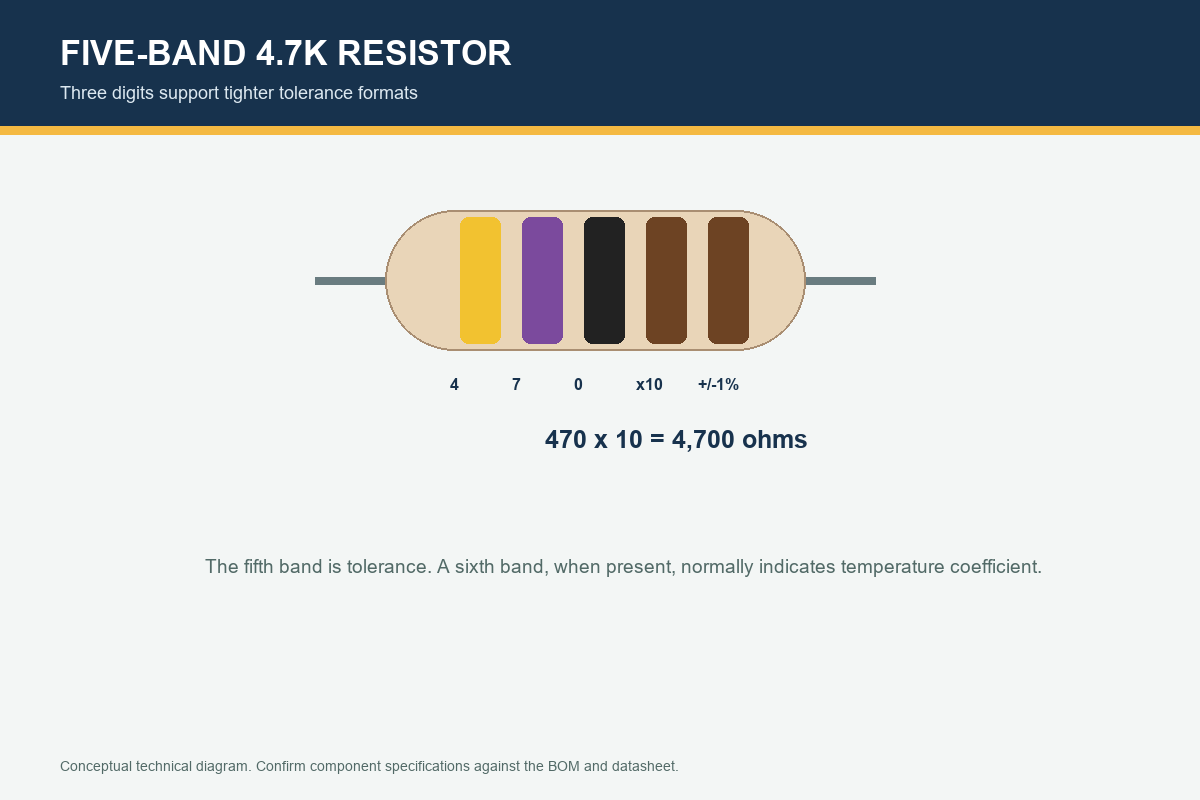
Precision resistors often use five bands because they need three significant digits instead of two. A 4.7k value can be shown as yellow, violet, black, brown, brown:
| Band | Color | Meaning |
|---|---|---|
| 1 | Yellow | 4 |
| 2 | Violet | 7 |
| 3 | Black | 0 |
| 4 | Brown | x10 multiplier |
| 5 | Brown | +/-1% tolerance |
The calculation is `(470 x 10) = 4,700 ohms`. The extra digit does not change the nominal value. It provides a format for tighter tolerance parts and for values that require three significant figures.
A six-band resistor adds a temperature-coefficient band after the tolerance band. That band should be interpreted from the applicable color-code standard and the component datasheet. Its presence does not by itself prove suitability for a temperature-sensitive circuit. Check the actual resistance tolerance, temperature coefficient, voltage rating, power rating, and construction.
How to Avoid Reading Errors
The `4 7k resistor color code` query often reflects a visual inspection problem rather than a calculation problem. Use this sequence before accepting the value:
- Identify the band that appears isolated. It is usually the tolerance band and should be read last.
- Check whether the resistor has four, five, or six bands before assigning digits.
- Read the significant digits first, then apply the multiplier.
- Confirm the calculated value against the schematic reference, BOM, or approved-value list.
- Measure the part with a calibrated meter only after isolating it from parallel circuit paths when necessary.
Lighting and aging can make red, brown, orange, and gold hard to distinguish. If the bands are ambiguous, use the manufacturer data sheet or the BOM manufacturer part number rather than guessing from color alone. For a production lot, verify the received label, lot traceability, and sampling method against the purchase and quality requirements.
4.7k Ohm Versus 4.7 Ohm
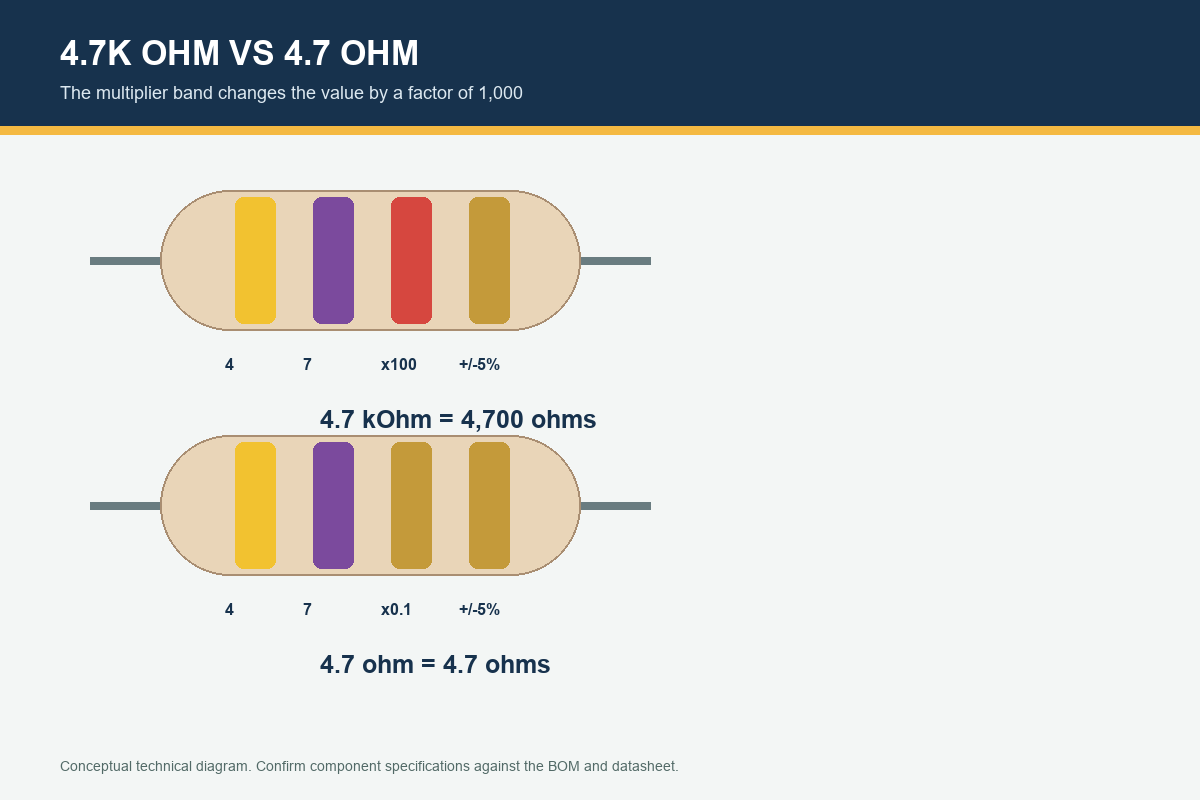
The `4.7 ohm resistor color code` is a different value and should be treated as a separate identification task. A typical four-band representation is yellow, violet, gold, gold:
| Value | Typical four-band sequence | Calculation |
|---|---|---|
| 4.7 kOhm | Yellow, violet, red, gold | 47 x 100 = 4,700 ohms |
| 4.7 ohm | Yellow, violet, gold, gold | 47 x 0.1 = 4.7 ohms |
The third band creates the difference. Red applies a x100 multiplier. Gold applies a x0.1 multiplier. A reader who sees yellow and violet but does not verify the third band can select the wrong component by three orders of magnitude.
This risk is especially relevant during manual rework, prototype bring-up, and incoming inspection of mixed loose components. In a controlled assembly process, the BOM reference designator, reel label, package, and placement data should control selection. Color-band inspection is a useful backup check, not a substitute for component traceability.
When Color Bands Are Not the Right Method
Color codes apply primarily to through-hole resistors. Most surface-mount resistors use printed markings, EIA codes, or no visible marking at all. High-precision, high-power, current-sense, and specialty resistors may have markings that do not follow the common axial color-band convention.
If a design transitions from a through-hole prototype to surface-mount production, do not carry the color-code inspection method into the SMT process without checking the new package and marking convention. The relevant production controls become the approved manufacturer part number, distributor traceability, BOM version, pick-and-place data, and incoming inspection criteria.
For a broader component-recognition reference, see the basic electronic components guide. The 15 basic components of a PCB overview can also help place resistor selection in the wider circuit context.
Selection Checks Beyond Resistance Value
A correct nominal resistance does not complete component selection. Before releasing a design or placing a purchase order, check:
- Tolerance: A 5% resistor may be acceptable for a simple pull-up but not for a precision divider or reference network.
- Power rating: Determine dissipation from the actual circuit voltage and current with an appropriate margin. Do not infer a rating from body color or physical size alone.
- Voltage rating: Confirm the part can withstand the circuit voltage and expected transient conditions.
- Temperature coefficient: Use the datasheet when temperature drift affects the circuit requirement.
- Package and assembly method: Axial, radial, and surface-mount parts need different footprints, assembly controls, and inspection methods.
- Approved source and traceability: Confirm the BOM part number and sourcing rules before substituting an equivalent value.
When a prototype or production build includes mixed resistor packages or approved alternates, send the BOM, quantity, and any no-substitution requirements with the manufacturing data. For an assembly review, provide the BOM, Gerber files, package constraints, required quantity, and test expectations through the custom PCB assembly service. The review can clarify component-sourcing assumptions, package compatibility, and assembly requirements before the order is released.
A Practical Inspection Example
Suppose a technician finds an axial resistor with yellow, violet, red, and gold bands. The first two bands form 47. Red is x100, so the nominal value is 4,700 ohms. Gold indicates +/-5% tolerance. If the design calls for `R12 = 4K7`, the part matches the nominal resistance, but the technician should still confirm the required tolerance and power rating before approving it.
If the third band were gold instead of red, the calculation would be 47 x 0.1, or 4.7 ohms. That part must not replace a 4.7k pull-up resistor merely because its first two bands match.
Conclusion
The 4.7k ohm color code is yellow, violet, red, gold for a standard four-band, 5% resistor. A five-band 1% example is yellow, violet, black, brown, brown. Read the multiplier and tolerance band carefully, distinguish `4K7` from 4.7 ohms, and use the BOM and data sheet to confirm requirements that color bands cannot show.
For a build that includes resistor sourcing or assembly, submit the BOM, Gerber files, quantity, approved alternates, and test requirements through the PCB quotation request. The review can confirm component-sourcing assumptions and identify data needed for an assembly quotation.
Latest Blog


Contact Info
Phone: +86-755-82882936
Email: [email protected]
WhatsApp: +86-13570802455
Wechat: +86-13570802455
Address: 2nd floor,D Bldg.,Electric Link Technology Bldg.,Gongming,Guangming New Dist.,518106 Shenzhen, China