
Choosing a 6-Layer PCB Manufacturer for Dense, Reliable Boards
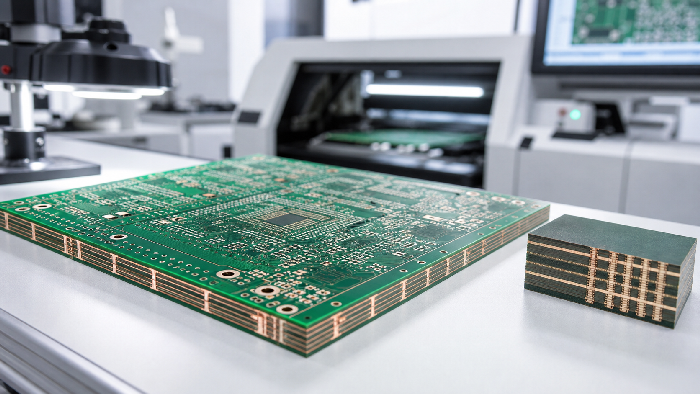
Table of Conent
Table of Conent
A capable 6-layer PCB manufacturer should manage stackup control, lamination quality, impedance review, DFM feedback, and assembly testing as one workflow. Six-layer boards are common in production electronics, but they still require more engineering discipline than simple 2-layer or 4-layer jobs.
If you need stackup guidance first, read our 6-layer PCB design guide.
What Separates a Good 6-Layer Supplier
The main difference is process control. A supplier that treats 6 layers as a commodity may still build a board, but you need confidence in registration, dielectric spacing, plating, warpage control, and test coverage.
| Capability | Why It Matters |
|---|---|
| Stackup confirmation | Keeps impedance and thickness predictable |
| Controlled lamination | Reduces delamination and registration risk |
| Drill and plating control | Protects through-hole reliability |
| Copper balance review | Reduces bow and twist |
| Electrical testing | Catches opens and shorts before shipment |
| PCBA inspection | Finds assembly defects after components are mounted |
For the larger fabrication flow, see multilayer PCB from design to production.
The Supplier Should Challenge the Design
A strong 6-layer PCB manufacturer does not create friction for no reason, but they should challenge details that affect yield. If the annular ring is too small, they should say so. If a controlled impedance trace does not match their stackup, they should ask for approval before changing geometry. If a dense connector area creates assembly access problems, they should flag it before tooling.
This is especially important for overseas sourcing, where time zone gaps can turn one small question into a multi-day delay. Specific engineering feedback saves more time than a fast quote with no review.
Ask About Warpage Before Production
Six-layer boards can warp if the copper distribution, material construction, or panel design is poorly balanced. Warpage affects assembly because stencil printing, pick-and-place, and reflow all expect the board to sit flat.
Ask the supplier how they control:
- Symmetric stackup construction.
- Copper balance across paired layers.
- Press cycle and material compatibility.
- Panel rail design.
- Baking and storage before assembly.
Our article on preventing PCB deformation gives more detail on this risk.
Stackup Documentation to Request
Before production, ask for a stackup drawing or table. It does not need to be fancy, but it should be specific enough for engineering review.
| Stackup Detail | Why You Need It |
|---|---|
| Material grade | Confirms thermal and electrical expectations |
| Core thickness | Affects impedance and total thickness |
| Prepreg type | Affects dielectric spacing |
| Copper weight | Affects trace width, current, and etching |
| Finished thickness | Affects connectors and enclosure fit |
| Impedance layers | Confirms where critical nets should route |
If the manufacturer cannot provide this, they may still be able to build low-risk boards, but they are not the best fit for high-speed or production-sensitive 6-layer work.
Confirm Impedance and High-Speed Requirements
If your 6-layer PCB includes USB, Ethernet, LVDS, RF, fast clocks, DDR, or other controlled nets, the manufacturer should not guess. Provide target impedance, layer, trace width, spacing, and reference plane assumptions.
| Requirement | Supplier Should Confirm |
|---|---|
| Single-ended impedance | Trace width, dielectric spacing, copper thickness |
| Differential impedance | Pair width, spacing, reference plane, tolerance |
| Reference plane | No unwanted plane splits under critical nets |
| Test coupon | Whether coupon measurement is needed |
An experienced manufacturer will tell you when your requested geometry does not match their stable process window.
What to Send for Impedance Review
Do not send only “controlled impedance required” in the notes. That leaves too much room for interpretation. Provide a simple table.
| Net Group | Target | Layer | Trace / Space | Reference |
|---|---|---|---|---|
| USB D+ / D- | 90 ohm differential | L1 | As routed | L2 ground |
| Ethernet pairs | 100 ohm differential | L3 | As routed | Adjacent plane |
| Clock line | 50 ohm single-ended | L1 | As routed | L2 ground |
The exact values depend on your design, but the format helps the manufacturer check the board quickly.
File Package Quality Matters
A 6-layer PCB manufacturer can only review what you send. A complete package reduces quoting delays and production questions.
Send:
- 1. Gerber or ODB++ files.
- 2. NC drill files.
- 3. Stackup drawing or requirements.
- 4. Fabrication notes.
- 5. Impedance table, if needed.
- 6. BOM and placement files for assembly.
- 7. Test requirements.
For PCBA orders, use our guide to documents required by PCB assembly.
Prototype, Pilot, and Production Builds
Treat the first order as part of a larger manufacturing path. The prototype may prove the circuit. The pilot build proves the process. Production proves repeatability.
| Build Stage | Main Goal | Manufacturer Role |
|---|---|---|
| Prototype | Confirm electrical design | Fast DFM and fabrication |
| Engineering validation | Find design weaknesses | Stackup and assembly feedback |
| Pilot | Prove process stability | Panelization, inspection, sourcing |
| Production | Repeat with control | Traceability, test records, yield tracking |
If the design may go to volume, ask the manufacturer to identify which prototype choices might change in production. Examples include panel format, test fixture, component sourcing, and packaging.
Assembly and Test Should Be Part of Supplier Selection
Many 6-layer boards are too complex for “build and ship” sourcing. You may need component sourcing, AOI, X-ray, in-circuit testing, or functional test support.
| Board Feature | Inspection Need |
|---|---|
| Fine-pitch ICs | AOI and stencil review |
| BGA or QFN packages | X-ray inspection |
| Many test points | ICT or fixture planning |
| Power electronics | Functional and thermal checks |
| Regulated product | Traceability and documentation |
See our PCBA testing process guide for how inspection methods fit together.
Cost Questions That Reveal Real Capability
The cheapest quote is not always the weakest, and the most expensive quote is not always the best. What matters is whether the quote explains the manufacturing assumptions.
Ask:
- Is the stackup standard or custom?
- Is controlled impedance included?
- Is electrical test included?
- Is ENIG or another finish included?
- Are panel tooling and fixture costs separated?
- Are components quoted from authorized sources?
- Are AOI, X-ray, ICT, or functional test included?
If a quote is much cheaper than others, identify what is missing before approving it.
FAQ: Choosing a 6-Layer PCB Manufacturer
Is 6-layer PCB fabrication difficult?
It is routine for qualified multilayer manufacturers, but it still requires stackup control, lamination quality, drill accuracy, plating control, and electrical testing.
Should I choose a manufacturer with assembly capability?
If the board will be assembled, yes. A supplier that understands PCBA can catch issues that a bare-board-only review may miss.
What is the biggest red flag?
The biggest red flag is a supplier that will not discuss stackup, impedance, material, or DFM before production.
Do I need HDI for a 6-layer PCB?
Usually no. Standard through vias are enough for many 6-layer boards. HDI is used when density or package pitch demands it.
How early should I involve the manufacturer?
Before final routing, especially if the design has impedance requirements, tight mechanical constraints, or dense assembly.
Supplier Audit Points for Production Orders
For a prototype, a basic capability check may be enough. For production, ask deeper questions. A 6-layer PCB manufacturer should be able to explain not only what they can build, but how they keep the process repeatable.
| Audit Point | What to Ask |
|---|---|
| Material control | Can the same laminate be used for repeat orders? |
| Stackup control | Is the approved stackup locked in the job record? |
| Drill control | How are finished holes and annular rings verified? |
| Plating control | How is through-hole reliability monitored? |
| Inspection | What is checked before shipment? |
| Traceability | Can material and production lots be traced? |
| Change control | How are substitutions approved? |
These questions are especially important for regulated, industrial, automotive, medical, or long-life products. A prototype supplier may be able to build a good first batch, but production needs documentation and repeatability.
How to Reduce Quote Revisions
Many quote revisions happen because the manufacturer receives incomplete information. For a 6-layer PCB, include stackup intent, controlled impedance notes, material preference, surface finish, copper weight, and assembly expectations from the first request.
If you are unsure about a requirement, mark it as flexible. For example, “1.6 mm finished thickness preferred, but 1.2 mm acceptable if impedance works” gives the manufacturer room to propose a stable construction. A rigid but unnecessary requirement can raise cost without improving the product.
The best quotes are built from engineering clarity. A clean package helps the supplier give better advice, better pricing, and fewer surprises after order placement.
Final Recommendation
Choose a 6-layer PCB manufacturer that communicates risk early. A supplier who says “yes” to everything may feel easy at the quote stage, but dense multilayer boards benefit from pushback. You want a partner who can say, “This will build, but here is the yield risk,” before production starts.
For production buyers, the ideal supplier is the one that can support both engineering and operations. Engineering needs stackup and DFM feedback. Operations needs stable lead time, repeatable quality, sourcing control, and test records. If one supplier can provide both, the project is easier to manage from prototype through repeat orders.
Red Flags in a 6-Layer PCB Manufacturer
Be cautious if the supplier cannot provide a stackup, does not ask about impedance, or gives no meaningful DFM feedback. Also watch for vague material substitutions or unclear lead times.
A typical failure pattern looks like this: a compact industrial controller is ordered as a 6-layer board. The layout routes fast signals near a split plane. The supplier builds exactly what was sent, but nobody flags the return-path issue. The board powers up, then fails EMC testing. A better manufacturer would raise the question before fabrication.
Final Checklist
Before selecting a 6-layer PCB manufacturer, confirm:
- Stackup and material are documented.
- Impedance requirements are reviewed.
- Drill and annular ring are within process limits.
- Warpage risks are checked.
- Electrical test is included.
- Assembly inspection is available.
- Communication is clear before production release.
AssyPCB supports 6-layer PCB fabrication, DFM review, sourcing, assembly, AOI, X-ray, ICT, and functional testing. Send your files and we will help you turn a dense layout into a stable, buildable product.
Latest Blog

Contact Info
Phone: +86-755-82882936
Email: [email protected]
WhatsApp: +86-13570802455
Wechat: +86-13570802455
Address: 2nd floor,D Bldg.,Electric Link Technology Bldg.,Gongming,Guangming New Dist.,518106 Shenzhen, China