
MIL-PRF-31032 PCB Procurement: Verify the Qualified Scope
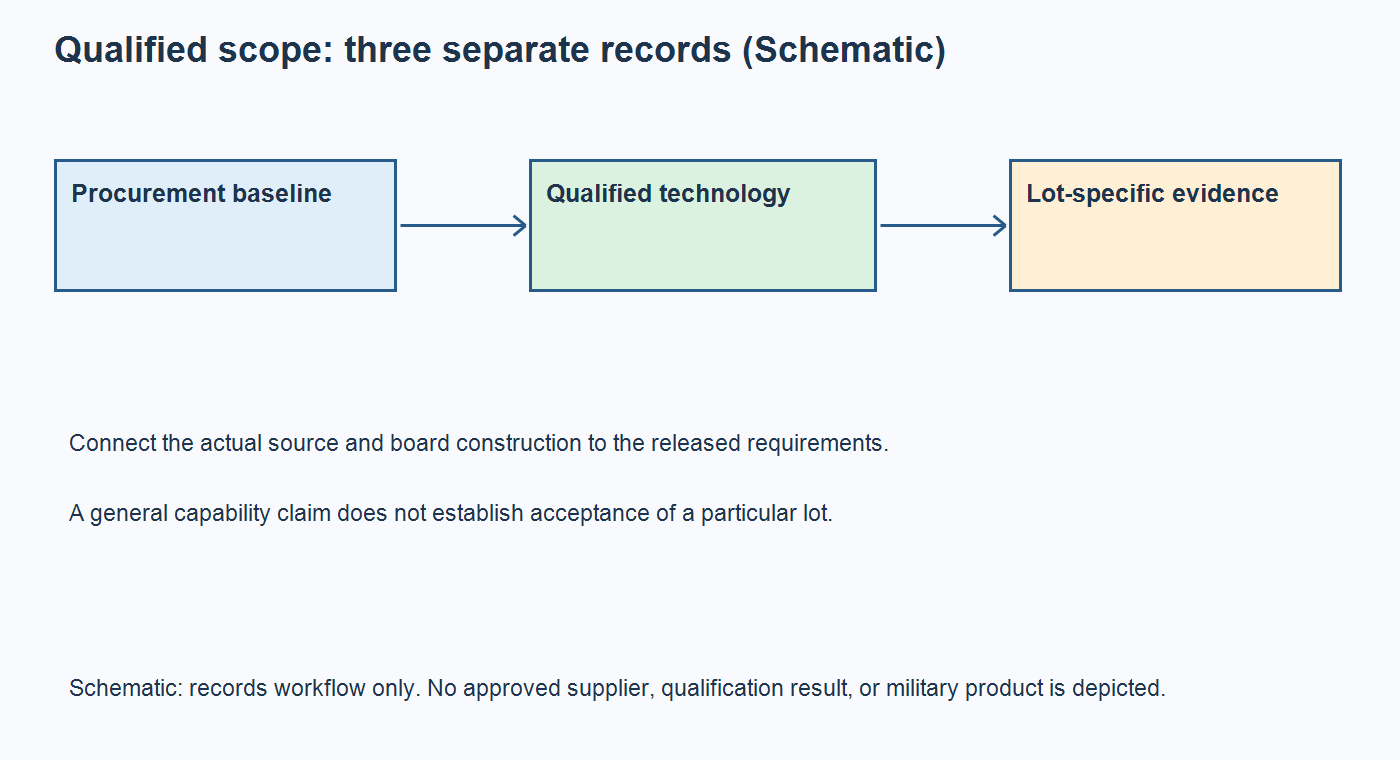
Table of Conent
Table of Conent
MIL-PRF-31032 PCB procurement should verify three separate things: the released document requirements, the actual manufacturer’s qualified scope, and the evidence required for the delivered lot. A certificate banner or a statement that a factory can build demanding boards does not close all three questions. Compare the proposed construction and manufacturing source with documented qualification coverage before authorizing a build, then define the records that will support acceptance.
This is a purchasing and engineering handoff method for printed boards, not a qualification decision for any supplier or a complete interpretation of the specification. Qualified Manufacturers List (QML) evidence must be checked through the appropriate official information and responsible reviewers. Keep printed-board fabrication separate from component assembly, and keep qualification separate from permission to disclose technical data. If scope evidence is incomplete, record an open decision instead of assuming either approval or disqualification.
Freeze the contractual document baseline
Identify the requirements governing this order before comparing supplier claims. The DLA document record for MIL-PRF-31032, reviewed October 22, 2026, identifies Revision D dated March 4, 2025 as active. That catalog fact does not independently replace the revision cited by an existing contract or released drawing.
Build a baseline index containing the purchase-order requirement, master drawing revision, general specification, applicable associated specification sheet, and customer-specific requirements. An associated specification sheet, sometimes called a slash sheet, narrows the relevant technology requirements. Record the document revision or amendment information actually required by the purchaser.
When documents conflict or a historical requirement cannot be retrieved, assign the question to the contract and technical owners. Preserve the clarification and its approval reference. Do not quietly choose the newest available document, copy an old order’s notes, or assume that a general workmanship requirement replaces a qualification requirement.
Check official qualification evidence for the actual source
Verify the source behind the quotation, including the proposed manufacturing location and relevant technology coverage. A sales office, reseller, or corporate name alone may not identify where the printed boards will be fabricated.
The DLA qualification FAQ identifies the Qualified Products Database (QPD) as the official source of DoD qualification data and notes that public QPLDOCS information is limited. The ASSIST qualification-information guidance describes access through the governing specification’s qualification information. Use those routes rather than treating a search-engine snippet as a current listing.
Keep the retrieval date, source identity, relevant scope evidence, and any unresolved question together. A failed website request, limited public view, or unavailable attachment is an access limitation, not proof that a manufacturer is unqualified. If the available evidence does not settle the question, seek the necessary information from the responsible source or qualifying activity before closing the purchasing decision.
Compare the board construction with qualified technology
Compare the proposed material and manufacturing process with the scope actually supported by qualification evidence. Avoid converting one qualified technology into an unrestricted claim covering every construction a supplier advertises.
MIL-PRF-31032D Appendix B connects QML capabilities to materials and processes demonstrated through qualification. Its qualification-plan discussion includes a relationship between test vehicles and the proposed listing. That is the reason to ask for a construction-to-scope comparison instead of accepting a general certificate as the entire review.
For the purchasing worksheet, identify the material system, board type, interconnect construction, process route, and any special features that need confirmation. Ask the responsible reviewer to identify the applicable documented boundaries and explain any gap. Do not invent universal layer-count, hole-size, aspect-ratio, or material limits for the specification.
Keep the comparison definitions explicit. If a scope record states a dimensional boundary, confirm its units and whether it describes a drilled hole, finished hole, board thickness, or manufacturing panel. Match the same definition on the drawing and in the supplier response. A similar-looking number with a different measurement basis does not close the comparison.
| Decision | Evidence to connect | Open-question owner | Release implication |
|---|---|---|---|
| Governing requirements | Order, drawing and specification revisions | Purchaser and technical authority | Resolve conflicts before release |
| Actual manufacturing source | Manufacturer, location and relevant qualification evidence | Supplier quality | Do not substitute an unidentified source |
| Construction coverage | Material/process description and documented qualified scope | Responsible technical reviewer | Keep unsupported coverage open |
| Lot acceptance package | Required inspection, test, identification and records | Quality and purchasing | Agree deliverables before pricing closes |
If the manufacturing boundary needs clarification, send a non-controlled requirements summary and scope questions with the required specifications and quantity. OrinewPCB can review whether the inquiry can be accepted and identify missing manufacturing inputs. Mandatory qualifications and source eligibility must be confirmed separately; this inquiry does not establish QML status or authorize disclosure of controlled files.
Resolve scope changes before authorizing production
Keep a proposed material, process, source, or construction change open until its impact on the required qualification scope is resolved. A technically attractive change should not enter a production order through an informal quotation assumption.
Describe the proposed change and the evidence it affects. Ask whether the documented qualification coverage remains applicable, whether additional review is needed, and who has authority to close the issue. Preserve the disposition with the released manufacturing package. A buyer’s worksheet is a coordination tool, not permission to bypass the manufacturer’s qualification process.
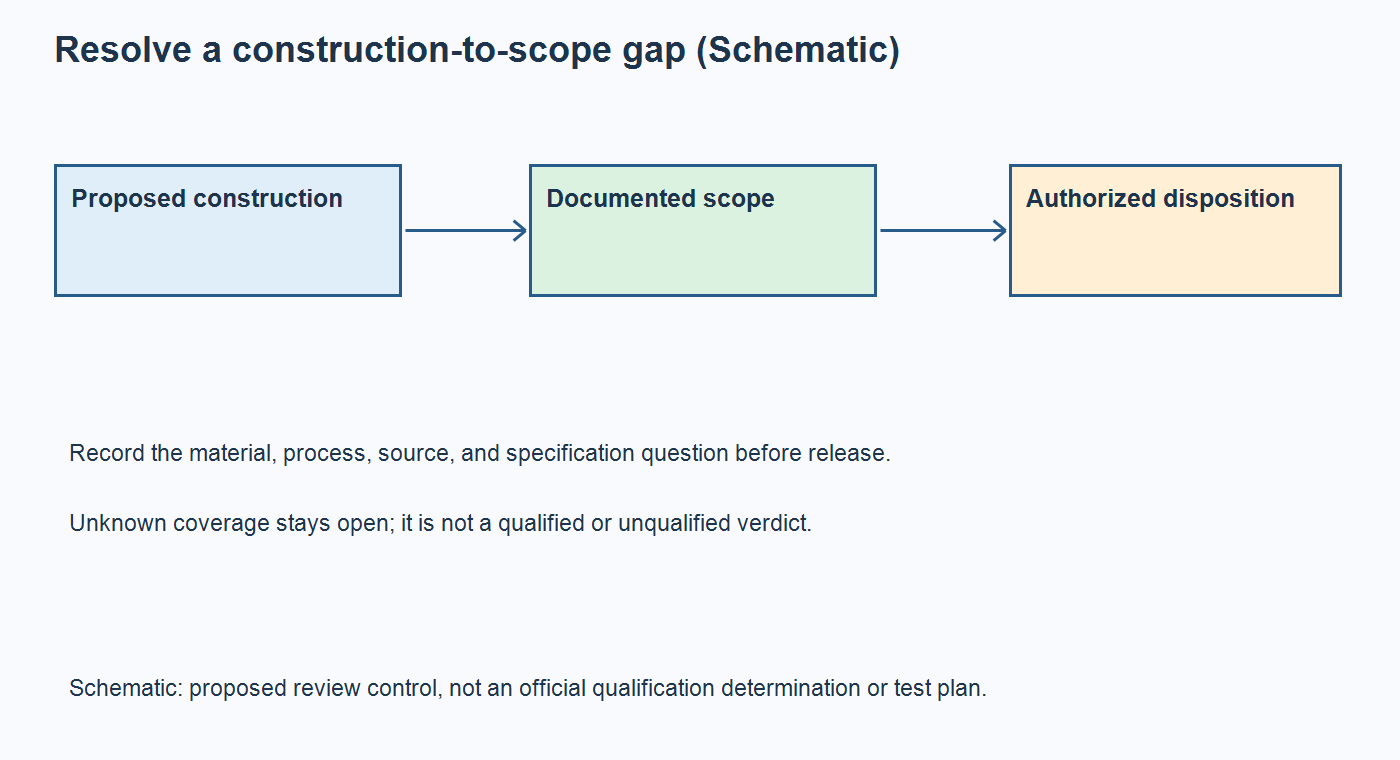
For example, a proposed material-system substitution may leave the drawing dimensions unchanged while changing the process being purchased. Treat that as an example of a scope question, not an automatic conclusion that new qualification is required or that the existing coverage is sufficient. The responsible reviewer needs the actual proposal and applicable evidence.
Track commercial consequences separately. A hold may affect material commitment, schedule, tooling, inspection planning, or the quotation’s validity. Record the dependency and decision date instead of promising that an unresolved scope question will have no effect on delivery.
Keep lot evidence separate from general capability claims
Define what the delivered lot must demonstrate, then request records that support those claims. General qualification information, an electrical-test report, and a certificate accompanying shipment serve different evidentiary roles.
The bare-board electrical test records guide explains why connectivity evidence needs a controlled reference and defined coverage. Such a report does not independently establish every fabrication requirement, the supplier’s complete qualification scope, or acceptance of a populated assembly.
| Record | Question it can help answer | What still needs its own evidence |
|---|---|---|
| General certification or capability statement | What program or capability does the supplier claim? | Current relevant source and technology coverage |
| Relevant qualification information | What scope is documented for the proposed source? | Conformance of the actual delivered lot |
| Lot inspection and test results | What checks were performed against which requirements? | Uncovered requirements and accepted exceptions |
| Assembly programming and functional records | What was done to the populated configuration? | Printed-board qualification and complete product acceptance |
As a proposed acceptance-packet structure, connect the part and drawing revision, lot identity, actual source, required conformance statement, agreed inspection and test evidence, and disposition of deviations. Identify which records accompany shipment and which must remain retrievable. Do not assume an unpriced report will appear automatically after the order is placed.
Define how corrected or replacement records will be linked to the original lot. If a report is revised after shipment, retain its revision history and reason for change. If a proposed substitute source is introduced, reopen the source and scope review rather than treating the existing part number as sufficient evidence.
Keep the supplier’s original statements and the buyer’s review conclusions distinguishable. If a document covers only a test operation, do not rewrite its meaning as certification of the entire build. Close missing evidence with the responsible owner rather than adding a broader label to the shipment folder.
Carry the fabrication boundary into the assembly RFQ
Preserve the printed-board source and acceptance requirements when the order expands into component sourcing and assembly. A one-stop commercial arrangement does not erase the boundaries between fabrication qualification, assembly workmanship, programming, test, and final product release.
Record who selects and approves the bare-board source, who purchases components, who controls substitutions, and who accepts each set of records. The ordinary turnkey PCB assembly scope is a starting point for discussing manufacturing responsibilities; it is not evidence that a particular mandatory military qualification is held.
Also retain separate customs and export-control reviews where applicable. Source qualification does not determine whether a recipient may receive drawings, software, or other information. Establish the permitted recipient and transfer before sending a detailed package.
The useful purchasing outcome is a consistent baseline: required documents, identified source, supported construction coverage, agreed lot evidence, and named acceptance owners. Keep unresolved questions visible and close them before they become production assumptions.
For a project whose recipient eligibility, qualification boundary, and data release have been cleared, provide the cleared fabrication and assembly package with BOM, placement data, drawings, quantities, inspection and test requirements, traceability needs, and delivery expectations. OrinewPCB can review manufacturing feasibility and quotation boundaries. Mandatory source qualifications and final acceptance remain subject to the responsible program’s verification.
Latest Blog
Contact Info
Phone: +86-755-82882936
Email: [email protected]
WhatsApp: +86-13570802455
Wechat: +86-13570802455
Address: 2nd floor,D Bldg.,Electric Link Technology Bldg.,Gongming,Guangming New Dist.,518106 Shenzhen, China