
PCB Imports to the US: Separate Customs and Export-Control Decisions
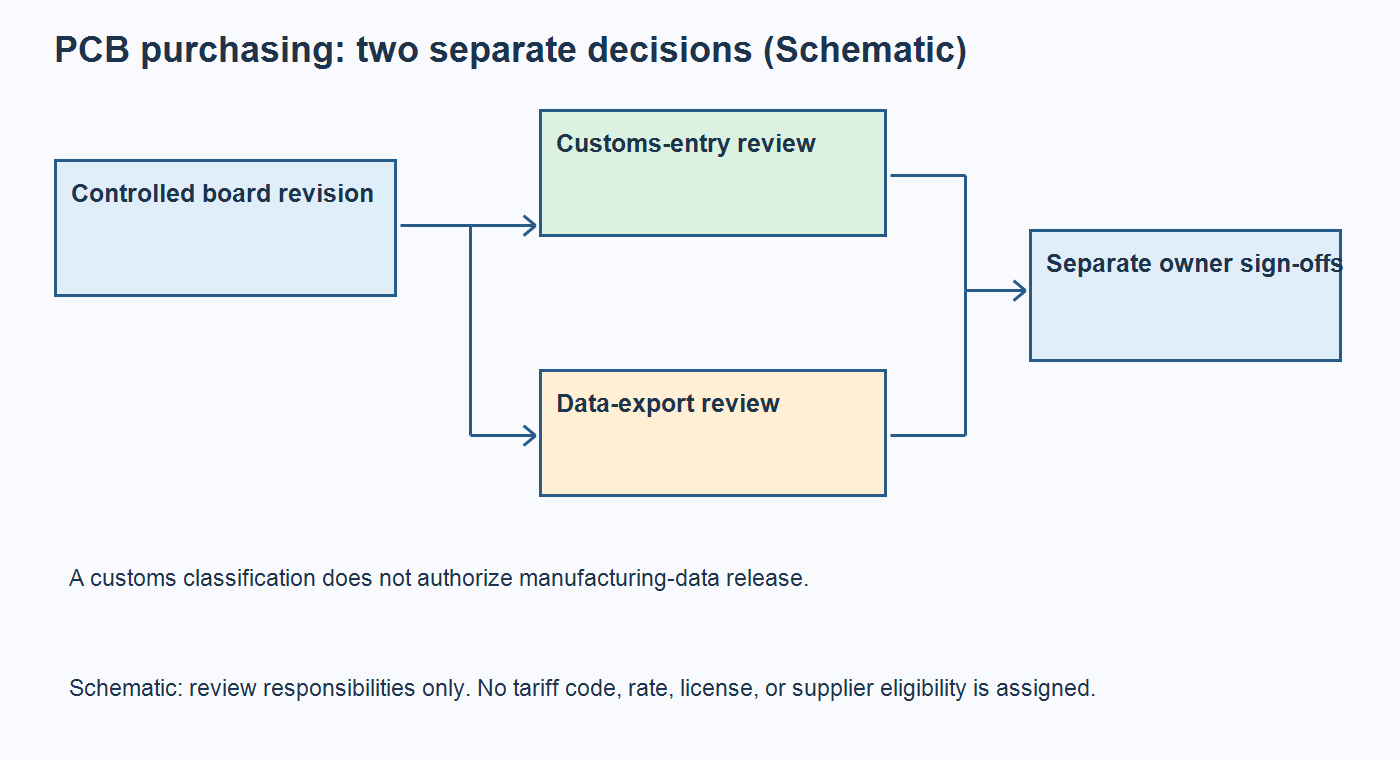
Table of Conent
Table of Conent
For a PCB or PCBA purchase imported into the United States, keep the customs-entry decision separate from the export-control review of hardware, software, and manufacturing information. Start with the exact configuration being shipped, identify who owns the import declaration, and obtain a transaction-specific duty review. Before sending production files to an overseas manufacturer, have the responsible compliance owner determine whether the proposed recipient and transfer are permitted. A tariff code, an NDA, or an accepted manufacturing quotation does not answer all of those questions.
This guide gives OEM engineering and purchasing teams a practical handoff structure for ordinary commercial assembly projects. It does not assign your HTS classification, country of origin, duty rate, ECCN, or ITAR status. Those decisions require product and transaction facts, current rules, and qualified review. The useful output is a controlled record connecting the board revision, proposed recipients, shipment description, assumptions, and named approval owners.
Sources reviewed October 22, 2026. Recheck transaction-specific rules before data release or shipment.
Define the configuration that will cross the border
Describe the article as it will actually arrive, rather than using “PCB” as a catchall. A bare board, populated controller assembly, programmed module, and enclosed finished unit can present different facts for classification review. Engineering should document those facts before procurement asks a broker to assess the shipment.
Create a configuration card with the part number, hardware revision, populated variant, firmware identity where relevant, physical contents, principal function, intended equipment, and photographs or a block diagram cleared for the recipient. Identify separately supplied accessories and unfinished operations. Explain whether a sample is functional, incomplete, or being returned for investigation; do not let an informal label replace an accurate description.
For example, an illustrative controller order might include assembled boards in one shipment and separately packed housings in another. The handoff should preserve that distinction. It should not automatically copy the description or classification used for a previous enclosed unit. Ask the reviewer what additional information is needed instead of choosing the lowest-looking code.
| Decision | Evidence engineering supplies | Owner to identify | Unresolved result |
|---|---|---|---|
| Imported article identity | Revision, population, function, physical shipment contents | Product engineering | Hold the final description |
| Customs classification and origin | Configuration card and manufacturing process facts | Importer with qualified customs support | Seek a documented determination |
| Export jurisdiction and classification | Hardware, software, technical information and intended use | Export-compliance owner | Do not assume EAR99 or ITAR status |
| Recipient and transfer permission | Exact entities, locations, people, files and purpose | Authorized compliance reviewer | Keep the affected transfer on hold |
| Manufacturing release | Approved files, sourcing, test scope and accepted exceptions | Engineering and purchasing | Do not equate a quote with release |
Separate customs classification from export jurisdiction
A customs classification identifies the imported goods for the entry process; it is not an export authorization. Keep the import analysis and export review as separate records even when they reference the same board revision.
For items subject to the Export Administration Regulations, the BIS item-classification guidance explains ECCN classification and EAR99. EAR99 is not a blanket exemption from transaction restrictions: end user, end use, and destination can still matter. Establish whether the item is subject to the EAR before applying that classification process. Do not infer the board’s result solely from a component supplier’s classification.
When jurisdiction under the U.S. Munitions List is uncertain, Commerce’s 2025 Defense Export Handbook describes DDTC’s commodity-jurisdiction determination route. Assign that question to the appropriate reviewer before commercial release. A supplier’s willingness to quote is not evidence that a proposed defense-related manufacturing arrangement is authorized.
The practical purchasing rule is to maintain two visible dispositions: what the shipment is for customs purposes, and what may be supplied or disclosed to each proposed recipient. A completed field in one record must not silently close the other. An unresolved disposition should name an owner and the missing facts, rather than defaulting to “not applicable.”
Clear the recipient and file package before an RFQ
Resolve the proposed information transfer before uploading the detailed manufacturing package. The review should cover the actual recipient, manufacturing site, subcontractor access, files, and intended work. An NDA protects contractual confidentiality but does not determine export authorization.
The BIS explanation of deemed exports also shows why physical shipment is not the only relevant event: releasing controlled technology or source code to a foreign person in the United States can constitute a deemed export. Overseas file transfers require their own applicable review; they should not simply be labeled deemed exports. Whether a particular drawing or file is controlled depends on the facts and governing rules.
Once your compliance owner has cleared the intended recipient and permitted information, send the cleared build scope and open manufacturing questions with quantities, proposed sourcing, and the approved document list. OrinewPCB can review the manufacturing inquiry and identify missing fabrication, sourcing, assembly, or test inputs. Share only information cleared for that recipient; eligibility and any required authorization must be confirmed separately.
Make a file manifest listing document names, revisions, purpose, approved recipients, and the review reference. Include programming images, debug instructions, fixture software, and engineering discussions in the review scope where relevant. A later troubleshooting attachment should not bypass the process merely because the initial Gerbers were approved.
Build a dated duty record instead of a fixed tariff promise
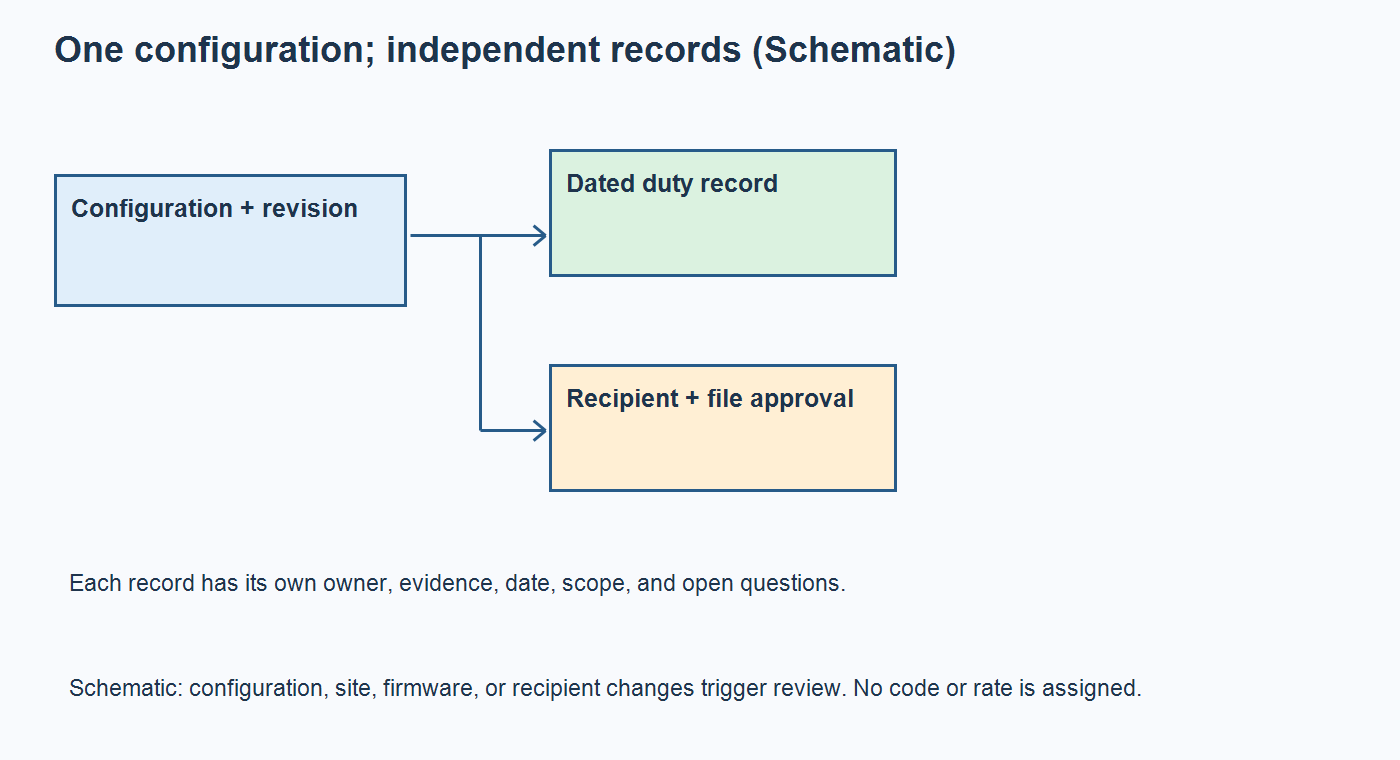
Use a dated, transaction-specific duty record for purchasing decisions. A percentage copied from an old quotation or a general PCB article is not a dependable release basis for a new shipment.
The USITC tariff-classification and importing FAQ distinguishes national tariff-code suffixes, legal HTS provisions, informational aids, and additional duties. A supplier’s export-country code is not automatically the complete U.S. reporting number. Review the applicable legal text and current requirements for the relevant entry date; do not rely only on a search result or a base-rate column.
Ask the qualified reviewer to record the classification rationale, origin basis, applicable additional-duty provisions, any claimed relief and its conditions, valuation assumptions, effective-date basis, and open questions. Keep the source reference and review date beside each conclusion. Mark uncertain amounts as unresolved, not zero. No rate or relief eligibility is assigned by this guide.
| Record field | Why it changes the decision | Recheck trigger |
|---|---|---|
| As-imported configuration and function | Defines the article actually assessed | Population, enclosure or functional change |
| Origin and process evidence | Supports the reviewer’s origin conclusion | Manufacturing-site or process change |
| Rule sources and effective-date assumptions | Exposes stale or conditional duty estimates | Entry timing or governing-rule change |
| Declared-value basis and unresolved items | Prevents an incomplete commercial total becoming a declaration | Transaction, supplied-material or pricing change |
Keep manufacturing economics readable alongside this record. The separate parts, assembly, and NRE cost groups help distinguish the supplier’s manufacturing price from logistics and duty assumptions. A purchasing cost comparison does not itself establish customs value.
Tie manufacturing changes to the shipment description
Reconcile the built configuration with the reviewed configuration before shipment. A released BOM does not guarantee that the shipped lot still matches the original commercial and compliance assumptions.
Use the BOM alternate-approval workflow to control component substitutions. Add a separate question to change review: does this substitution, firmware update, manufacturing-site change, enclosure addition, or recipient change require the compliance owner to revisit a prior disposition? Engineering approval of fit and function does not answer that question automatically.
Retain a concise link between the as-built BOM, programmed version where applicable, inspection and test records, packing list, and shipment description. Assign someone to resolve mismatched part numbers, quantities, and variant names before dispatch. Use the same controlled configuration identifier across the manufacturing and shipment records.
If classification or origin remains materially uncertain, consider qualified advice and the prospective ruling process described in CBP’s rulings-program guidance. Supply the relevant facts through an appropriate, authorized channel. A ruling for another product is not a substitute for comparing the actual facts of your transaction.
Release the assembly package with named decision owners
Release the build only when the manufacturing scope and the separate compliance dispositions are understood by their owners. The useful deliverable is a coherent package, not a folder containing unrelated approvals.
For an ordinary commercial project, connect the approved fabrication files, BOM, placement data, assembly drawings, firmware and programming instructions, inspection and test requirements, quantities, packaging, and destination. Record what the manufacturer supplies and what remains with the OEM, importer, broker, or other adviser. The turnkey PCB assembly service scope provides a starting point for discussing fabrication, sourcing, and assembly responsibilities; specific project acceptance still requires review.
Separate import classification, dated duty assumptions, and permitted information transfer throughout that handoff. Preserve unresolved questions as explicit holds, and reopen the relevant review after a configuration or recipient change. This keeps commercial scheduling tied to the build that can actually be released.
For a cleared commercial assembly project, provide the approved fabrication and assembly package, including BOM, placement files, drawings, quantities, test requirements, packaging, and delivery expectations. OrinewPCB can review manufacturability, sourcing assumptions, test scope, and quotation boundaries. Provide only files authorized for the intended recipient, with separate compliance decisions retained by their responsible owners.
Latest Blog

Contact Info
Phone: +86-755-82882936
Email: [email protected]
WhatsApp: +86-13570802455
Wechat: +86-13570802455
Address: 2nd floor,D Bldg.,Electric Link Technology Bldg.,Gongming,Guangming New Dist.,518106 Shenzhen, China