
IPC-6013 Flex and Rigid-Flex: Specify Use and Evidence
Table of Conent
Table of Conent
IPC-6013 specifies qualification and performance requirements for flexible and rigid-flex printed boards. A usable purchase requirement identifies the agreed revision, board construction, performance class, and installation use separately, then connects those choices to a drawing and an evidence plan. A class designation alone cannot tell a supplier whether the circuit bends during installation, moves repeatedly in service, or must tolerate a particular assembly process. Nor does a material’s flexural-endurance result prove the life of a populated assembly inside its enclosure.
For engineering and purchasing, the practical task is to define what the supplier must build, which tests represent that construction, and who can release the delivered lot. Include the actual flex geometry, mounting conditions, processing history, and required records. This guide provides a procurement framework; numerical acceptance criteria and exact designators must come from the licensed revision invoked by the order.
Freeze the revision, construction, class and use separately
Write four explicit decisions into the procurement package instead of relying on a note such as “IPC flex, Class 3.” Each decision answers a different question, and each needs a consistent reference in the drawing, purchase order, and supplier response.
The public IPC-6013D scope and contents, dated September 2017, distinguish classification, board type, installation use, and procurement selection. They also identify separate qualification, acceptance, and quality-conformance sections. That historical sample explains the framework; it does not establish the detailed criteria of a newer revision.
| Decision | What to record | Question to resolve |
|---|---|---|
| Revision | Complete standard identifier and any applicable addendum | Do the drawing, order, and inspection plan invoke the same issue? |
| Construction | Rigid/flex regions, conductive layers, interconnects and stiffeners | Does the selected board-type designation describe the actual stack? |
| Performance class | Class selected by the product owner for the intended service | Which requirements and records change with that selection? |
| Installation use | Forming, repeated motion and environmental conditions | What evidence represents the intended installed condition? |
Revision control deserves attention now. The publisher’s September 17, 2026 IPC-6013F release notice identifies an August 2026 release replacing E. It highlights transition regions, strain relief, interconnect integrity and dimensional evaluation. A release announcement is not a substitute for the acceptance tables. Before adopting F, have engineering and the supplier identify affected features and approve the corresponding drawing and inspection changes. A new publication does not itself rewrite an existing purchase order.
The guide to IPC performance-class selection explains the end-use decision. Keep the bare-board specification and assembly acceptance references distinct when documenting the complete product.
Describe the installed motion before choosing flex evidence
Specify what moves, where it moves, and how often it moves before requesting a flex-life commitment. A circuit formed into position and restrained afterward presents a different problem from a loop that rolls during every operating cycle.
Prepare a mechanical view showing the free flex length, mounting points, stiffener boundaries, bend direction, intended radius, and motion endpoints. State whether maintenance can reopen the bend. Include relevant temperature and exposure conditions. Avoid treating the entire board thickness as the flex-region thickness: the rigid island, stiffener, adhesive and coverlay boundaries need their own stack views.
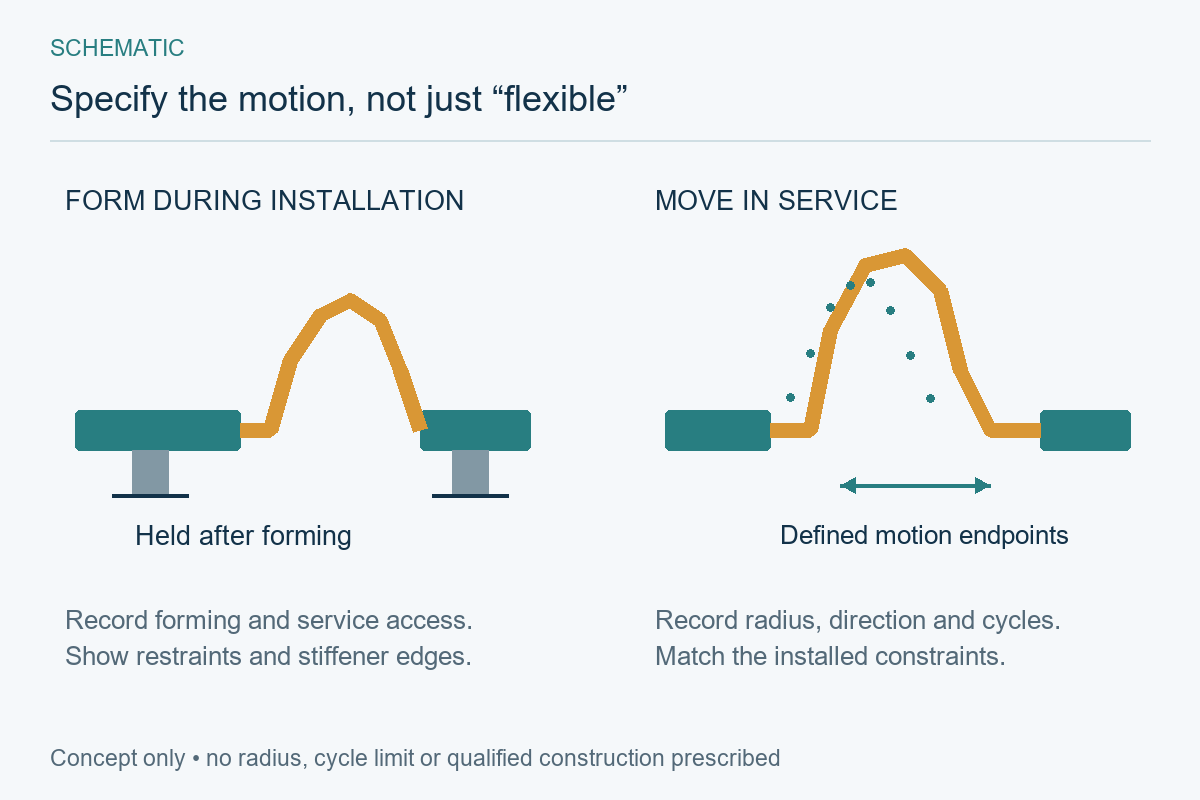
Minco’s manufacturer guide to flex-circuit flexibility discusses construction, bend geometry and static versus dynamic applications. Use that relationship to frame a supplier review, rather than copying a single bend multiplier into every design. The relevant structure includes the copper, dielectric, cover system and any attached features that affect the bend.
A useful review question is whether the test specimen and fixture reproduce the strain-driving features of the installation. If the housing clamps the flex near a transition, a freely moving sample may omit that constraint. Mark the difference as an open qualification question, with an owner and a planned resolution.
Include assembly exposure in the qualification boundary
Evaluate the circuit in the condition that will enter service, including the agreed assembly and handling history. Incoming bare-board evidence answers part of the question; it does not automatically cover subsequent soldering, forming, attachment or repair.
Identify soldering processes, planned thermal exposures, moisture-management instructions, assembly supports, and permitted rework. Obtain handling and conditioning requirements for the selected construction from the supplier. Do not transfer a generic rigid-board bake recipe to a flex assembly without confirming compatibility with its adhesives, finishes and attached parts.
Keep process assumptions visible in the quotation. A fixture, handling support, additional qualification specimen or special inspection record can change the quoted scope even when the copper artwork is unchanged. Ask suppliers to separate these items from recurring board and assembly charges so competing offers describe comparable work.
The full turnkey PCB assembly service provides a route to discuss fabrication, component sourcing, assembly and testing together. Project-specific flex construction and qualification requirements still need explicit confirmation. If those assumptions remain open, share the flex stack and assembly-process constraints with the drawings so the manufacturing scope and unresolved engineering questions can be reviewed before release.
Check whether an endurance report represents the product
Read the test method, specimen and failure endpoint before applying an endurance number to a product. A report is useful only within the conditions it evaluated; the method name alone does not establish equivalence to an installed assembly.
The public IPC-TM-650 2.4.3F procedure, dated May 2022, evaluates etched conductor patterns to conductor failure. It specifies a loop inside diameter of 6 mm ± 1 mm and defines failure through electrical discontinuity. Those are material-pattern test conditions, not a universal allowable bend radius or product-life guarantee.
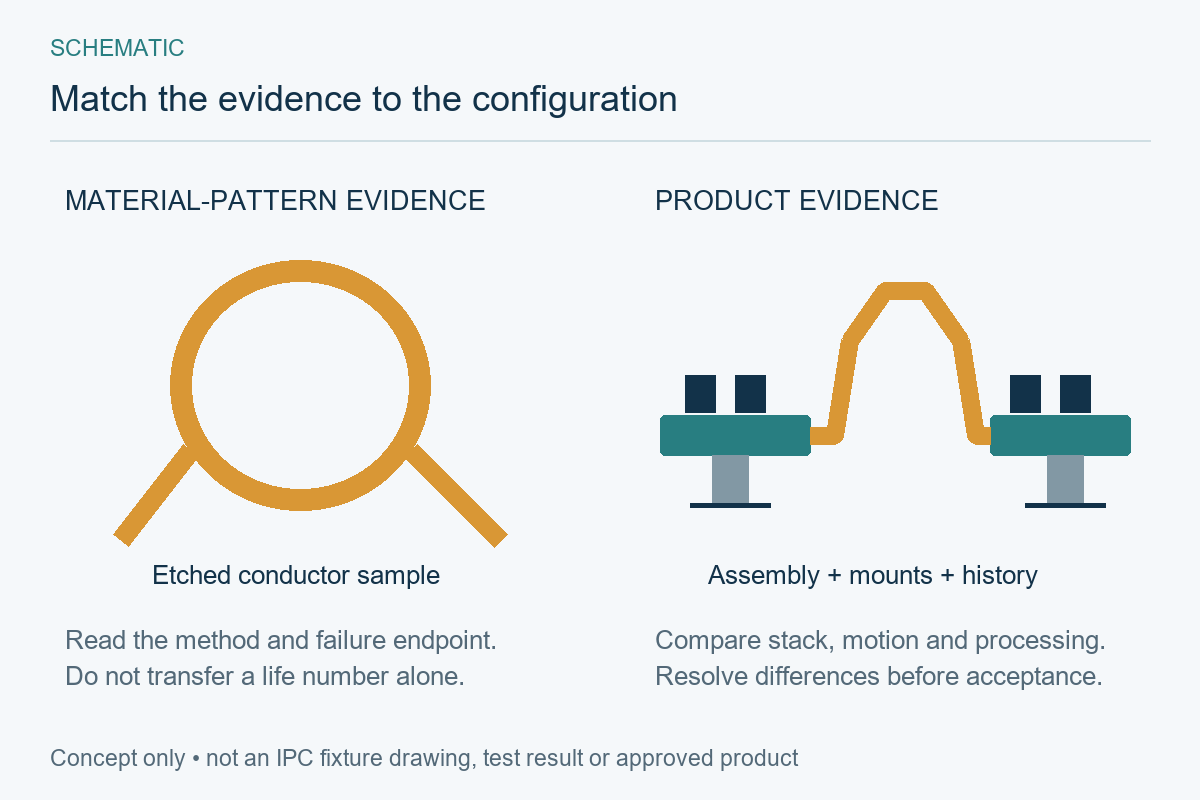
Build an evidence-transfer worksheet with columns for reported condition, product condition, difference, and disposition. Compare the material stack, copper orientation, conductor geometry, cover system, bend shape, mounting constraints, environment, assembly exposure, and electrical endpoint. Where the report provides no information, record “not established” instead of assuming a match.
For example, a material report may describe electrical discontinuity after repeated rolling, while a product requirement concerns intermittent resistance during movement after assembly. The endpoint and processing history differ. The appropriate response is an agreed product verification plan, rather than relabeling the material result as an assembly qualification.
Have the product owner approve the representative configuration, conditioning, motion, monitoring, sample plan and acceptance rule. Preserve the actual results and exceptions. A change in the adhesive stack, copper treatment, bend length, clamp position or assembly history should trigger review of whether earlier evidence remains applicable; it does not automatically require every test to be repeated.
Keep a photograph or drawing of the tested mounting arrangement with the report, together with the specimen identifier and the controlled stack reference. A statement such as “flex test passed” cannot show whether the tested bend occurred in the free span or next to a stiffener. Ask the reviewer to identify which product requirement the result closes and which conditions remain outside its scope. This makes the evidence usable when a future enclosure revision changes the available bend space.
Release each lot against a traceable evidence package
Separate construction qualification from the evidence required for each delivery. Before ordering, agree which records accompany the lot, how they identify the controlled construction, and who resolves an exception.
Use an annotated board view to connect each concern to an inspectable feature. Mark rigid-to-flex transitions, strain-relief regions, stiffener edges, interconnect structures and controlled dimensions. Require the supplier’s record references to identify the relevant drawing revision and lot. A certificate that lists only a standard number may leave these relationships unresolved.
| Concern | Evidence to agree | Decision before lot release |
|---|---|---|
| Transition or strain-relief feature | Annotated location, invoked requirement and appropriate inspection record | Does the observed condition meet the agreed revision, or need disposition? |
| Internal interconnect integrity | Representative specimen identification and required evaluation record | Does the evidence represent this construction and lot? |
| Repeated-motion performance | Approved product protocol and applicable qualification results | Have changes invalidated the earlier evidence? |
| Material or process substitution | Change description, affected features and engineering approval | Accept unchanged evidence, request additional work, or hold release? |
This worksheet is a proposed procurement tool, not a mandatory test list extracted from IPC-6013. Select methods and limits from the contracted specification and product requirements. The bare-board inspection and lot-release guide explains why observations, internal evaluation and release authority need separate records.
When evidence is incomplete, identify the missing record and responsible reviewer. Avoid accepting a substitution merely because the board passes a connectivity test. Equally, avoid rejecting a shipment from an illustrative diagram: disposition needs the actual requirement and measured or observed condition.
For example, consider two offers for the same artwork. One includes only incoming bare-board records; the other also includes a product-specific motion study after the proposed assembly sequence. They are different scopes, even if both reference IPC-6013. Request separate prices and deliverables for construction qualification, recurring lot inspection and assembled-product verification. Purchasing can then choose the required evidence deliberately instead of treating an omitted study as a price advantage. The example does not imply that every flex circuit needs a separate motion study; the approved product requirements determine whether it is necessary.
Close the flex and assembly order with one controlled revision
A releasable flex order connects the standard selection, physical construction, installed motion and acceptance evidence. Confirm these relationships before comparing price or authorizing production. Keep supplier clarifications with the approved revision so a repeat order does not inherit unresolved assumptions.
For a complete assembly project, provide the controlled build files and flex verification requirements with the BOM, placement data, quantity, mechanical bend drawing, substitution rules and target schedule. These inputs support a coordinated review of fabrication, sourcing, assembly and test scope. The release decision remains tied to the product’s approved requirements and supporting evidence.
Latest Blog
Contact Info
Phone: +86-755-82882936
Email: [email protected]
WhatsApp: +86-13570802455
Wechat: +86-13570802455
Address: 2nd floor,D Bldg.,Electric Link Technology Bldg.,Gongming,Guangming New Dist.,518106 Shenzhen, China