
Checkweigher PCBA Quotes: Separate Assembly, Calibration, and Test Costs
Table of Conent
Table of Conent
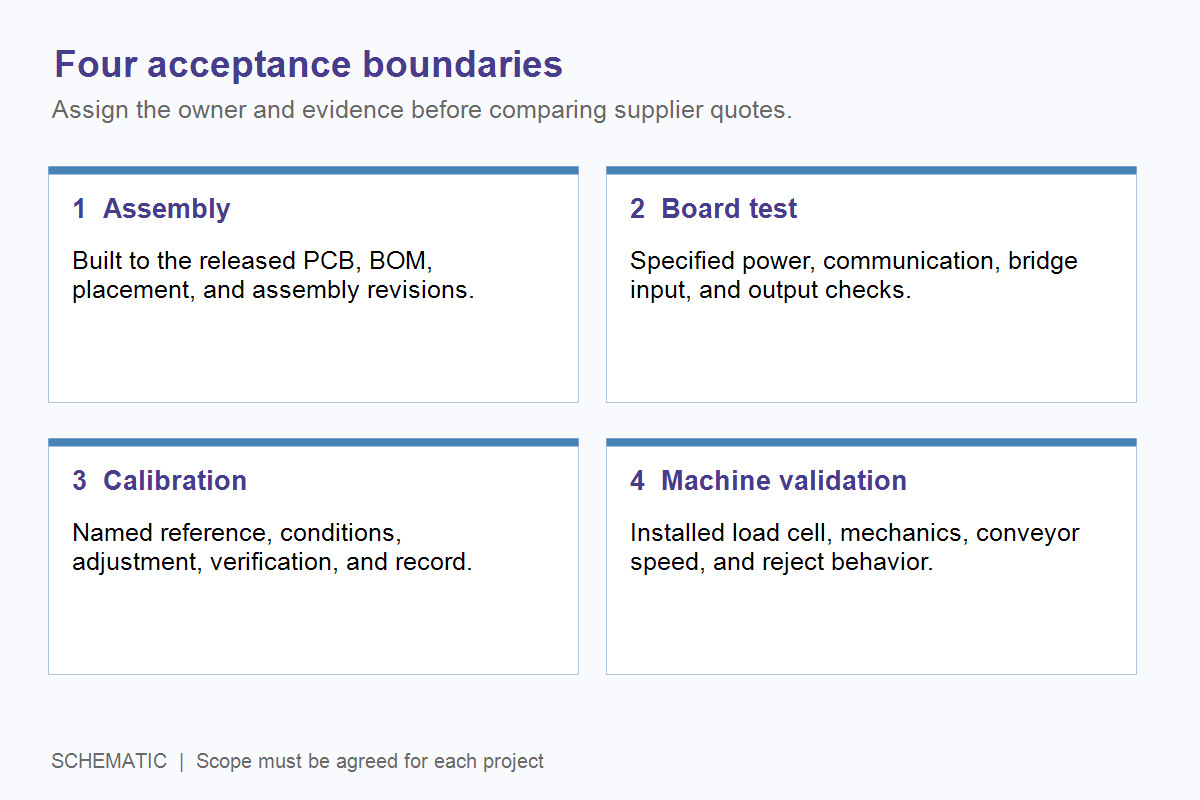
A checkweigher PCBA quote is comparable only when each supplier prices the same deliverable. Separate bare boards and components, assembly setup and placement, board-level inspection, programmed functional test, calibration, and any machine-level validation. Calibration is not automatically part of PCB assembly, and an assembled board that passes electrical test has not necessarily proved weighing accuracy in a moving conveyor. Define the boundary, fixture, acceptance limits, records, and owner of each activity before comparing unit prices.
This matters most when a controller combines a load-cell analog front end with conveyor or reject outputs. The quote must account for the manufacturing work that can be performed on a bare assembly and the work that needs a load cell, mechanics, firmware, and known test loads. The checklist below is for OEM engineers and purchasing teams preparing a controlled build package; it is not a price list or a claim that every checkweigher needs the same architecture.
Which costs belong in a checkweigher PCBA quote?
Quote the board, assembly, inspection, programmed test, and calibration as separate scopes. A supplier may combine line items commercially, but the RFQ should still identify their assumptions so a low unit price cannot conceal an omitted fixture or verification step. A useful starting point is the broader PCBA quote breakdown for parts, assembly, and NRE; the checkweigher adds measurement-specific acceptance questions.
| Scope | Buyer must define | Quote or acceptance evidence | Decision if omitted |
|---|---|---|---|
| PCB and components | Released fabrication data, controlled BOM, alternates, quantity, and supply model | Material assumptions, substitutions, and any procurement exceptions | Do not compare component totals until part identity and supply responsibility match. |
| Assembly and setup | Placement data, assembly drawing, programming instructions, and lot size | Setup/NRE, recurring build scope, inspection method, and rework policy | Separate one-time work from recurring unit cost. |
| Board-level functional test | Inputs, outputs, firmware version, test points, pass limits, and fixture owner | Fixture build, cycle assumption, failure disposition, and serial-level result | Ask for a test plan rather than accepting “100% tested.” |
| Calibration | Whether the board, sensor chain, or complete machine is calibrated; reference and conditions | Adjustment method, traceability, stored coefficients, verification points, and record owner | Exclude it explicitly if the OEM performs it later; otherwise price and specify it. |
| Machine validation | Conveyor speed, product range, reject timing, environment, and applicable requirements | System acceptance protocol and responsible organization | Do not infer machine performance from PCBA test results. |
The last row is usually outside a conventional PCBA order. It belongs in the commercial comparison because a supplier may price it as an additional integration service while another supplier leaves it with the OEM. The table identifies responsibility; it does not assert a particular factory’s test capability.
Why is board functional test different from calibration?
Functional test can confirm that the assembled electronics communicate, accept a controlled bridge-simulator input, read a plausible conversion, and drive designated outputs. Calibration establishes a relationship between a known reference and the measurement chain under specified conditions. A calibrated ADC alone does not establish the accuracy of the load cell or the installed conveyor system.
Analog Devices distinguishes internal ADC offset/gain calibration from system calibration, which includes the external measurement path. Its guidance notes that system calibration is relevant to weigh-scale applications because load-cell behavior contributes error. Texas Instruments likewise describes the load cell as a bridge that needs excitation and generates a small differential signal proportional to load. Those sources support asking which path is in the fixture; they do not supply a universal fixture time or cost. See the Analog Devices calibration application note and Texas Instruments bridge-measurement brief.
For example, a board can pass a simulated-input test even if the final load-cell cable introduces noise, the mounted sensor shifts mechanically, or reject timing changes with belt speed. Conversely, an OEM may intentionally perform system calibration after installation. Put that split in the RFQ so both parties know whether the PCB assembler must provide only a tested assembly, a programmed measurement board, or a calibrated subsystem.
At the first decision point, identify who owns the firmware image, test fixture, bridge simulator or reference load, coefficient storage, and failure log. If these are undecided, share the controlled BOM and proposed test boundary for review together with Gerber files, placement data, and a pilot quantity. The response can then clarify which fabrication, sourcing, assembly, and test assumptions require an engineering decision before a comparable quotation is prepared.
Which calibration assumptions change the quoted work?
Calibration cost depends on the defined procedure, equipment ownership, and time at the station; it cannot be inferred from a generic assembly price. Specify whether adjustment is performed at PCB, sensor-module, or complete-machine level. State the reference stimulus, environmental conditions, number of verification points, firmware and coefficient handling, acceptance limits, and required record. Then ask the supplier to separate fixture development from recurring execution.
A rational comparison also states who supplies the physical load cell and whether the test uses a bridge simulator. Simulation can exercise electronics repeatably, but it cannot replace a system check that includes the mechanical path. If a design uses multiple measurement channels, define the procedure for each rather than multiplying a one-channel price by an unsupported rule of thumb. Specify any soak, stabilization, or warm-up condition only when the design or acceptance method requires it.
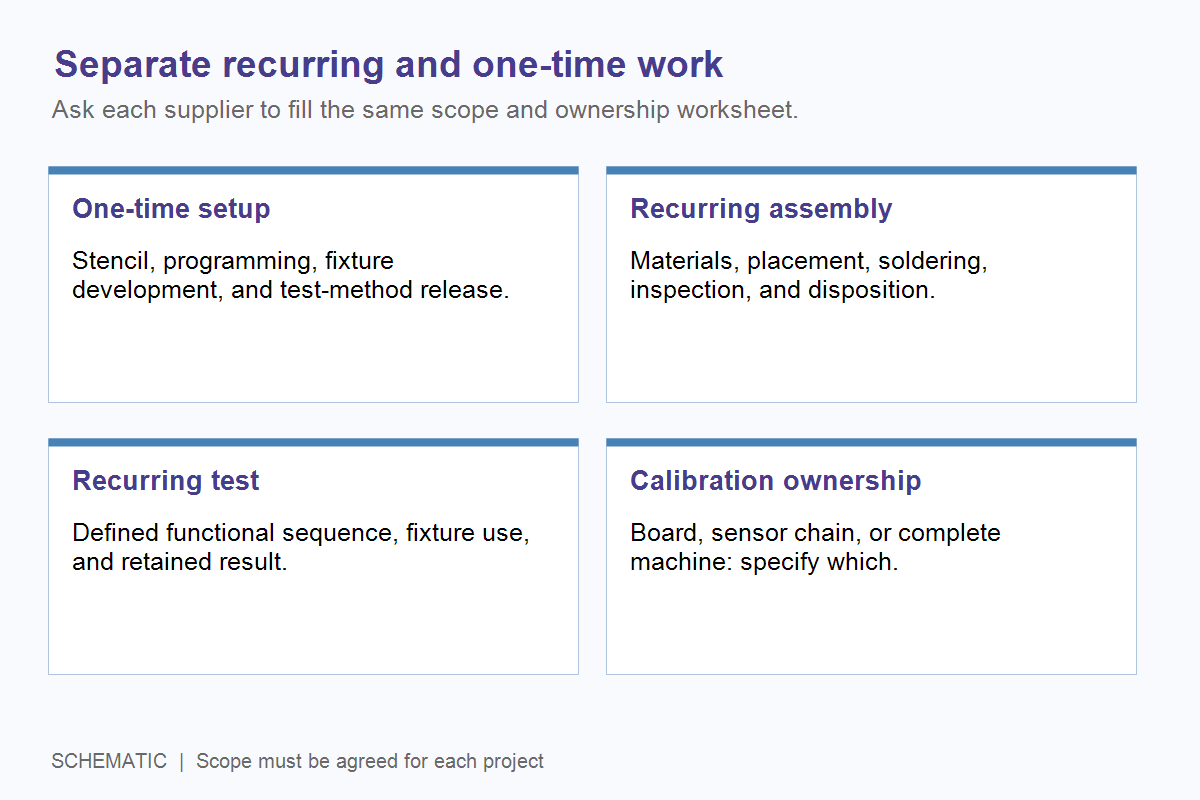
Build quantity changes how setup and fixture development are spread across units. It does not erase a per-unit procedure that the acceptance plan requires. A purchasing worksheet should therefore show both nonrecurring engineering and recurring work, with the quoted lot size beside the cycle assumption. For broader supplier comparison, see how tooling, test scope, and delivered cost change PCB quote comparisons.
What evidence should accompany a test and calibration quote?
Ask for acceptance evidence at the same level as the purchased deliverable. For a PCBA-only order, a revision-controlled test procedure and a serial- or lot-linked result can be appropriate. For a calibrated subsystem, the reference, adjustment, verification points, conditions, and retained coefficient record become part of the handoff. The OEM should also define the disposition of a failed or reworked board: retest, recalibration, new record, or engineering review.
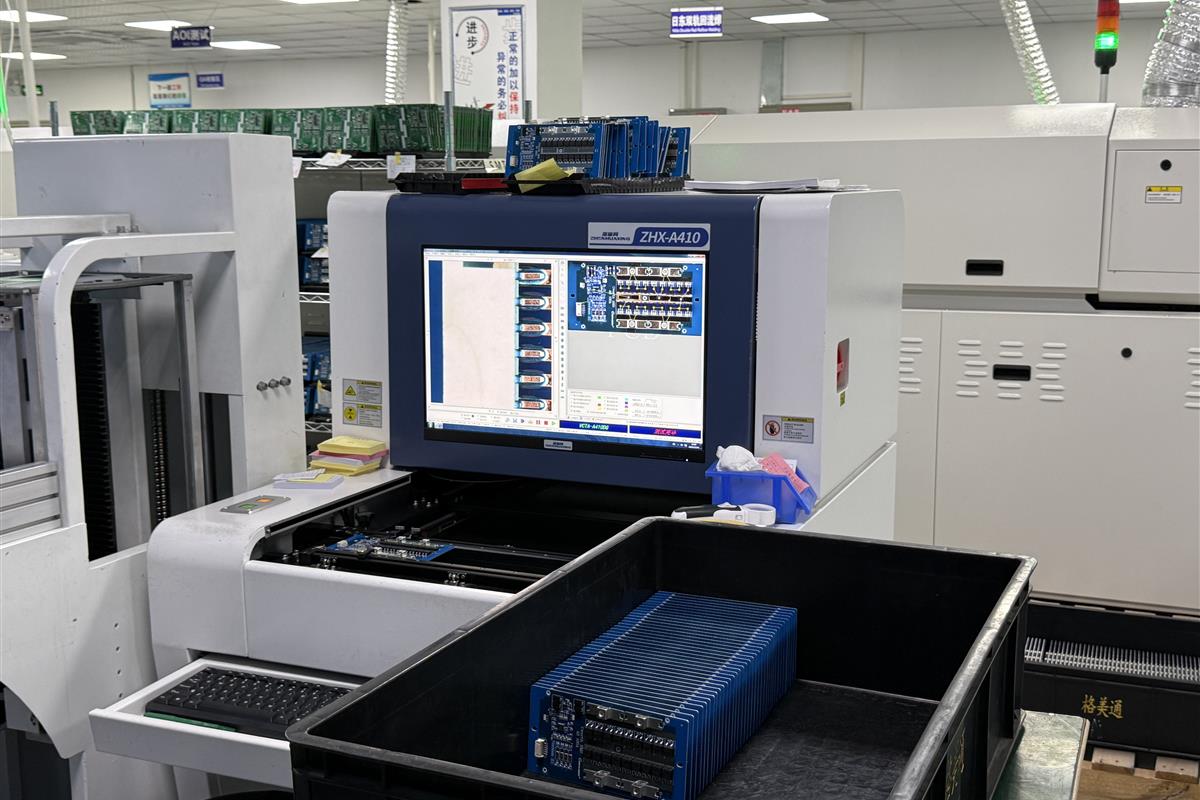
Do not use “AOI,” “ICT,” “functional test,” and “calibration” interchangeably. Automated optical inspection detects visible assembly anomalies under its programmed criteria. Electrical continuity or in-circuit checks address a different defect set. Functional test exercises specified behaviors. Calibration relates measured response to a known reference. One method may reduce risk in another stage, but none silently substitutes for the others. This distinction is why controlled BOM alternate approval matters for a measurement path: a substituted component can trigger a defined verification or calibration review even when it fits the footprint.
Machine-level legal metrology is a separate question. In the United States, the 2026 NIST Handbook 44 section 2.24 includes automatic checkweighers within its stated application and also lists exceptions, including certain controllers or auxiliary devices except as they affect weighing performance. Applicability depends on the instrument and its use; a PCBA supplier should not promise regulatory compliance from a board-level test alone. The OEM should check the applicable jurisdiction and full-system requirements. See NIST Handbook 44, section 2.24 (2026).
What should the OEM send for a comparable quotation?
A controlled package should identify the exact board revision, fabrication data, BOM and approved alternates, centroid or pick-and-place file, assembly drawing, firmware build, expected quantity, and the intended test and calibration boundary. Add the relevant schematic pages, connector pinout, safe power conditions, measurement range, output behaviors, and pass limits. If a fixture already exists, state its ownership, interface, software version, maintenance responsibility, and availability. If it does not, request fixture development as a distinct proposal. The PCB turnkey assembly service scope is a useful reference when the buyer wants fabrication, component sourcing, and assembly coordinated in one inquiry; define specialized calibration separately.
Ask each supplier to return assumptions in the same rows: included work, excluded work, NRE, recurring scope, records delivered, and handoff state. This is more useful than comparing a single “price per board” figure, especially when one offer includes programming and test while another stops after assembly. OrinewPCB’s official short video, How to Get a Fast, Accurate PCB Quote | 5 Things to Send, gives a general file-preparation overview; the checkweigher-specific boundary above should be added to that package.
If the program is ready for supplier review, provide the released fabrication and assembly package with test requirements, including the BOM, placement data, pilot or production quantity, and a note on who will own sensor calibration and machine validation. The next engineering discussion can establish the complete PCB fabrication, component sourcing, assembly, and test quotation scope without assuming that board-level inspection proves end-machine accuracy.
Conclusion
The best checkweigher PCBA comparison is a comparison of equal responsibilities. Separate setup from recurring assembly, define functional-test acceptance, and assign calibration and machine validation to the correct owner. Use a controlled revision and a common scope worksheet so differences in unit price have an engineering explanation. When a supplier cannot state what it tested or calibrated, resolve that gap before treating the offers as equivalent.
Latest Blog

Contact Info
Phone: +86-755-82882936
Email: [email protected]
WhatsApp: +86-13570802455
Wechat: +86-13570802455
Address: 2nd floor,D Bldg.,Electric Link Technology Bldg.,Gongming,Guangming New Dist.,518106 Shenzhen, China