
PCB vs PCBA: Key Differences and What to Order
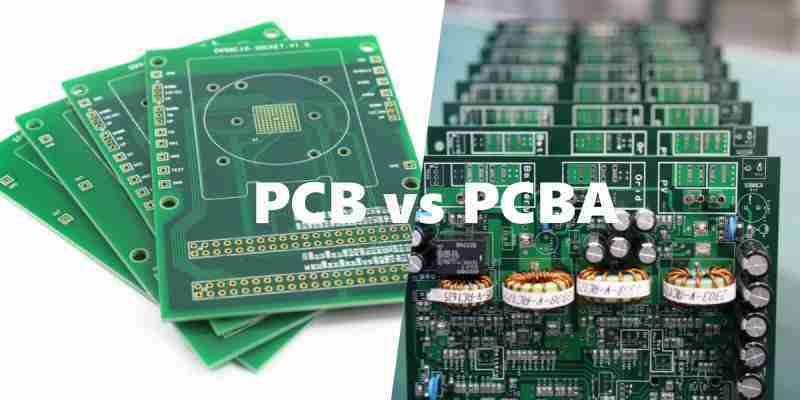
Table of Conent
Table of Conent
The difference between PCB and PCBA is the assembly state. A PCB, or printed circuit board, is the board that supports and interconnects components. In a bare-board order, it is supplied without mounted components. A PCBA, or printed circuit board assembly, is the populated board with its components and connections. The term can also refer to the assembly activity in a supplier’s service description.
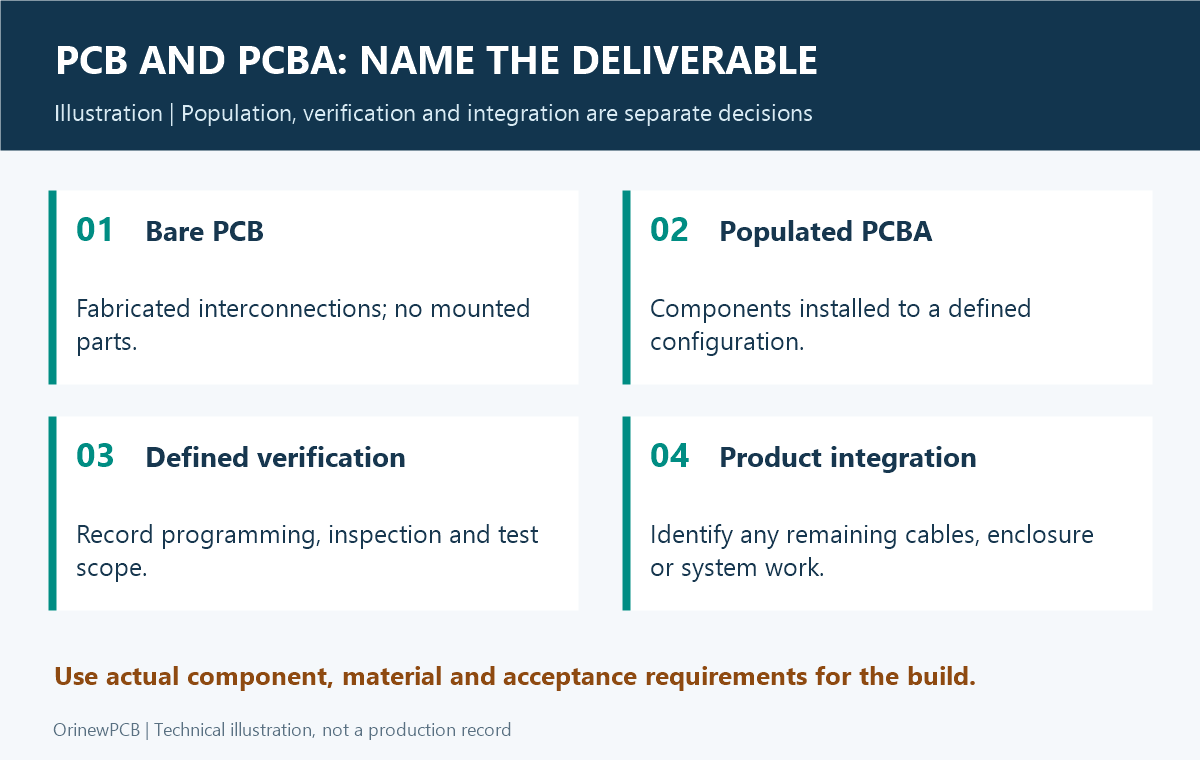
When comparing PCB vs PCBA, specify what you want delivered: bare boards, populated boards, programmed assemblies, or assemblies tested to an agreed procedure. “PCBA” alone does not guarantee firmware, functional testing, coating, or a complete finished product. Those items belong in the order scope. This guide explains the distinction and the information needed to select the right deliverable.
Updated November 5, 2026. Examples below illustrate purchasing and engineering decisions; they are not quoted production results or fixed service packages.
What Is a PCB?
A PCB provides the physical structure and conductive interconnections for a circuit. A bare PCB has the fabricated board features required by its design, but no mounted electronic components. “Bare” does not mean that it lacks solder mask, markings, or a surface finish.
The construction may include insulating materials, patterned copper, holes, plated connections, and protective or solderable surfaces. Features depend on the released design. Boards are not limited to four, six, or eight layers, and FR-4 is not the only available material family. Layer count and material selection describe the board construction, not whether it is a PCB or PCBA.
For example, an unpopulated two-layer sensor board and an unpopulated multilayer controller board are both bare PCBs. Their fabrication requirements can be very different, but neither becomes an assembly merely because its drilling, plating, or surface finish is complete.
A bare-board order is appropriate when another party will perform the component assembly or when the boards are needed for a separate evaluation. The handoff still needs a controlled fabrication revision, quantity, inspection requirements, and handling instructions. Confirm how the fabricator will identify the delivered lot and any permitted construction substitutions.
What Does PCBA Mean?
PCBA means printed circuit board assembly: the board after components have been mounted and interconnected for the specified configuration. IPC’s PCBA checklist distinguishes the bare printed circuit board from the printed circuit board assembly. In everyday conversation, people may still call an assembled board a “PCB,” so a purchase order needs more detail than the acronym.
Assembly can use surface-mount technology (SMT), through-hole technology (THT), or a combination. SMT components attach to surface lands; through-hole component leads enter board holes. Harwin’s SMT and THT explanation describes this mounting distinction. An SMT-based assembly can still contain vias or other drilled features in its PCB.
DIP means dual in-line package. It names a component package, not the general process for inserting and soldering every through-hole component. A connector or other leaded part need not be a DIP to use through-hole assembly. Select the mounting and soldering route for the actual component and board requirements.
A PCB assembly service needs a defined scope for the specific build; a service name alone does not identify every included operation. For the manufacturing sequence, the separate printed circuit board assembly process guide follows the board through the relevant production stages. Here, the important distinction is what is populated and what operations the buyer has ordered. An assembly awaiting programming or final test should be identified by that status; calling it a PCBA does not establish that it has passed either operation.
PCB vs PCBA: The Differences That Affect an Order
A PCB order supplies the fabricated board; a PCBA order adds the defined component population and assembly work. Compare the deliverables and acceptance requirements before comparing prices. A low bare-board price is not an alternative price for the same populated and tested assembly.
| Question | Bare PCB order | PCBA order |
|---|---|---|
| What is delivered? | Fabricated boards without mounted components | Boards populated to the specified assembly configuration |
| What defines the build? | Fabrication data, construction requirements, drawings, revision | The board definition plus BOM, placement, assembly, and operation requirements |
| Who provides components? | Usually outside the bare-board scope | Customer, supplier, or both, as agreed |
| What must be verified? | Specified board construction and fabrication acceptance | Specified population, workmanship, and contracted test coverage |
| Is firmware included? | Not a bare-board fabrication operation | Only if programming is explicitly included |
| Is it a finished product? | No assembled circuit is supplied | It may still require cables, enclosure integration, or product-level verification |
Consider a hypothetical purchase for a controller. If the buyer requests 100 bare PCBs, the supplier has not been asked to provide 100 populated controllers. If the buyer requests 100 PCBAs but omits the configuration and programming scope, the population and delivery status can still be ambiguous. Resolve these differences in the controlled order documents rather than relying on a sample photograph.
For an order whose boundary is unclear, share the board files and the intended delivery state, together with the preliminary BOM and quantity, so the fabrication-versus-assembly scope can be clarified before pricing assumptions are fixed.
Which Files and Responsibilities Change for PCBA?
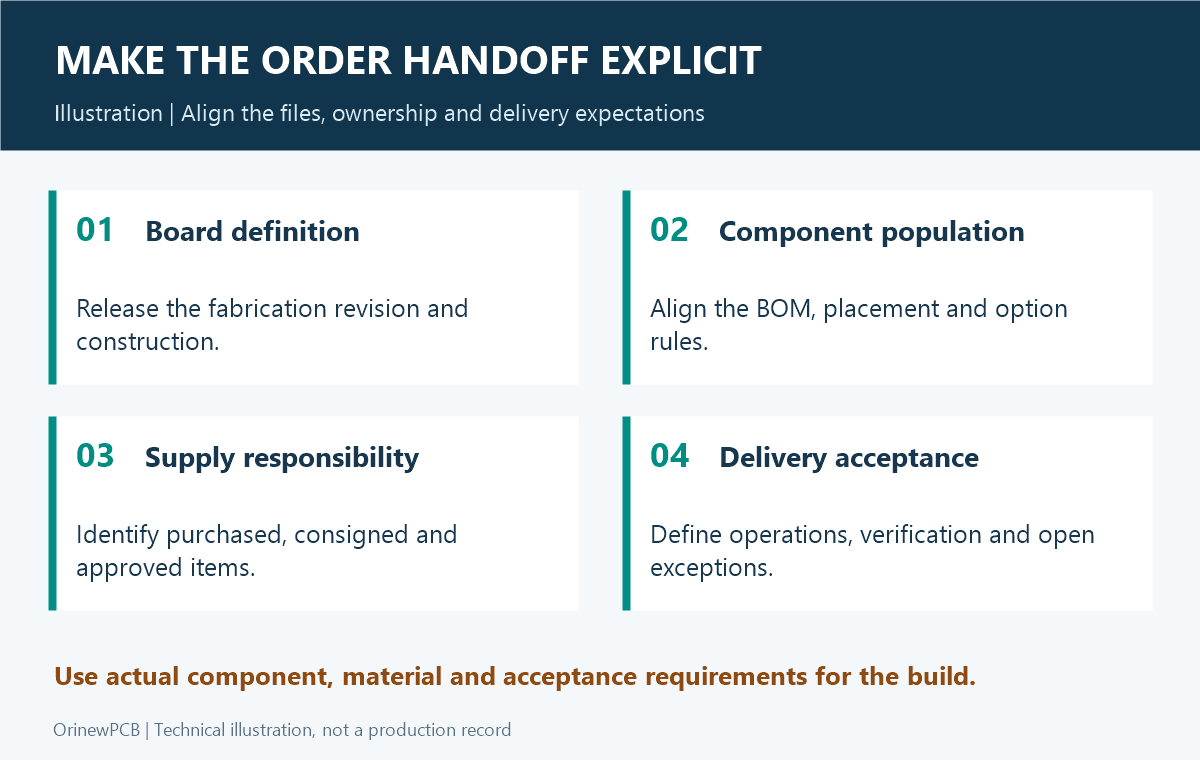
Assembly needs an unambiguous component population and installation definition in addition to the board data. Align the revisions before release. A fabrication package from one revision and a BOM from another can describe a build that engineering never approved.
Ucamco’s Gerber documentation describes PCB design-data transfer, including layer and fabrication information. Do not assume that a folder labeled “Gerber” identifies every purchased component, population option, firmware version, or functional test. Check the actual contents and the assembler’s accepted input formats.
| Information | What it resolves | Owner or approval to identify |
|---|---|---|
| Fabrication data and drawing | Which board construction and revision will be built | Released design and approved fabrication exceptions |
| BOM and population rules | Exact parts, quantities, reference designators, and unpopulated options | Engineering approval of configuration and substitutes |
| Placement data and assembly drawing | Locations, orientation, polarity, hardware, and special instructions | Resolution of inconsistent or unclear installation data |
| Material-supply model | Which parts and boards are purchased or customer supplied | Purchasing responsibility, shortages, and unused material |
| Programming and test definition | What software and verification are included at delivery | Approved versions, procedure, limits, and result records |
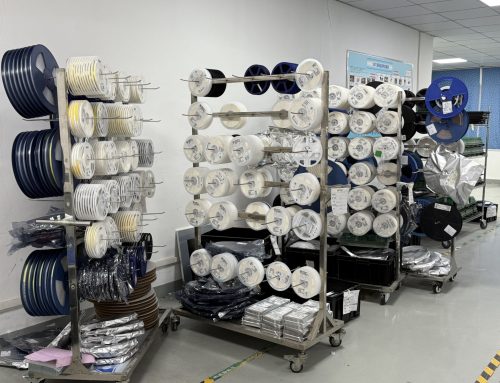
For a turnkey build, the manufacturer sources the agreed materials as part of the assembly scope. In a consigned build, the customer supplies agreed items; a hybrid arrangement splits the responsibility. State the model by item or group rather than assuming that “PCBA manufacturing” always includes every component purchase.
Also identify permitted substitutions, do-not-populate locations, configuration differences, and who resolves missing information. The supplier should not infer a replacement part solely from a similar description or footprint. Keep approvals tied to the released build so the sourcing model does not silently change the circuit.
Keep Price, Inspection, and Functional Test Separate
The word PCBA does not define either the total price or the verification coverage. State which materials, operations, inspections, programming, and tests are included. A populated board can have a documented manufacturing status while still awaiting a separate test or integration step.
For cost detail, the PCBA quote breakdown separates parts, fabrication, assembly, setup, and other charges. This comparison article does not assign a universal cost ratio between PCB and PCBA. The ratio changes with the design, component population, order quantity, and contracted work.
Inspection and functional test answer different questions. Checking component placement or visible solder workmanship does not demonstrate every electrical function. Define what the delivered assembly must do, how it will be tested, and what evidence accompanies it. Do not treat “tested” as a complete specification.
The IPC J-STD-001J overview addresses requirements for soldered electrical and electronic assemblies, while the IPC-A-610J overview concerns assembly acceptability. Specify the applicable documents, revisions, classification, and customer requirements with the supplier. Naming a workmanship standard does not, by itself, define a product-specific functional test.
For a hypothetical handoff, an assembly may have the correct parts and acceptable inspected joints but no firmware loaded. That status should be visible in the delivery record if programming is a later operation. If the order instead requires programmed and functionally tested assemblies, the firmware and test procedure must be available and controlled before acceptance can be evaluated.
A useful receipt record identifies the board and assembly revisions, population option, programming state where applicable, completed verification, and open exceptions. If enclosure integration or system-level testing belongs to another supplier, state that boundary. A PCBA can be an electronic subassembly rather than a finished, saleable product.
Frequently Asked Questions
Is a bare PCB unfinished?
It can be the finished deliverable of a fabrication order. It remains unpopulated because component assembly is a separate scope, not necessarily because fabrication is incomplete.
Does PCBA mean every part is surface mounted?
No. An assembly can use surface-mount parts, through-hole parts, or both. Confirm the actual mounting and soldering requirements from the released design.
Should the purchase order say PCB or PCBA?
Use the appropriate term, then state the deliverable precisely. Include the revisions, population, material-supply responsibility, required operations, and acceptance evidence rather than relying on the term alone.
The practical PCB vs PCBA decision is what you need delivered and who owns the remaining work. Use a bare PCB order for the board itself and a defined assembly scope for populated boards. For a complete project, provide the fabrication and assembly package with the required verification, including the BOM, placement data, quantity, supply model, and programming or test requirements, so OrinewPCB can review the board, material, and assembly scope together.
Latest Blog

Contact Info
Phone: +86-755-82882936
Email: [email protected]
WhatsApp: +86-13570802455
Wechat: +86-13570802455
Address: 2nd floor,D Bldg.,Electric Link Technology Bldg.,Gongming,Guangming New Dist.,518106 Shenzhen, China
