
Outsourcing Digital Textile Printer Electronics: Supplier and Build Checks
Table of Conent
Table of Conent
Outsourcing digital textile printer electronics works best when the supplier is evaluated against the actual build, not a generic capability presentation. The essential checks are whether the manufacturer can control the released PCB and PCBA data, source critical components under explicit rules, assemble the board’s real package mix, program and configure it correctly, test printhead, motion, heater, sensor, and communication interfaces, preserve traceability, and manage changes without silently altering the design.
A credible selection process uses evidence: a controlled quotation package, technical review, documented assumptions, process and quality records relevant to the product, a pilot build, measurable acceptance criteria, and a clear escalation path. Certifications and equipment lists can support due diligence, but they do not replace review of the exact board, BOM, firmware, fixtures, loads, failure modes, and production responsibilities.
Define the outsourced scope before comparing suppliers
The word “outsourcing” can describe very different scopes. One supplier may fabricate bare boards only; another may provide a coordinated PCB assembly workflow covering components and PCBA; a third may also program firmware, build harnesses, integrate the enclosure, run functional tests, and coordinate delivery. Quotes are not comparable until the ownership boundary is explicit.
List each deliverable and owner: fabrication data review, stackup approval, controlled impedance, panelization, component sourcing, customer-supplied material, SMT and through-hole assembly, cleaning, inspection, programming, functional test, harnesses, enclosure integration, serialization, packaging, and nonconforming material. State who approves substitutions and process deviations, and who owns excess or noncancelable material.
A complete PCB manufacturing handoff package is the foundation. Gerbers or ODB++, drill data, fabrication drawing, BOM, pick-and-place data, assembly drawings, approved alternates, firmware, programming instructions, test specification, mechanical interfaces, and revision history must describe the same configuration.
Screen technical fit against the real controller board
Digital textile printer controllers can combine high-speed digital logic, printhead drive, motion control, heater or dryer control, fluid-system sensors, isolation, industrial communications, and power conversion. Supplier review should therefore start with the real package and process risks: fine-pitch devices, BGAs or bottom-terminated packages, large thermal pads, mixed thermal mass, high-current connectors, through-hole parts, press-fit items, conformal coating, selective soldering, and sensitive cleaning requirements.
Ask how the supplier converts your released data into manufacturing programs and how engineering questions are closed. A useful DFM review identifies stackup conflicts, annular ring and drill concerns, solder-mask clearances, footprint discrepancies, component orientation, stencil strategy, panel support, depaneling risk, test-point access, and assembly sequence. The output should distinguish mandatory corrections from recommendations and record customer dispositions.
Do not infer capability from machine model names alone. Request evidence that the relevant processes are controlled: first-article records, inspection strategy, programming verification, rework controls, maintenance or calibration where applicable, operator instructions, and examples of how escapes or recurring defects are investigated. IPC explains that its standards support consistent communication across electronics manufacturing, but the contract must identify the standards, revisions, classes, addenda, and product-specific requirements that actually apply.
Evaluate component sourcing and lifecycle control
Material control often determines whether an outsourced build stays predictable. Require exact manufacturer part numbers, approved alternates, do-not-substitute items, authorized-source expectations, packaging and moisture requirements, date-code rules where justified, customer-owned inventory rules, and a written process for shortages and product-change or discontinuation notices.
For high-consequence devices such as processors, FPGAs, printhead drivers, isolated interfaces, power modules, precision references, and proprietary connectors, review lifecycle status and recovery time before committing volume. The component obsolescence risk framework shows how to rank parts by consequence, supply exposure, and the time needed to qualify a response.
Traceability depth should match risk. IPC-1782 establishes risk-based manufacturing and supply-chain traceability levels agreed between user and supplier. For a textile printer project, define which component, lot, process, firmware, inspection, and test records must be tied to a work order or serial number. More data is not automatically better; the required data must support containment, investigation, field service, and contractual obligations.
Compare sourcing models and commercial assumptions
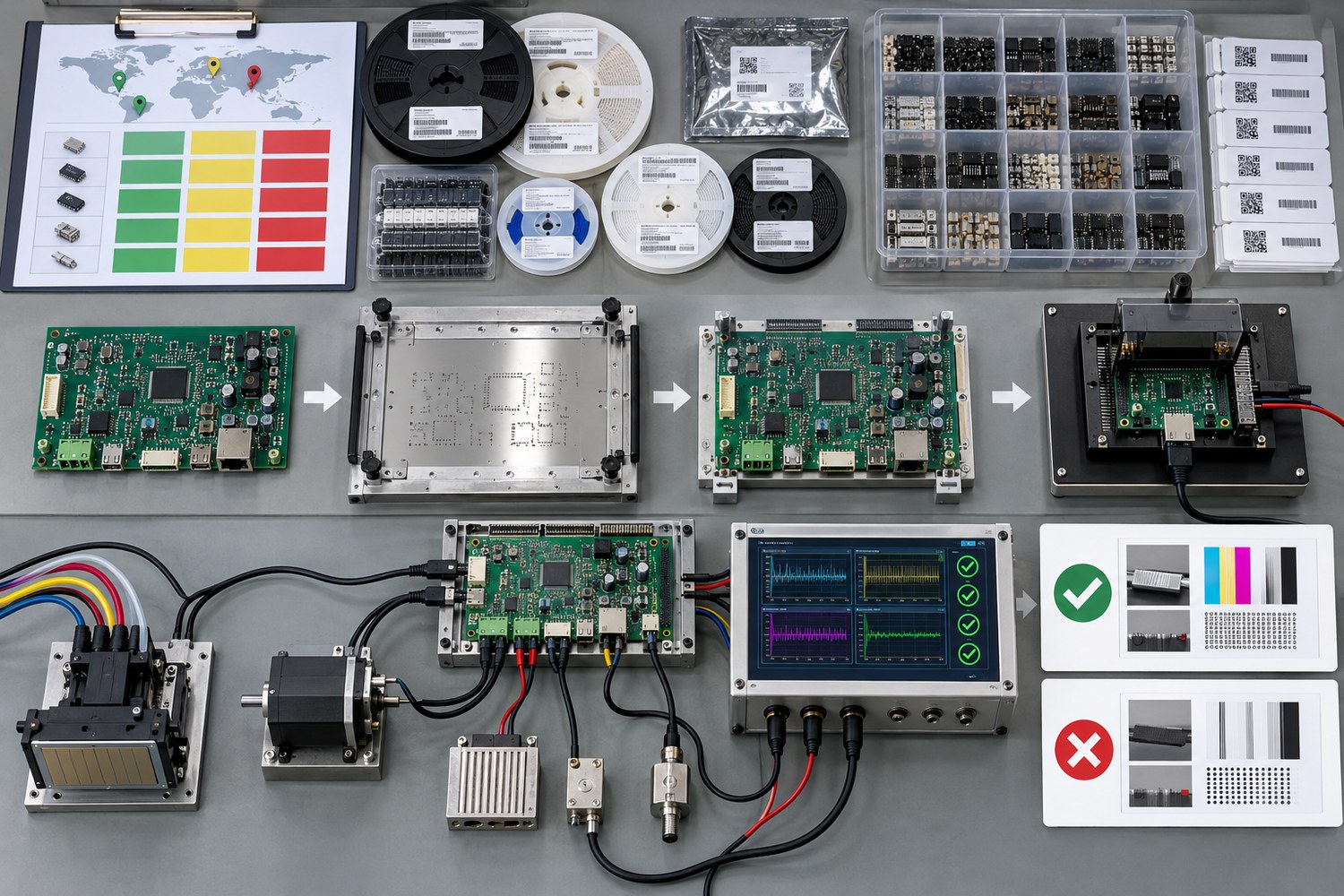
Turnkey, consigned, and hybrid sourcing distribute risk differently. Turnkey sourcing can simplify coordination, but the quote must reveal approved sources, alternates, material liability, price-validity assumptions, and shortage handling. Consigned material gives the customer more purchasing control while adding kitting, completeness, damage, and reconciliation risks. Hybrid sourcing may protect critical components while letting the manufacturer manage common material, but it requires precise ownership and shortage rules.
The turnkey, split, and hybrid sourcing comparison provides a practical way to map handoffs. When evaluating candidates, compare total project cost rather than headline unit price: engineering support, tooling, fixtures, test development, nonrecurring charges, material excess, minimum order quantities, rework, freight, schedule risk, and the cost of managing several suppliers all matter.
If the sourcing boundary and product files are ready, share the released PCB data, BOM with alternate rules, quantities, target ramp, programming package, and test requirements for a coordinated manufacturing review. The response should expose assumptions and open technical issues before purchase commitments are made.
Define process quality and acceptance evidence
Quality requirements must be translated into buildable and inspectable criteria. J-STD-001 addresses soldered-assembly process requirements, while IPC-A-610 addresses electronic assembly acceptance. IPC’s current document revision table lists IPC-A-610J released in March 2024. Neither document defines the printer’s product-specific functional behavior, so the purchase specification must add electrical and system-level limits.
Define how AOI, X-ray, visual inspection, electrical test, programming, and functional test are selected for the actual package and failure risks. X-ray can help evaluate hidden joints; AOI can inspect visible assembly features; in-circuit or flying-probe methods can evaluate selected nets; functional test verifies product behavior. A supplier should explain coverage and limitations rather than claiming that one method proves everything.
Review nonconformance handling before the first build. Required controls include identification and segregation, defect description, disposition authority, repair or rework instructions, verification after repair, trend review, and customer notification thresholds. Ask how the supplier distinguishes process indicators, defects, and design issues, and how evidence is preserved for repeated failures.
Design functional tests around printer failure modes
A textile printer controller needs more than a power-on check. The test plan should derive from interfaces and failure modes: rail sequencing and current, processor and memory operation, firmware identity, communications, encoder inputs, motor or servo outputs, printhead channel control, waveform timing where applicable, heaters, pumps, valves, fluid sensors, temperature feedback, safety interlocks, watchdog recovery, stored parameters, and fault reporting.
Use representative loads or validated simulators for expensive or delicate printer subsystems. Specify the fixture revision, software revision, connection checks, operating limits, expected responses, result format, and failure disposition. Protect the board and simulated loads against incorrect assembly. Where print quality is part of final acceptance, define the controlled printhead, fluid or ink condition, media, pattern, environment, and measurable criteria rather than relying only on visual judgment.
The layered box-build acceptance method is useful beyond dot peen systems: configuration inspection, wiring checks, controlled power-up, I/O simulation, and representative functional operation should build evidence in a safe sequence.
Use a pilot build to qualify the relationship
A pilot build is the most useful supplier audit because it tests the real transfer. Agree on exit criteria before material is ordered: DFM closure, material exceptions, first-article approval, programming readiness, inspection coverage, functional-test readiness, defect handling, data deliverables, and approval to build the balance.
During the pilot, measure communication quality as well as hardware quality. Track how quickly and clearly questions are documented, whether assumptions are surfaced, whether revision changes are controlled, and whether the supplier can explain actual findings with evidence. A polished sample that required undocumented handwork is not proof of repeatable production.
After the pilot, review defects, yields only when the measurement basis is defined, test failures, rework, material variances, fixture issues, cycle constraints, and open risks. Update the drawings, BOM, work instructions, programs, and test limits before volume. Use gated engineering, pilot, and production releases rather than increasing quantity simply because the prototype operated successfully.
Perform supplier due diligence without turning it into paperwork
Due diligence should investigate the claims that matter to the product. Confirm legal identity and manufacturing location, process ownership, subcontracted steps, quality-system scope, applicable certificates with issuing bodies and validity, relevant training, change controls, data protection, business continuity, and escalation contacts. If a requirement is safety-, regulatory-, or customer-mandated, verify the exact scope rather than accepting a logo on a presentation.
NIST SP 800-161 Rev. 1 addresses cybersecurity supply-chain risk management for information and communications technology. Not every control maps directly to commercial PCBA procurement, but its emphasis on supplier visibility, risk assessment, provenance, resilience, and lifecycle management is useful when printer electronics include networked firmware, service tools, or protected design data.
IPC Validation Services publishes QML and QPL programs for specific standards and processes. A listing can be relevant evidence, but it should be checked for the correct site and scope. Likewise, an ISO certificate or IPC-trained personnel do not automatically qualify an unrelated process or guarantee the outcome of the customer’s board.
Compare quotes using a common decision record
Build a comparison table that separates scope, assumptions, exclusions, technical findings, material model, test coverage, traceability, change control, lead-time basis, tooling, nonrecurring costs, excess liability, logistics, and open questions. Normalize quantities and revision levels before comparing prices. The guide to PCB quote total-cost comparison helps prevent a low unit price from hiding missing test, incomplete sourcing, or extra coordination.
Assign risks rather than inventing a single universal supplier score. A capable prototype partner may not be the right volume source; a strong assembler may depend on outside fabrication or harness suppliers; a low-cost quote may be reasonable only when the customer provides fixtures and consigned material. Record the decision, conditions, and requalification triggers.
When the shortlist has been narrowed, provide the controlled fabrication, assembly, sourcing, firmware, quantity, compliance, and test package for a complete PCB assembly evaluation. A useful final response should confirm responsibilities, DFM findings, material assumptions, pilot evidence, acceptance data, traceability, and unresolved risks.
Conclusion
The right digital textile printer electronics supplier is the one that can repeatedly build and verify the released product under explicit sourcing and change rules. Define the scope, audit technical fit against the actual design, control the BOM and provenance, require product-specific test evidence, and use a pilot build to validate both the process and the working relationship.
Supplier selection becomes more reliable when every claim connects to a document, record, demonstration, or measurable result. That evidence protects engineering intent, purchasing decisions, production continuity, and field support long after the first acceptable sample.
Latest Blog
Contact Info
Phone: +86-755-82882936
Email: [email protected]
WhatsApp: +86-13570802455
Wechat: +86-13570802455
Address: 2nd floor,D Bldg.,Electric Link Technology Bldg.,Gongming,Guangming New Dist.,518106 Shenzhen, China