
Flexo Press Controller Boards: Manage Component Obsolescence and Supply Risk
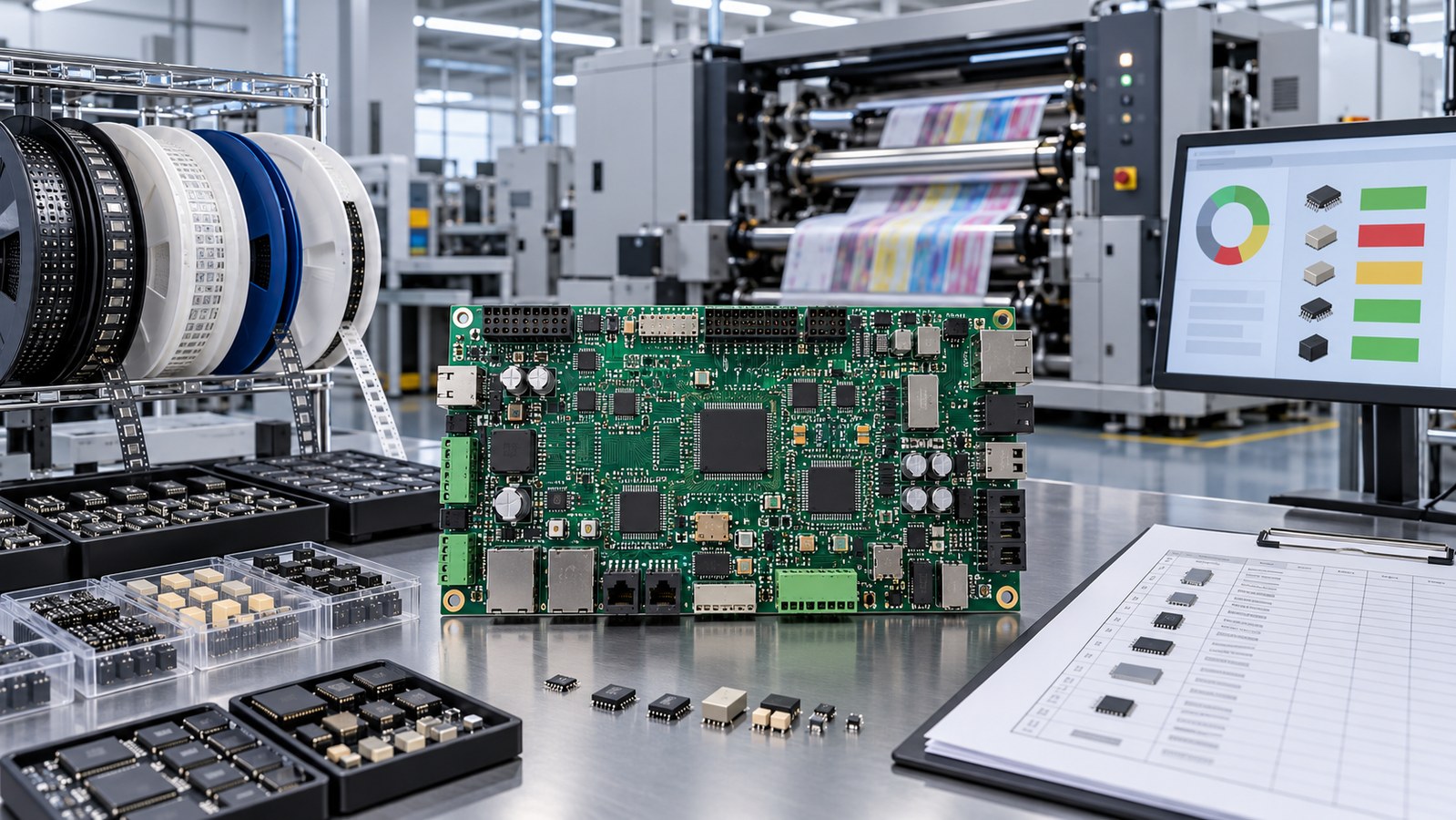
Table of Conent
Table of Conent
Component obsolescence on a flexo press controller board should be managed as an engineering and production-control problem, not as a last-minute purchasing emergency. The practical approach is to maintain a risk-ranked BOM, monitor lifecycle and supply signals, define approved alternates before shortages occur, and connect every substitution to documented technical review, assembly validation, firmware impact, and functional test. This protects uptime and serviceability without treating every aging component as an immediate redesign.
A good plan distinguishes parts that merely have a long lead time from parts that create true redesign risk. For a flexographic press, the most consequential items often include processors, FPGAs, motor-control devices, encoder interfaces, isolated communications, safety-related I/O, power modules, displays, and proprietary connectors. The goal is not to eliminate all supply uncertainty. It is to identify where a loss of availability can stop production, delay field service, or force an uncontrolled board revision.
Build a controlled BOM before scoring risk
Obsolescence management starts with a BOM that can be trusted. Each line should identify the exact manufacturer part number, package, description, quantity, approved manufacturer list, current lifecycle status, sourcing restrictions, and the released board revision. Distributor stock codes alone are not stable engineering identifiers. Generic descriptions such as “10 kΩ resistor” are also inadequate when voltage rating, tolerance, temperature coefficient, package, pulse behavior, or qualification status matters.
Link the BOM to the schematic, layout, firmware release, assembly drawing, and test specification. A component change can affect more than electrical function: it may change the land pattern, stencil aperture, reflow behavior, programming sequence, startup state, EMC performance, thermal margin, or diagnostic response. The PCB design-transfer checklist explains how to keep these manufacturing artifacts aligned under one revision.
Assign ownership for BOM updates and approval. Purchasing may detect a notice or shortage, but engineering must decide whether the proposed response is technically acceptable. The manufacturer should not substitute a part merely because it appears equivalent in a catalog. Every approved alternate needs an auditable basis and a defined effective revision.
Rank components by consequence, exposure, and response time
A useful risk model is simple enough to maintain and specific enough to drive action. Score each component on three dimensions: the consequence if it becomes unavailable, the likelihood or evidence of supply disruption, and the time required to qualify a response. A common passive with several already-approved equivalents may be low risk even when lead time rises. A single-source processor with embedded software dependencies may be high risk while still listed as active.
| Risk factor | Questions to ask | Typical evidence |
|---|---|---|
| Design consequence | Would replacement require PCB, firmware, compliance, or fixture changes? | Schematic role, package, interfaces, safety and performance requirements |
| Supply exposure | Is the part single-source, allocation-prone, aging, or already under a change notice? | Manufacturer lifecycle data, authorized-channel availability, PCN/PDN records |
| Recovery time | How long would alternate qualification, tooling, software, and validation take? | Engineering estimate, prototype lead time, test coverage, approval path |
| Inventory coverage | How much qualified demand can current stock support? | On-hand, open orders, service demand, forecast, attrition allowance |
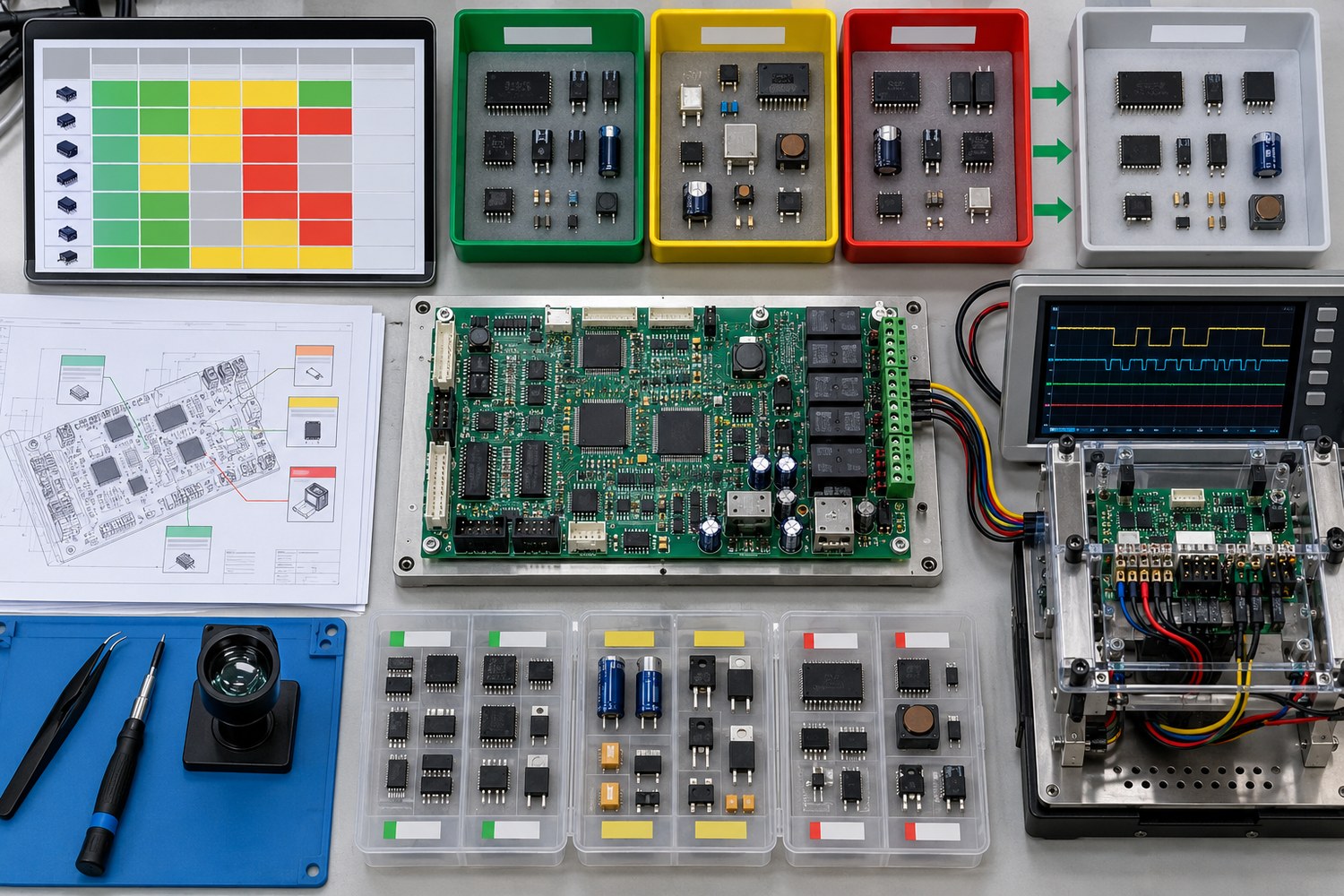
Do not turn the score into false precision. A red-yellow-green matrix is useful only when the thresholds, evidence date, owner, and next review are visible. The IEC 62402:2019 obsolescence-management framework treats the subject as a lifecycle process involving policy, planning, mitigation, resolution, and improvement—not a one-time spreadsheet cleanup.
Monitor lifecycle signals without overreacting
Lifecycle labels are inputs, not decisions. Monitor manufacturer product-change notifications, product-discontinuation notices, authorized-distributor availability, lead-time movement, minimum order quantities, allocation, and the reliability of the upstream source. Record the date and origin of each signal. Marketplace listings and broker stock can support investigation, but they do not prove authenticity, traceability, storage condition, or long-term availability. A coordinated PCB assembly program should connect those sourcing decisions to fabrication, assembly, test, and revision control rather than treating procurement as a separate workstream.
Define review frequency by risk. High-consequence single-source devices may require frequent monitoring, while stable commodity parts can be reviewed at longer intervals. Also monitor supporting tools: programmers, compilers, device libraries, calibration equipment, test adapters, and operating systems can become obsolete before the silicon does.
For a flexo controller, service demand matters as much as new-build demand. Preserve the configuration data needed to identify which board revisions, press models, firmware versions, and field spares use each component. IPC’s overview of IPC-1782 describes risk-based manufacturing and supply-chain traceability; the exact traceability level should be agreed between customer and supplier for the product and market.
Choose the right response for each risk
There are several legitimate responses, and the cheapest unit price is rarely the only decision criterion. The right choice depends on remaining product life, forecast confidence, service commitments, qualification cost, storage risk, and how much redesign work can be absorbed.
- Approve a form-fit-function alternate: appropriate only after electrical, mechanical, thermal, firmware, manufacturing, and test differences are reviewed.
- Make a controlled lifetime buy: useful when demand is predictable and redesign cost is high, but it creates inventory, storage, date-code, moisture, oxidation, and forecast risks.
- Redesign the affected circuit: justified when several high-risk parts cluster around an aging architecture or when a new platform improves maintainability.
- Bridge with an interposer or controlled rework: sometimes practical for limited service demand, but only with documented assembly and reliability validation.
- Retire or consolidate a board revision: sensible when supporting multiple low-volume variants creates more risk than a planned migration.
The NASA MSFC standard on EEE parts obsolescence management and control is written for a specific institutional context, but it illustrates why responsibilities, control documents, and planned responses matter in long-life electronic systems. Commercial projects should scale the rigor to their own product risk rather than claiming compliance unless it is contractually required and demonstrated.
If a flexo controller BOM already contains lifecycle warnings or single-source dependencies, submit the released BOM, Gerbers, placement data, annual demand, service horizon, current stock, and test requirements for a coordinated fabrication, sourcing, assembly, and risk review. The output should identify assumptions, unresolved data, proposed alternates, validation needs, and quotation boundaries before material is committed.
Qualify alternates as engineering changes
An alternate is approved only for a defined application and revision. Compare absolute maximum ratings, operating conditions, tolerances, switching behavior, timing, pinout, package dimensions, thermal impedance, environmental limits, startup state, internal pullups, communication behavior, and errata. For passives, examine dielectric, voltage coefficient, DC-bias behavior, ESR, ripple, temperature coefficient, surge capability, and construction—not just nominal value and footprint.
Then review manufacturing effects. A nominally compatible package can differ in terminal finish, coplanarity, moisture sensitivity, thermal mass, exposed-pad geometry, marking, X-ray appearance, or inspection criteria. Update approved vendor data, the BOM, drawings, programming instructions, inspection program, and test limits together. The BOM alternate approval workflow provides a disciplined path from proposed substitution to released manufacturing data.
Use a validation plan proportional to the change. It may include incoming identity checks, first-article assembly, AOI or X-ray program review, electrical measurements, programming, boundary tests, full functional test, thermal checks, communications stress, motion-control testing, safety interlocks, print-registration behavior, and representative press loads. A paper comparison alone cannot reveal every interaction in a complex controller.
Protect production with sourcing and change controls
Approved sources should be explicit. Authorized channels normally provide the strongest path to manufacturer traceability, but every project should define acceptable evidence and escalation rules. If constrained material must come from an independent source, establish a separate authenticity and quality plan before purchase. Do not quietly mix source classes within a lot.
Set rules for manufacturer PCNs, supplier changes, substitutions, date codes, excess material, noncancelable orders, and customer-owned inventory. The sourcing model itself changes risk: turnkey, split, and hybrid structures create different responsibilities for shortage detection, excess liability, traceability, and change approval. The comparison of controller-board sourcing models can help clarify those handoffs.
When a change is released, keep old and new configurations distinguishable. Record effective dates, affected work orders, lot or serial traceability, firmware compatibility, fixture revision, validation evidence, and field-service instructions. IPC’s current document revision table is also a reminder to identify the actual revision of any assembly or acceptance standard placed on a purchase order; citing “latest IPC” is not a complete contractual requirement.
Use production test to contain substitution risk
Functional test should target the product risks that a component change could introduce. For a flexo press controller, that may include power sequencing, motor and brake outputs, encoder capture, registration timing, analog sensor accuracy, isolated communications, HMI interfaces, safety and fault inputs, watchdog recovery, stored parameters, and firmware identity. Representative loads or validated simulators are often more useful than a simple power-on test.
Separate manufacturing inspection from product validation. AOI and X-ray can find assembly defects; in-circuit or flying-probe methods can evaluate selected nets; programming verifies device loading; functional test verifies behavior. Acceptance criteria should use the contractually selected assembly standard plus product-specific limits. IPC reports that J-STD-001J and IPC-A-610J were released in 2024, but neither standard replaces a product-specific functional specification.
Trend failures after an alternate enters production. A passing first article is necessary, but early lots can reveal marginal process windows, thermal behavior, timing differences, or test escape patterns. Define who reviews the data and what triggers containment, additional validation, or rollback.
Create an actionable obsolescence review package
A practical review package should contain the controlled BOM, lifecycle evidence with dates, risk ranking, usage forecast, on-hand and open-order inventory, product and service horizon, approved-source rules, alternate candidates, engineering comparison, validation plan, and decision record. Add the board revision, firmware revision, test fixture revision, responsible owner, and next review date.
Before asking a manufacturer to quote a mitigation build, distinguish confirmed facts from assumptions. Identify which parts are customer-mandated, which alternates are already approved, which require engineering work, whether current inventory is usable, and whether the objective is a bridge build, lifetime buy, or redesigned revision. This makes cost, lead time, and technical risk comparable rather than burying them inside a single unit price. The framework for comparing PCB assembly quotes by total project cost is useful when evaluating competing mitigation paths.
After the risk list and validation requirements are defined, share the controlled manufacturing package, priority risks, target quantities, approved-source rules, and functional-test criteria for a complete PCB assembly evaluation. A responsible response should confirm manufacturability, material assumptions, alternate status, validation scope, traceability, and open technical questions before production release.
Conclusion
Flexo press controller obsolescence is best controlled before a discontinuation notice becomes a line-down event. Maintain a revision-linked BOM, rank risk by engineering consequence and recovery time, monitor credible lifecycle signals, qualify alternates through documented analysis and product-level testing, and preserve source and lot traceability. Use lifetime buys selectively, redesign when architecture risk justifies it, and connect every mitigation to production and field-service configuration control.
The result is not a promise that shortages will disappear. It is a decision system that exposes risk early, assigns ownership, protects the released design, and gives procurement and manufacturing a technically defensible path forward.
Latest Blog


Contact Info
Phone: +86-755-82882936
Email: [email protected]
WhatsApp: +86-13570802455
Wechat: +86-13570802455
Address: 2nd floor,D Bldg.,Electric Link Technology Bldg.,Gongming,Guangming New Dist.,518106 Shenzhen, China