
3TG Conflict Minerals: Connect CMRT Evidence to Your BOM
Table of Conent
Table of Conent
For an electronics buyer, 3TG conflict-minerals due diligence starts with connecting supplier information to the products being purchased. Identify the manufacturer and exact part number, review the declaration’s scope, and record which questions remain unresolved. A completed spreadsheet is useful evidence, but its presence alone does not demonstrate that every component on a PCB assembly has a known mineral origin.
The Responsible Minerals Initiative’s reporting-template introduction identifies 3TG as tin, tantalum, tungsten and gold. This guide focuses on a practical PCBA procurement workflow: organizing declarations, handling coverage gaps and preserving the record when sourcing changes. It does not determine a company’s legal filing obligations. Assign those decisions to the responsible compliance owner using the applicable customer and regulatory requirements.
Define the purchased product before requesting declarations
Start with the released BOM and the actual sourcing scope. A supplier cannot give a useful product-specific answer if the request contains only an internal board name or an incomplete list of manufacturer part numbers.
The RMI describes the Conflict Minerals Reporting Template, or CMRT, as a standardized way to exchange mineral-origin and smelter/refiner information through a supply chain. It supports information collection; it does not replace the buyer’s review of what the supplied declaration actually covers.
For each BOM line, distinguish the internal item number, manufacturer name, manufacturer part number and purchasing source. Keep distributor order identifiers separate from manufacturer identities. When the assembly provider purchases components, agree who obtains manufacturer declarations and who follows up with the purchasing channel. When components are customer supplied, identify who provides the supporting information.
If the handoff mixes process names and product identifiers, clarify the BOM and assembly terminology before collecting documents. A description such as “SMT capacitor” is not a sufficient key for associating a declaration with an approved purchasing item.
Include relevant manufacturing inputs in the agreed scope as well as purchased components. For example, ask who owns documentation for solder materials or a procured bare board when these are included in the reporting request. Do not assume that a component manufacturer’s declaration answers questions about every material introduced during assembly.
As a practical record format, retain the BOM revision, requested reporting scope, document identifier, supplier response date and review owner together. This creates a traceable question-and-answer record without claiming more certainty than the supplier information supports. Define the reporting period explicitly rather than assuming the newest file name matches the customer’s request.
Check declaration scope before assigning product coverage
Read the scope field before using a supplier declaration to close a BOM question. A broad response may cover the supplier’s business while leaving the connection to the purchased part unclear.
The RMI’s historical CMRT guidance explains company, product or product-list, and user-defined scopes. Use that distinction as a review principle, while checking the instructions in the current template requested by the customer. The older guide is not evidence that a particular template revision remains current.
The matrix below is an original purchasing aid. It separates a declaration’s stated boundary from the evidence needed to associate it with a build. It is not an official CMRT worksheet or a substitute for the responsible reviewer’s determination.
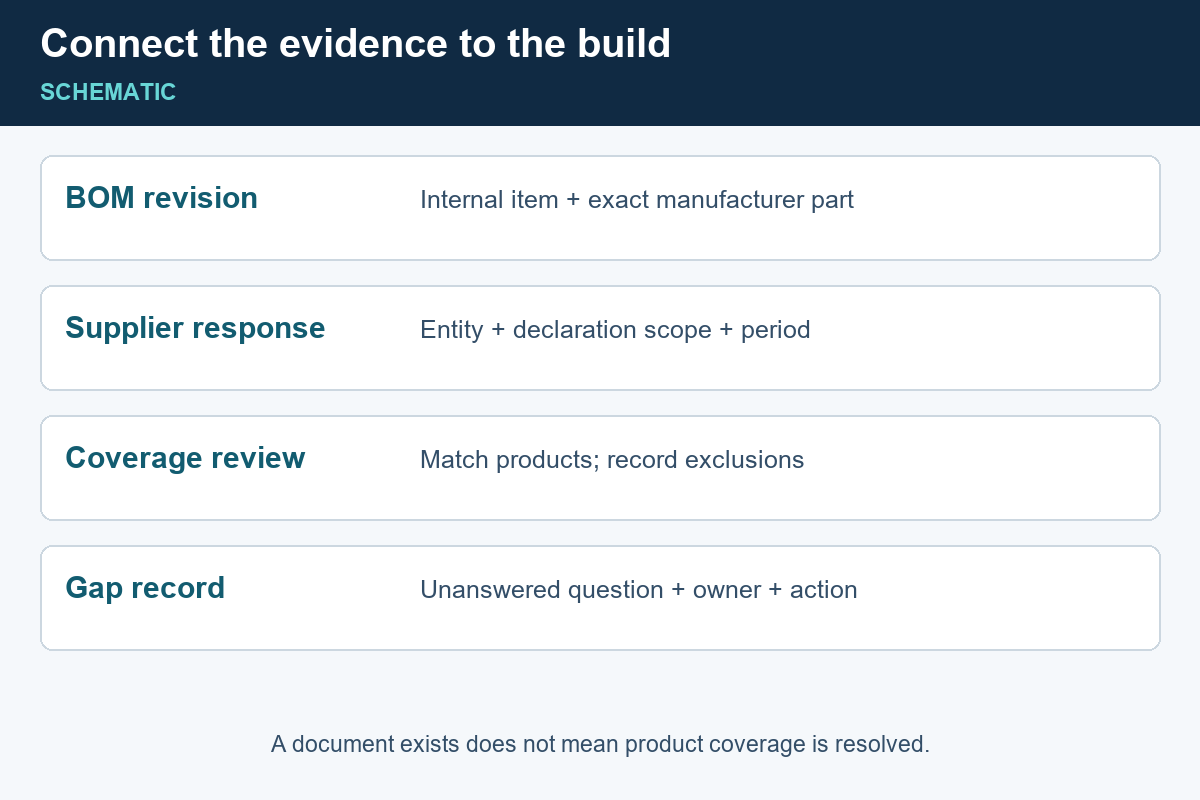
| Response received | What to check | Next action |
|---|---|---|
| Company-level declaration | Responding legal entity and relevance to the supplying manufacturer | Clarify how the purchased products relate to the declared scope |
| Product or product-list declaration | Exact manufacturer part numbers and the associated list | Match the list to the released BOM, recording exclusions |
| User-defined scope | Whether the written boundary is clear enough to evaluate | Ask for clarification where parts, entities or periods are ambiguous |
| Policy statement without a declaration | Whether it answers the requested product and reporting questions | Keep the policy as context and request the missing evidence |
When document availability affects the purchasing plan, share the BOM and supplier-document requirements with the build quantity and sourcing restrictions for feasibility review. Confirm which records can be obtained, by whom and at what stage before accepting a manufacturing quotation.
Record uncertainty instead of converting gaps into assurances
An unresolved response should remain visibly unresolved until the assigned reviewer has sufficient evidence to make a decision. Avoid turning an unanswered question into either an unsupported assurance or an automatic finding of misconduct.
The OECD framework for downstream companies emphasizes supplier engagement, supply-chain risk assessment, records and follow-up. For a PCBA team, a useful implementation is to maintain a controlled gap log alongside the collected documents. The log connects the unanswered question to an owner and a documented next step.
Use descriptive states rather than a single completed/not-completed flag. A response can exist while still requiring clarification of scope or product identity. The following states are suggested internal workflow labels, not RMI assessment categories.
| Observed gap | Question to resolve | Owner and next step |
|---|---|---|
| No supplier response | Who can provide the requested information? | Purchasing follows up and records the response deadline |
| Part identity mismatch | Does the declaration apply to the actual manufacturer part? | Sourcing reconciles manufacturer and part-number records |
| Scope clarification needed | Which products, entities or reporting period are included? | Document owner obtains a written clarification |
| Information remains incomplete | What limitation affects the customer’s reporting decision? | Compliance owner records the disposition and further action |
Preserve the evidence behind each state. Keep the supplier’s original response, the clarification request, the answer received and the review decision. A renamed file or a green cell should not erase the reason a question was raised. This helps the next reviewer understand whether a gap was actually closed or merely carried forward.
Separate manufacturing inspection from mineral-sourcing evidence. An electrical test or optical inspection can answer a board or assembly acceptance question, but it does not establish a mine of origin. Likewise, a mineral declaration does not establish solder-joint quality or electrical performance. Both types of records may belong to the same project while supporting different conclusions.
Reopen the evidence review when a component changes
A component substitution needs both engineering approval and a review of the relevant supplier-document coverage. Passing one review does not automatically close the other.
Consider an illustrative example: a shortage leads to a proposed replacement capacitor from a different manufacturer. The electrical team evaluates the replacement against the design requirements. Separately, the sourcing team checks whether the new manufacturer and part number are represented in the document register. Any missing declaration or unclear scope remains an open item for the assigned reporting reviewer.
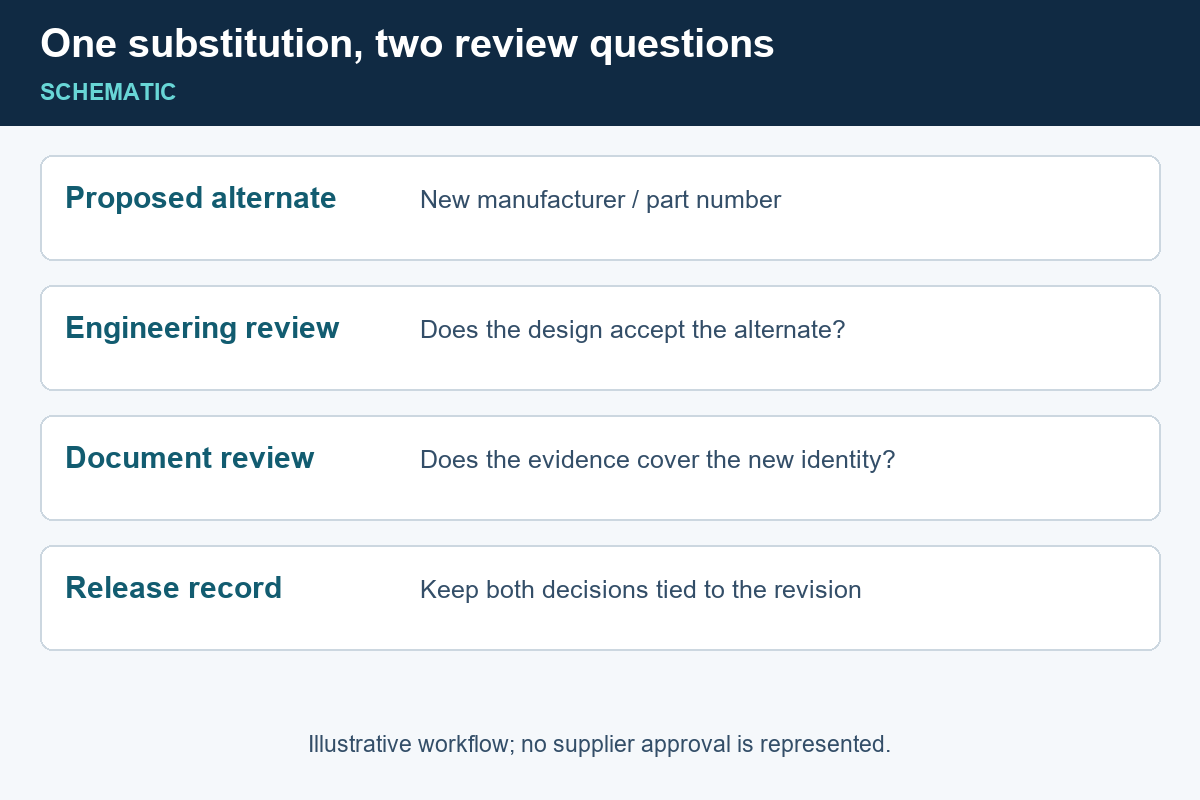
Use the BOM alternate approval process to control the engineering release, then link the accepted change to the document review. Record the old and new identities, affected build revision and authorization. Avoid carrying a previous manufacturer’s response forward under the replacement part without reviewing its relevance.
A purchasing-channel change also deserves a scope check. It may leave the manufacturer and product unchanged, but alter who supplies the documentation or how the response is obtained. Ask what actually changed before assuming either that all evidence must be recreated or that no review is necessary.
Keep previous document versions with their review history when updating the register. If a customer asks how a particular production release was evaluated, the team needs the evidence used for that release, not only the latest file in a shared folder. Record later corrections as updates with a clear relationship to the earlier decision.
Agree on reporting responsibilities in the assembly RFQ
A useful RFQ defines the documentation handoff as clearly as the component-sourcing and assembly work. State which party collects responses, which party reviews them and what the customer expects at quotation, build release and delivery.
The full-turnkey PCB assembly scope provides a way to discuss coordinated board procurement, components and assembly. Ask separately about project-specific responsible-minerals records. A general assembly-service description does not establish that every requested declaration is available or that a customer’s reporting obligation has been fulfilled.
Specify the customer’s requested template and reporting period, the BOM revision, approved manufacturers, substitution rules and customer-supplied items. Identify required product-list detail and how incomplete responses should be escalated. This lets suppliers explain document limitations early rather than treating them as an unexpected delivery requirement.
Check template currency at the source instead of relying only on a logo or an old attachment. RMI’s introduction page, checked November 10, 2026, notes an October 30 branding update to its reporting templates. The review question remains whether the actual file and its instructions meet the requested scope. Appearance alone is a weak version-control method.
The practical goal is a consistent record connecting the purchased product, supplier information, remaining uncertainty and the person responsible for the decision. That record supports an informed handoff without turning a spreadsheet into an unsupported blanket claim about the finished assembly.
For a complete project assessment, provide the released assembly and sourcing package with board files, BOM, placement data, quantities, testing expectations and mineral-reporting requirements so manufacturing scope and document responsibilities can be reviewed together. Confirm feasible deliverables and exclusions before proceeding to a quotation.
Latest Blog






Contact Info
Phone: +86-755-82882936
Email: [email protected]
WhatsApp: +86-13570802455
Wechat: +86-13570802455
Address: 2nd floor,D Bldg.,Electric Link Technology Bldg.,Gongming,Guangming New Dist.,518106 Shenzhen, China
