
PCB Assembly Cost: Estimating an Outsourced Build
Table of Conent
Table of Conent
A useful PCB assembly cost estimate starts with a defined build, not a universal price per board. Record the design revision, order quantity, component sourcing responsibilities, assembly operations, inspection and test requirements, and delivery assumptions. Then separate recurring build costs from setup or engineering charges and identify what remains unpriced. Without these boundaries, two attractive unit prices may describe different deliverables.
Outsourcing can reduce the need to buy and operate assembly equipment, but it does not automatically make every project cheaper. Material availability, purchased excess, handling, test development, and change requests still need an owner. The practical question is how much the specified outsourced build will cost under explicit assumptions, and which decisions could change that estimate before an order is released.
This guide explains early budgeting and scenario comparison. It does not provide a current supplier price list. Every dollar figure in the worked example is hypothetical and is used only to show the calculation.
Define what the outsourced build includes
Start with a one-sentence scope: for example, a specified quantity of populated boards of one revision, with named sourcing responsibilities and an agreed test plan. Clarify whether the purchase includes bare PCB fabrication, component procurement, assembly, programming, fixtures, packaging, and shipment. A service-only assembly number cannot be compared directly with a complete turnkey total.
The boundary also determines which files matter. Gerber or ODB++ fabrication data describes the board; the BOM identifies approved parts; placement data and assembly drawings describe population and orientation. Quantity, do-not-populate positions, approved alternates, special handling, and acceptance criteria complete the estimating context. Files from different revisions can invalidate an otherwise careful budget.
For an overview of the manufacturing and sourcing scope, see the PCB fabrication and assembly service description. Use the requested operations to define your build rather than assuming every service is included in a single advertised price.
Match estimate confidence to the available evidence
An early concept budget and a supplier-reviewed PCB assembly quote answer different questions. The first supports a feasibility decision; the second should describe a controlled scope, price validity, exclusions, and conditions. Do not present an early spreadsheet result as a committed purchase price merely because it has two decimal places.
| Estimate stage | Evidence available | Appropriate use and open items |
|---|---|---|
| Concept budget | Approximate board architecture, tentative BOM, forecast quantities | Compare design approaches; identify unpriced packages, unavailable parts, and test development. |
| File-based estimate | Aligned fabrication files, BOM, placements, build quantity, draft test scope | Compare sourcing and lot-size scenarios; label pending DFM, availability, tooling, and acceptance assumptions. |
| Supplier-reviewed offer | Resolved file questions, reviewed sourcing, defined operations and commercial conditions | Support an order decision within stated validity; confirm exclusions, changes, and release conditions. |
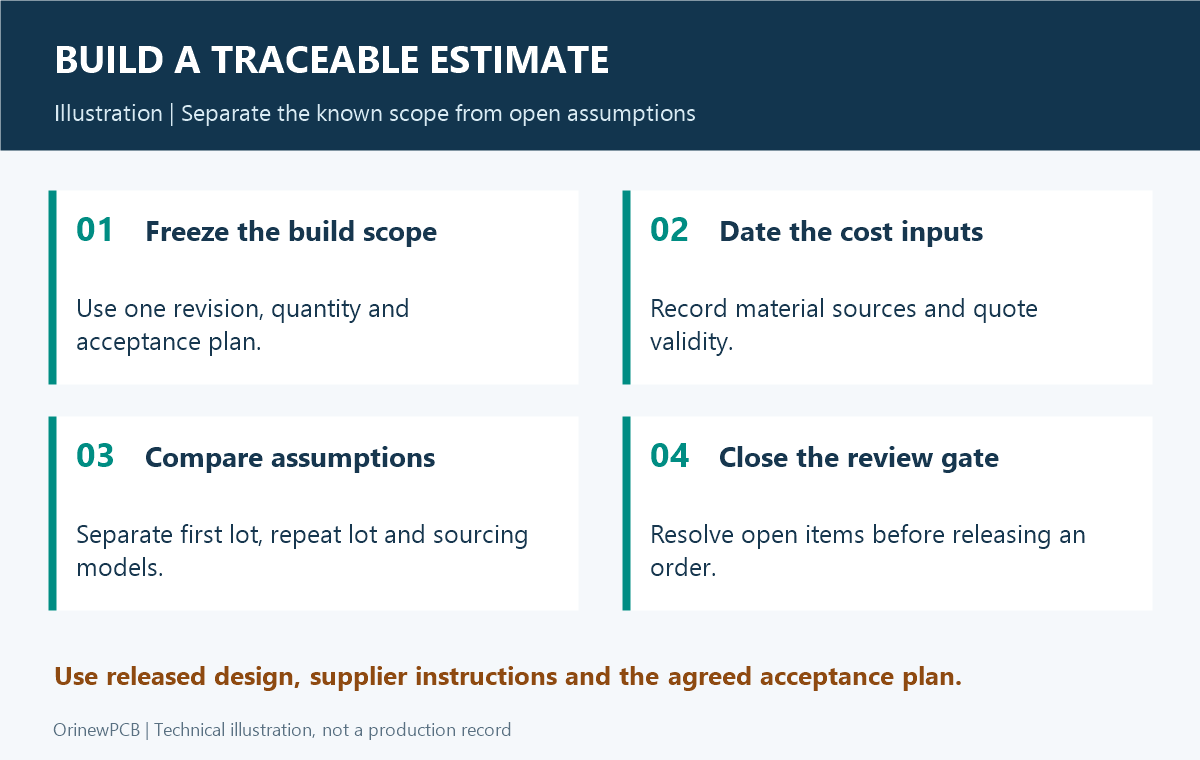
Record a date and source beside each important input. A distributor listing is evidence of an observed price and availability at that time, not a reservation of stock. An unresolved part should remain an open item, with an explicit scenario or allowance, instead of silently receiving a zero cost. Ask who must approve substitutes before purchasing begins.
Build a simple cost model before comparing suppliers
A basic model is: estimated lot total = fixed charges for that lot + quantity × estimated recurring cost per board + separately identified lot expenses. Define the denominator as the ordered quantity and state whether the offer specifies delivered accepted units. Do not assume extra production pieces, rework, or yield losses are included without checking the actual terms.
Recurring inputs may cover boards, components, assembly operations, and per-unit tests. Fixed or lot-specific inputs may include programming preparation, stencil or fixture work, setup, and special packaging. The classification depends on the offer: a charge described as setup can recur on later lots. The PCBA quotation cost breakdown explains the individual line items in more detail.
If the main uncertainty is the build boundary, share the BOM, quantity options, and sourcing responsibilities with the assembly files so the proposed scope and outstanding cost inputs can be reviewed together. A clear list of exclusions is more useful at this stage than an unsupported low unit figure.
Compare first-lot and repeat-lot arithmetic
A PCB assembly cost calculator is useful only when its assumptions remain visible. Consider the fictional example below. Assume a recurring cost of $18 per board, a $600 first-lot setup charge, and no other charges. For the repeat-lot scenario, assume written confirmation that the same setup can be reused at no charge. Hold the design, sourcing, test scope, and recurring rate constant to isolate the arithmetic.
| Scenario | Quantity | Fixed charge | Recurring total | Lot total / unit equivalent |
|---|---|---|---|---|
| First lot, smaller quantity | 100 | $600 | 100 × $18 = $1,800 | $2,400 / $24.00 |
| First lot, larger quantity | 500 | $600 | 500 × $18 = $9,000 | $9,600 / $19.20 |
| Repeat lot, reuse confirmed | 100 | $0 assumed | 100 × $18 = $1,800 | $1,800 / $18.00 |
The larger first lot spreads the same fixed charge over more units, but commits more total cash. It does not prove that buying 500 boards is the better business decision. The example excludes freight, duties, taxes, excess material purchases, financing, storage, and changes. Actual recurring prices may also change with quantity, part availability, and scheduling.
Keep forecast demand separate from a released order. If only 100 units are needed, an attractive 500-unit equivalent may leave inventory exposed to a design change. For that longer planning horizon, use the separate PCBA ownership-cost model for inventory and changes rather than expanding an initial build estimate into an unsupported lifetime forecast.
Normalize turnkey and customer-supplied scenarios
Turnkey sourcing places the agreed purchasing work with the assembler; consignment supplies some or all material from the customer. A partial-turnkey build combines those responsibilities. None of these labels alone establishes the lowest PCB assembly cost. Identify who purchases each material group, pays for required excess, verifies substitutions, and handles shortages before comparing totals.
For a consigned scenario, add customer-purchased components and associated freight to the assembly service amount. Record receiving, kitting, packaging, identification, and shortage responsibilities. Existing stock may avoid a new cash purchase, but it still has a documented inventory value and condition. A zero entry should mean a genuinely excluded cost, not an overlooked responsibility.
For a turnkey scenario, confirm whether quoted material quantities include purchasing minimums or packaging increments and who owns leftovers. Separate material reserved for this lot from a forecast arrangement. Do not assume a supplier’s purchasing scale guarantees the lowest available price, or that customer supply removes all handling and verification work.
Recheck the estimate when the build changes
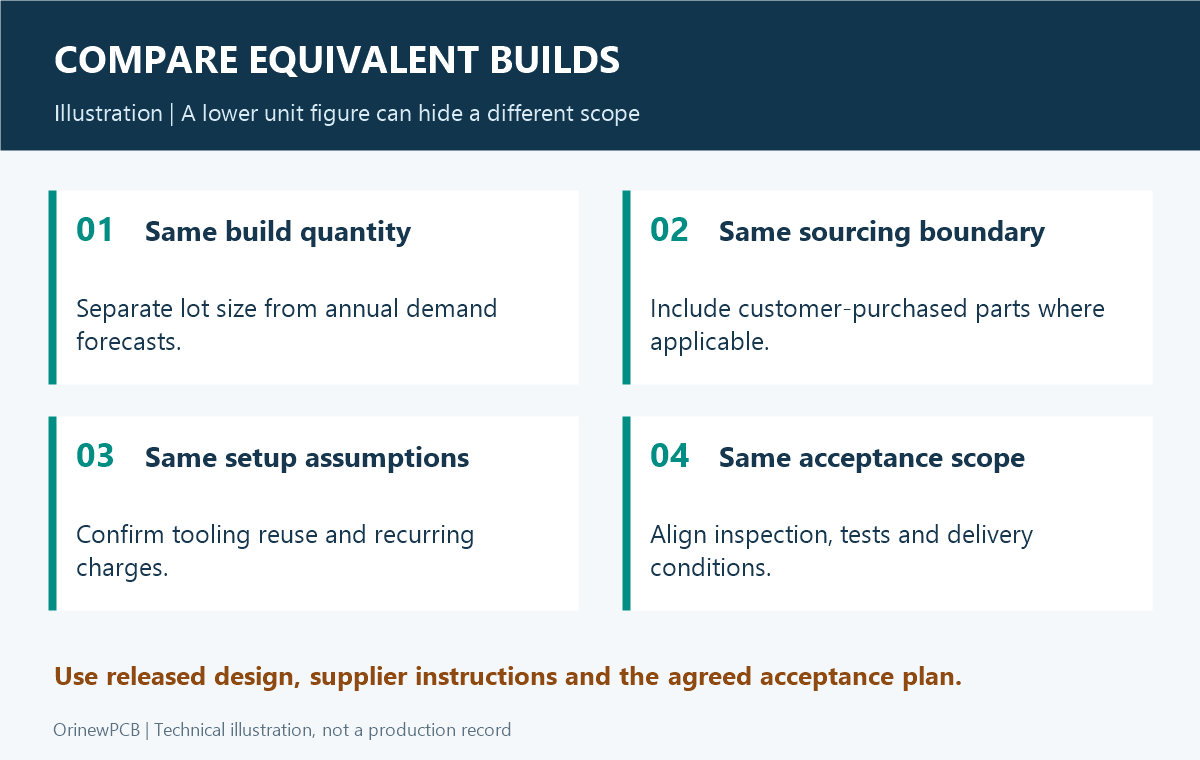
Changes to component packages, populated positions, board construction, assembly sides, through-hole operations, programming, or test access can alter the work. Faster delivery requests may also change sourcing and production assumptions. Ask for a revised estimate when these inputs change; do not reuse an old unit number solely because the product name is unchanged.
Supplier terms illustrate why this matters. MacroFab’s manufacturing service agreement ties pricing to the quoted configuration, volume, and assumptions and identifies exclusions. Those are that supplier’s terms, not OrinewPCB’s. They demonstrate why an estimate should retain its commercial boundary rather than being detached from the conditions that produced it.
The same principle applies to file scope. MacroFab’s platform description illustrates comparisons across order revisions and quantities. Check that fabrication, population, test, and delivery requirements remain aligned whenever you request an updated offer.
The official OrinewPCB video below explains the files and requirements to prepare for a PCB quotation. Use it as an input checklist alongside the estimate assumptions; it does not replace a reviewed project offer.
Frequently asked questions
Can I estimate assembly cost from component count alone?
Component count is an early input, not a complete scope. Package types, assembly sides, manual operations, sourcing, programming, and tests can change the work. Include those conditions before treating an estimate as comparable with a supplier offer.
Does a larger order always reduce the total project cost?
It can spread fixed charges across more units, but a lower unit equivalent can accompany a higher total commitment. Evaluate actual demand, design stability, and material obligations before increasing a lot to obtain a lower displayed unit figure.
What should I prepare before requesting a reviewed estimate?
Prepare aligned fabrication files, the BOM and placement data, assembly drawings, quantity options, sourcing rules, test expectations, and target delivery conditions. Mark unresolved items. For a defined project, provide the controlled build package and open-item list so fabrication, sourcing, assembly, and testing assumptions can be checked together. Retain the resulting scope and validity with the estimate before making an order decision.
Latest Blog

Contact Info
Phone: +86-755-82882936
Email: [email protected]
WhatsApp: +86-13570802455
Wechat: +86-13570802455
Address: 2nd floor,D Bldg.,Electric Link Technology Bldg.,Gongming,Guangming New Dist.,518106 Shenzhen, China
