
PCBA Total Cost of Ownership: Model Inventory and Changes
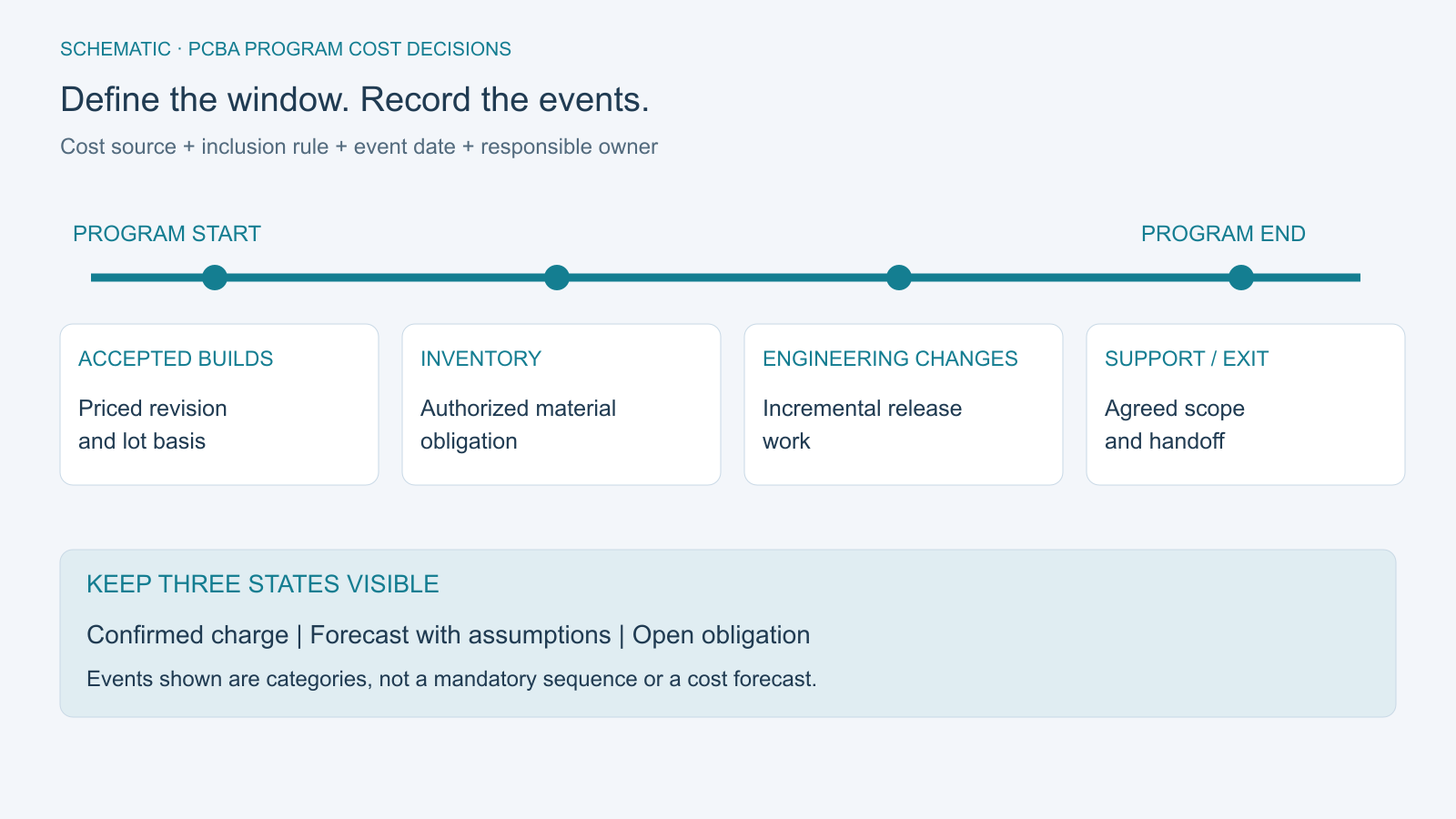
Table of Conent
Table of Conent
PCBA total cost of ownership is the cost of supporting a defined assembly program over a stated period, with a consistent quantity and revision basis. Start with comparable build prices, then add only the inventory, engineering changes, tooling, logistics, and support obligations that belong to that program and are not already included. Keep confirmed charges, forecasts, and unresolved liabilities separate.
The useful question is what a sourcing or engineering decision changes over the remaining program. A lower component price can require qualification, leave unusable stock, or change fixture software. Conversely, an expensive first build may include reusable work. A traceable event ledger makes those differences visible without inventing a universal inventory rate or warranty percentage.
Define the program window and the decision it supports
Define the analysis around a decision, a time window, and the assemblies that decision can affect. An annual sourcing review, a revision change, and a last-time purchase need different boundaries.
NIST MEP’s supply-chain guidance describes total cost of ownership as a view beyond purchase price, including inventory and supply-management consequences. For a PCBA program, turn that principle into a written boundary: included board revisions, accepted units, expected lot dates, delivery point, and the activities retained by the OEM.
Use the PCB quote comparison guide to normalize the purchased build first. This program review then follows what happens between orders and after changes. Keep the original quotations intact; the ownership model is a separate view with dated assumptions, not a replacement supplier offer.
Build a cost ledger that records each event once
Give each cost event one inclusion rule, an evidence source, and an owner. A category list without those controls can count the same material or repair twice.
The GAO cost-estimating guide overview connects scope, a technical baseline, assumptions, data, sensitivity analysis, and updates with actual costs. Those are useful controls for a manufacturing estimate; the guide is not a PCBA price schedule. Apply them with rows that can be traced back to an order, agreement, engineering estimate, or open question.
| Event or obligation | Evidence and inclusion check | Decision to record |
|---|---|---|
| Recurring accepted builds | Released revision, lot quantity, priced scope, and delivered-unit basis. | Include the agreed build charge once; identify what it already covers. |
| Tooling or test development | Separate charge or amortization in unit price; compatible revisions and reuse terms. | Do not add a separately estimated fixture when the same work is already priced. |
| Excess-material commitment | Purchase authorization, unused quantity, owner, cancellation and disposition terms. | Separate cash committed from the treatment of stock that remains usable. |
| Engineering change | Approved delta, affected stock and tooling, validation work, and release date. | Add the incremental work and remove superseded assumptions. |
| Support or recovery | Agreed failure boundary, return process, diagnostic work, repairs, and records. | Check whether the same work is already covered by the purchase terms. |
Keep an explicit “included elsewhere” reference and distinguish a confirmed zero from an unknown. Label estimates with their owner and review date. A missing supplier response is an open item, not evidence that the obligation is free. Retain costs outside the chosen boundary in a separate note so reviewers understand what the total excludes.
Treat inventory as an obligation with an owner
Model inventory from the authorized purchase through consumption, transfer, or disposal. The economic exposure depends on the agreement and future usability, not merely the number of reels on a rack.
For each critical part, connect the manufacturing requirement with the purchased quantity, minimum order or packaging multiple, approved attrition, remaining stock, and release schedule. State who owns the balance and who can authorize a further purchase. Identify whether an engineering change leaves that balance usable on another controlled revision or makes it a disposition question.
Keep cash planning and decision-cost reporting consistent. If the build price already includes consumed components, adding the full component purchase again duplicates that portion. Likewise, do not automatically count every remaining reel as a loss and then add its full disposal value again. Show outstanding commitments, usable closing stock, and the assumed treatment of unusable stock separately, with the program’s finance owner confirming the basis.
Storage, handling, inspection, repacking, financing, or disposal may matter, but each needs a supported assumption. Avoid applying an industry-wide carrying percentage to all materials without knowing what it includes. A supplier-held reel is not automatically supplier-owned, and an OEM-owned reel is not automatically available to a revised assembly.
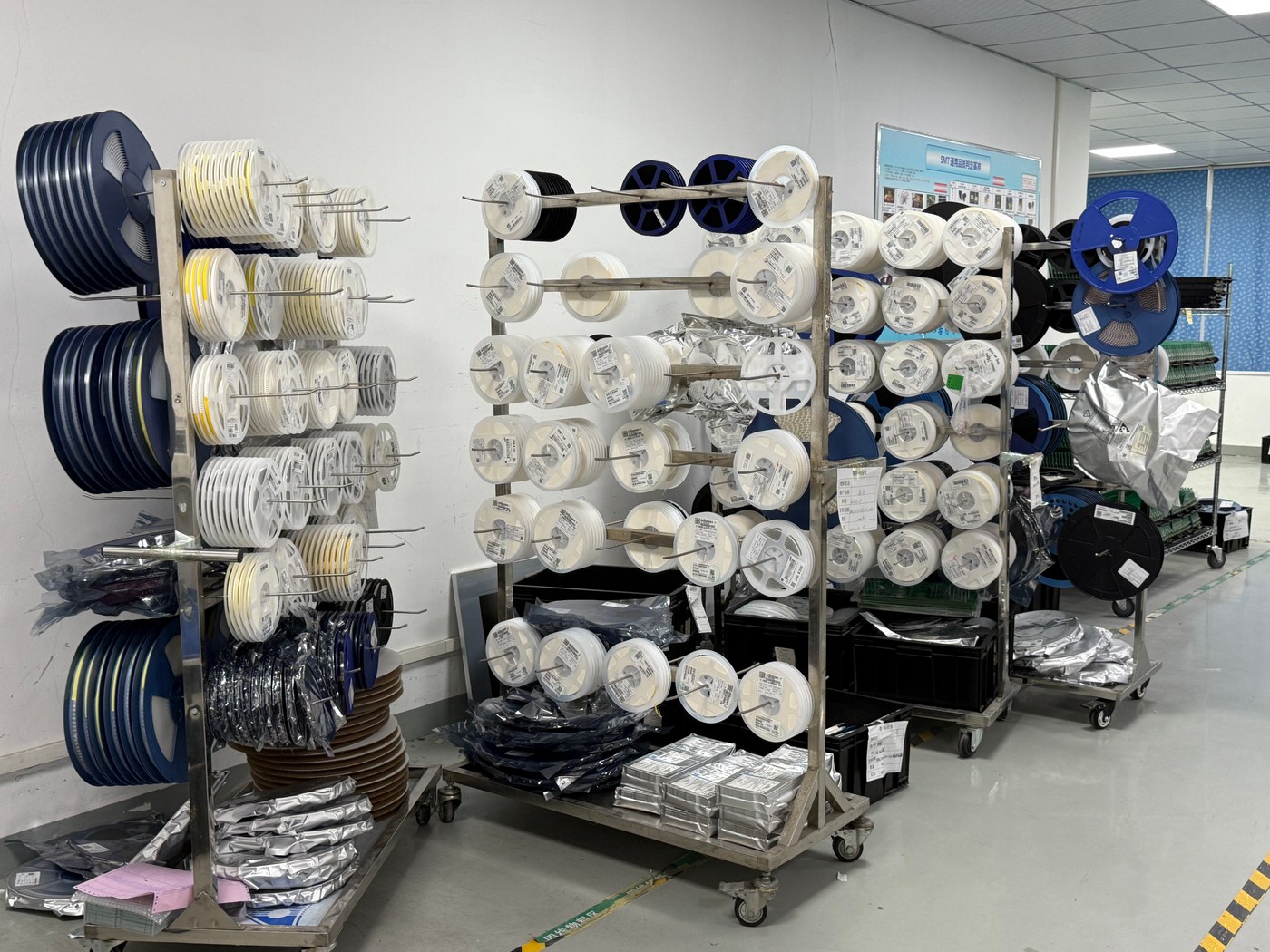
When material commitments are unclear, share the BOM, lot plan, and material-ownership questions with the current fabrication and placement data. OrinewPCB can review the sourcing and assembly assumptions and identify the terms that need confirmation before the program comparison is treated as actionable.
Price engineering changes as complete release events
Compare the full incremental change with the savings it can produce. Part-price reduction alone does not describe the cost of releasing a qualified replacement.
A change record should identify the affected manufacturer part number, board and BOM revisions, remaining stock, proposed approval evidence, and production cut-in. Add any required schematic or layout work, fixture changes, firmware configuration, programming files, test limits, first-article checks, and documentation. Not every change needs all of these activities; each exclusion should have an engineering reason.
TI’s product life-cycle definitions distinguish active, not recommended for new designs, last-time-buy, and obsolete states. Check the relevant product and orderable part information instead of treating a familiar family name as a supply commitment. The component-obsolescence planning guide explains the related sourcing review; here the additional task is to cost and assign the resulting release work.
OrinewPCB’s video below introduces BOM cost-reduction proposals after product finalization. Treat any replacement as a proposal requiring application-specific approval. A matching footprint or a general cost-down presentation does not establish that qualification or regression testing can be omitted.
Keep the old and new configurations distinct until approval and cut-in are complete. The PCB assembly variant-control guide helps connect population options with released data. Reuse of a stencil, fixture, or test program must be confirmed for that configuration; ownership of the tool alone does not establish compatibility.
Test the decision against remaining demand
Use remaining compatible demand to test whether an improvement can recover its incremental cost. Units already produced cannot generate savings from a change that takes effect later.
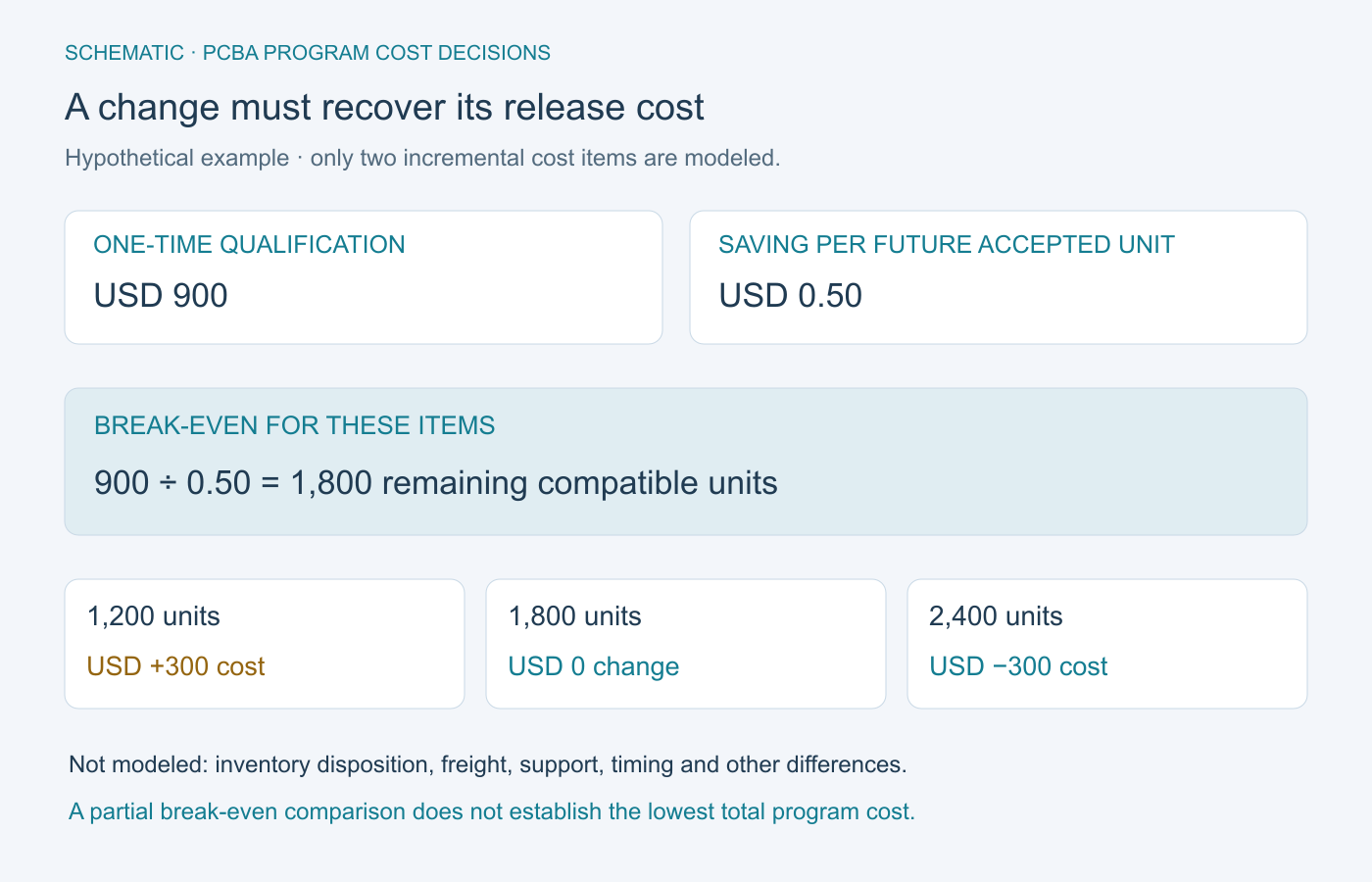
Consider a hypothetical example with a USD 0.50 saving per future accepted assembly and a USD 900 one-time qualification cost. The break-even quantity for these two items is 900 divided by 0.50, or 1,800 units. This is arithmetic for a limited comparison, not a supplier quotation or a complete ownership-cost forecast.
| Remaining compatible accepted units | Gross recurring saving | One-time qualification | Net cost change versus retaining the current part |
|---|---|---|---|
| 1,200 | 600 | 900 | +300: these items increase cost. |
| 1,800 | 900 | 900 | 0: these items break even. |
| 2,400 | 1,200 | 900 | −300: these items reduce cost. |
Inventory disposition, incremental freight, support, timing, and other differences are not modeled in this example. Add their supported deltas before making the complete decision. If the saving is uncertain, test more than one value rather than presenting the 1,800-unit threshold as a commitment. If there is no positive per-unit saving, this simple payback relationship does not establish recovery.
Assign support and exit responsibilities before award
Specify the support deliverable and its end condition instead of assuming an assembly agreement includes indefinite repair, storage, or redesign support.
Ask who diagnoses returns, supplies replacement material, maintains fixture software, retains records, and authorizes rework. Separate manufacturing-defect remedies from design changes, field damage, and extended service requests. If response time or replacement availability matters, obtain a defined proposal; do not invent a standard allowance.
ADI’s life-cycle and discontinuance information identifies product-change and discontinuance notices and fields such as affected models and final purchase and shipment dates. Use the actual notice for the actual part to set a review date. A last-time purchase changes material commitment and support assumptions; it does not itself prove the quantity will be consumed.
For a supplier transfer or program closure, assign tooling transfer, file and software access, residual material disposition, final records, packaging, and any agreed assistance. The cost ledger should show the triggering event, owner, quoted or estimated amount, and unresolved dependency. These terms need confirmation for the specific program.
Keep the program estimate connected to the released build
Maintain the model as a controlled decision record. Update the affected rows when demand, component status, configuration, sourcing terms, or support scope changes, and replace estimates with actual charges when available.
The decision package should retain the baseline, dated cost sources, inventory obligations, change assumptions, scenarios, approvals, and open items. A single-source arrangement can coordinate the full-turnkey PCB assembly scope, but the order still needs explicit ownership and acceptance terms. A program estimate is useful only while it describes the build and responsibilities that will actually be executed.
For a program review, provide the controlled build files and program assumptions through OrinewPCB’s inquiry form. Include fabrication data, BOM, placement files, quantities and lot timing, test requirements, and unresolved inventory or change responsibilities so manufacturing, sourcing, assembly, and the requested verification scope can be assessed together.
Sources accessed October 21, 2026. All numerical cost scenarios are hypothetical; confirm current part notices, quotations, and program-specific obligations before release.
Latest Blog
Contact Info
Phone: +86-755-82882936
Email: [email protected]
WhatsApp: +86-13570802455
Wechat: +86-13570802455
Address: 2nd floor,D Bldg.,Electric Link Technology Bldg.,Gongming,Guangming New Dist.,518106 Shenzhen, China