
UL 796 for PCBs: Verify Recognition and Markings
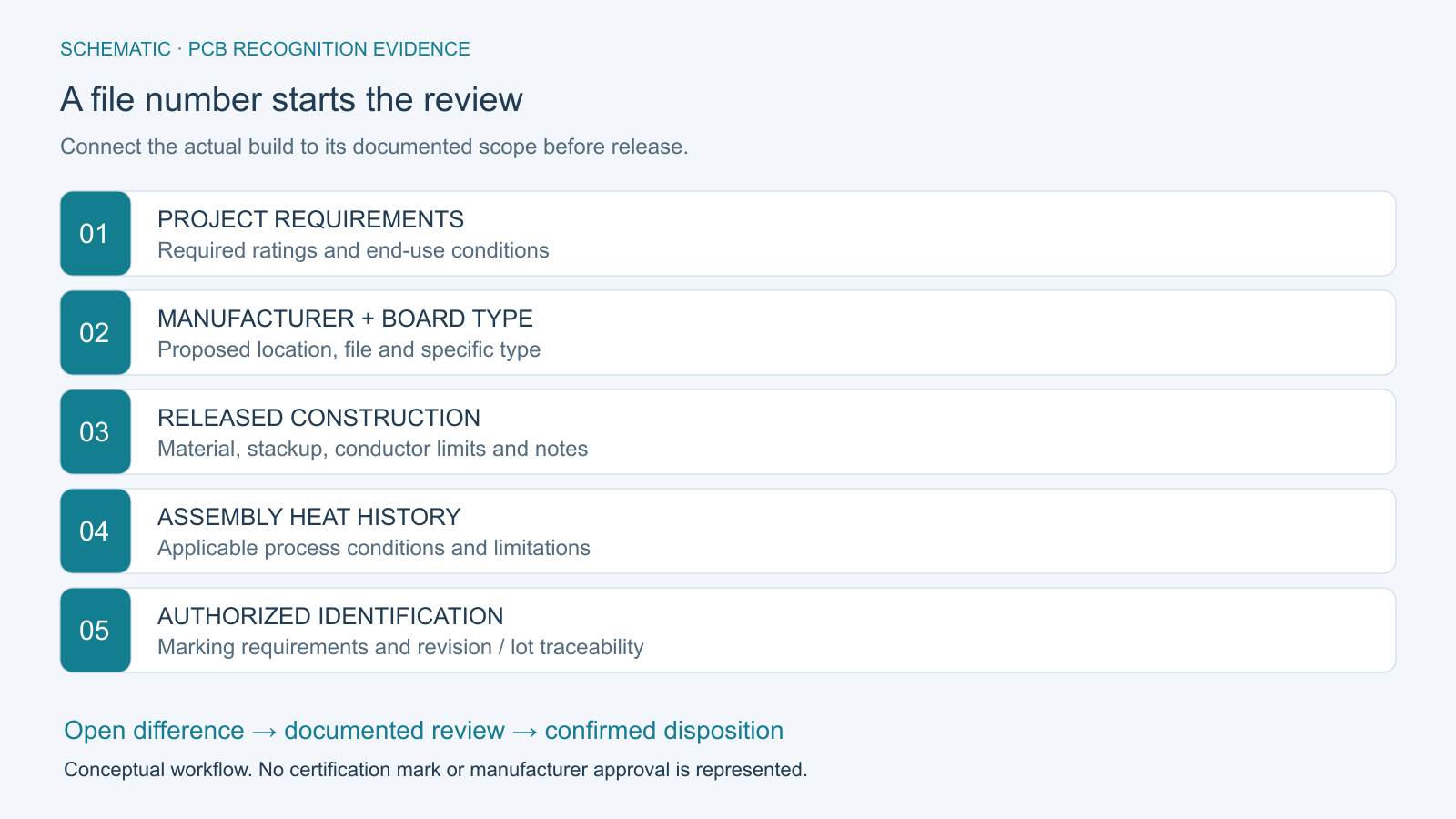
Table of Conent
Table of Conent
UL 796 PCB recognition should be checked against the board construction and manufacturing route you intend to buy. Start with the proposed fabricator, manufacturing location, file and board-type identification, then compare the documented ratings and limitations with the released design and assembly process. A file number or a V-0 statement alone does not complete that comparison.
Keep three questions separate: what is known about the material, what is recognized about the printed wiring board, and what the finished product must satisfy. For a purchasing team, the useful outcome is a traceable match between requirements and evidence, with unresolved differences closed before production. This guide explains that review without treating a database search as approval of an end product.
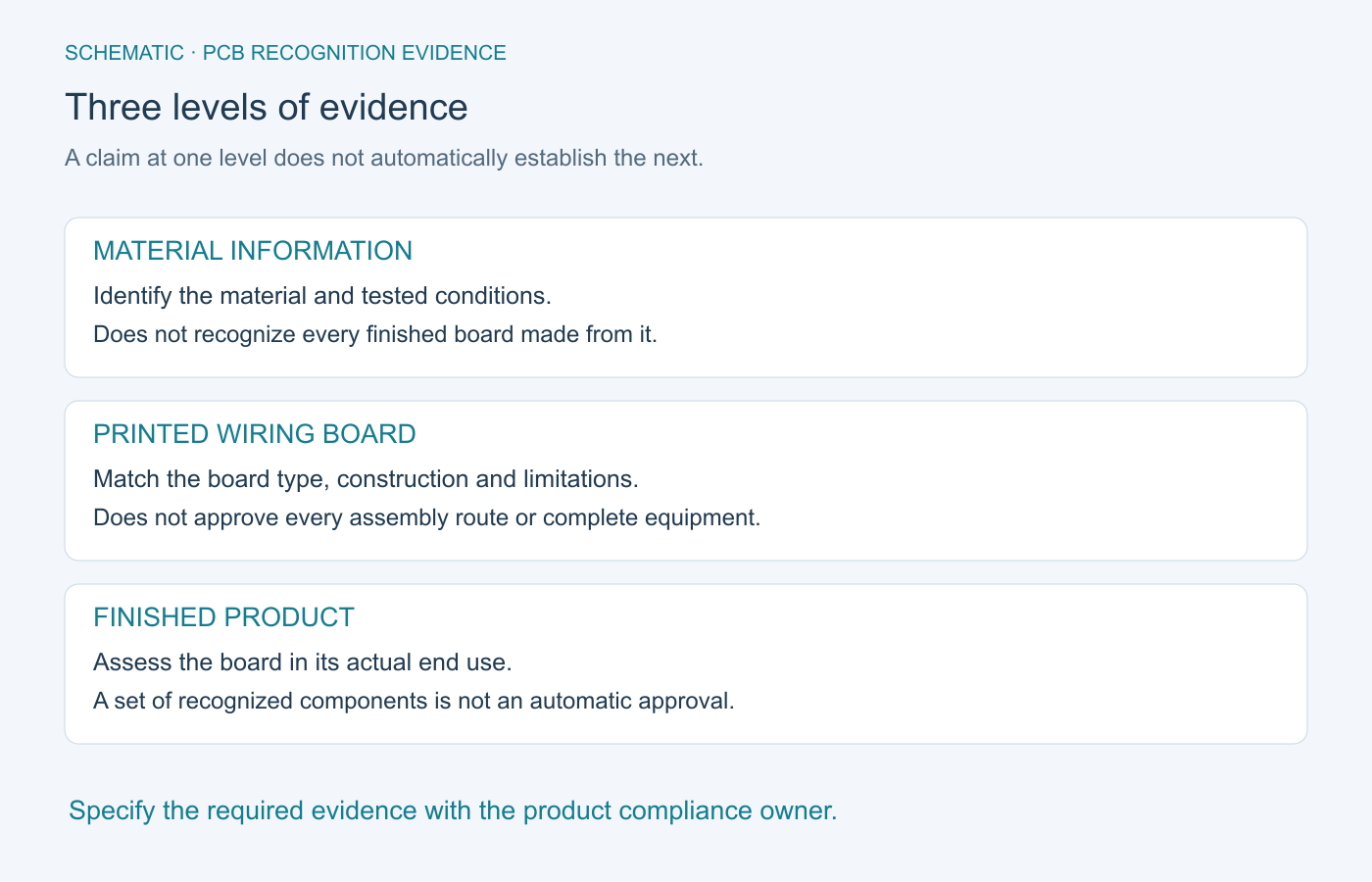
Separate material ratings, board recognition, and product approval
Use evidence at the level of the claim being made. A material classification, a recognized board construction, and a finished-product assessment answer different questions.
The UL Component Recognition explanation states that recognized components are evaluated for use within a larger product under defined conditions of acceptability. Recognition is not certification of a complete standalone product. Establish the required board ratings with the product’s compliance owner before translating “UL required” into a purchase specification.
| Evidence level | What to verify | What it does not establish by itself |
|---|---|---|
| Material or flammability information | The identified material and the applicable tested classification and conditions. | Recognition of any finished board made from a material carrying the same generic description. |
| Printed wiring board recognition | The identified board type, documented construction, ratings, limitations, and authorized manufacturing arrangement. | Suitability of every layout or every assembly process, or approval of the complete equipment. |
| Finished-product assessment | The applicable end-use requirements and how the board is employed in that product. | An automatic conclusion inherited from a collection of recognized components. |
For example, a hypothetical purchasing note reading “FR-4, V-0, UL” leaves several decisions open. Which material and board type are proposed? What operating conditions are required? Which assembly process will the board experience? Replacing those shorthand terms with explicit requirements gives the fabricator something concrete to confirm.
Match the supplier identity to an actual board type
Identify the proposed manufacturing arrangement and board type before reviewing ratings. A familiar trading name or an old certificate image is not enough to establish which construction will be supplied.
The official UL iQ PWB search provides fields including category, type/material designation, file number, company, and country. Start with the supplier’s specific identification, then resolve differences between the quotation, the database entry, and the manufacturing location named in the supporting documentation.
Record the lookup date, the entry or report reference, and the exact type designation proposed for the order. Read linked notes and request the necessary scope information when the public entry is only a summary. Do not infer that every plant associated with a corporate group is interchangeable.
A useful supplier response connects the identifiers: this manufacturer and location will produce this board revision using this documented construction. If the order passes through an assembly partner, establish who is responsible for supplying the bare-board recognition evidence. Keep that responsibility visible when comparing quotations.
Compare the released construction with the recognition evidence
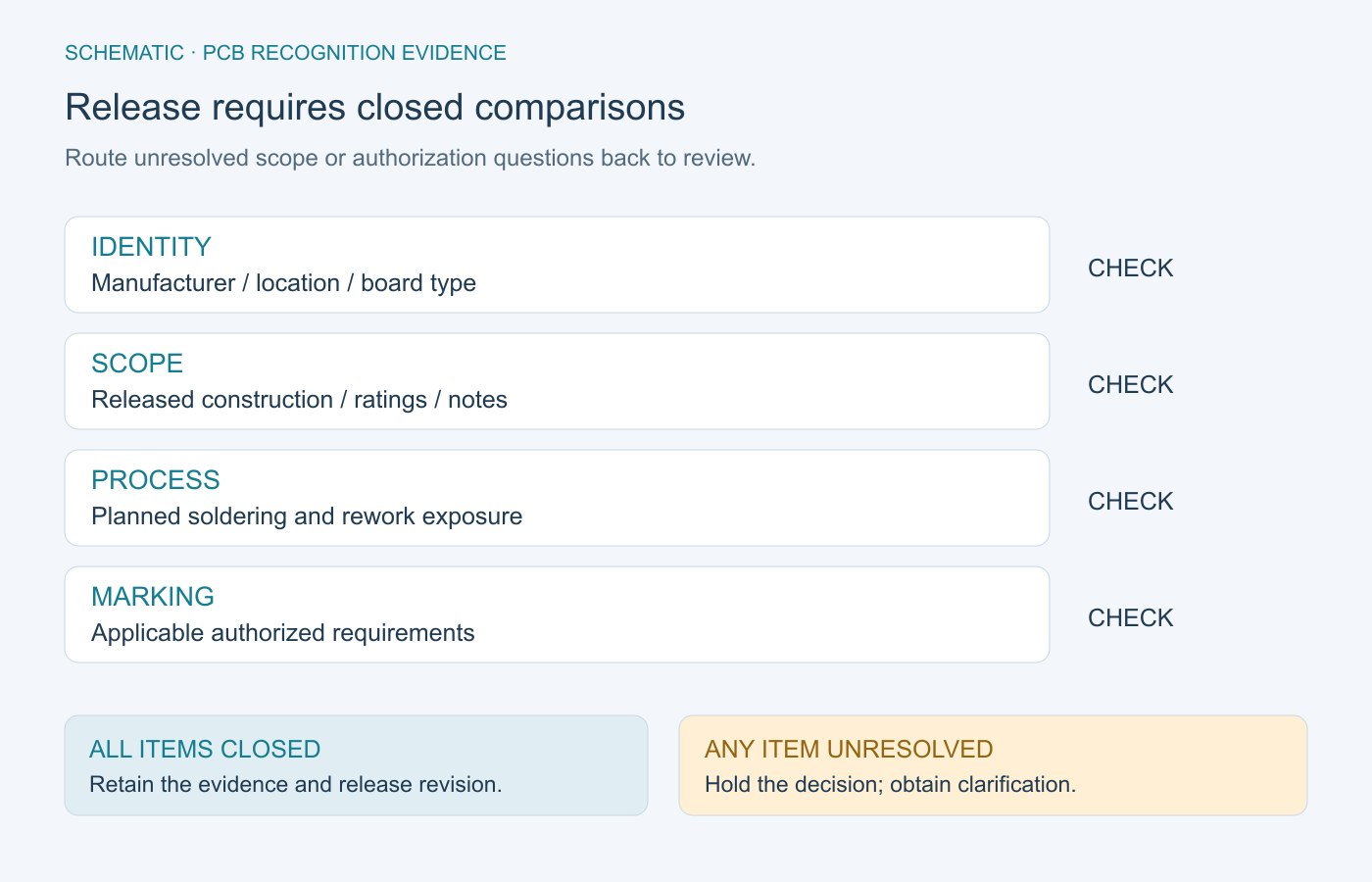
Compare requirements field by field and treat unexplained differences as open items. Finding a company in the database starts the review; it does not finish it.
A public PWB record example illustrates the structure: a type designation is accompanied by conductor-related limits, assembly solder process fields, operating temperature, flame class, and notes. That entry belongs to another manufacturer and is used here only to illustrate record structure, not as an OrinewPCB file or a sourcing recommendation.
| Review item | Evidence to compare | Decision before release |
|---|---|---|
| Manufacturer and board identity | Proposed manufacturing arrangement, file, type designation, and applicable supporting documents. | Resolve any identity or site mismatch. |
| Released construction | Actual material, stackup, thickness, and conductor construction against documented scope and notes. | Obtain confirmation for the exact build; do not substitute a generic laminate name. |
| Required ratings | End-use requirements against the applicable operating-temperature and flammability information. | Refer unmet or unclear conditions to the responsible compliance reviewer. |
| Assembly exposure | Planned soldering operations against the applicable assembly-profile and solder-limit information. | Close any unsupported thermal exposure before assembly. |
| Identification and delivery | Authorized marking requirements and the agreed revision/lot documentation. | Make the delivered board traceable to the approved evidence. |
If a proposed build cannot yet be matched to the requirement, share the construction and recognition requirements with the fabrication data, stackup, quantity, and known constraints. OrinewPCB can review the requested manufacturing and assembly scope and identify the evidence needed from the proposed supply route; this review does not replace certification authority.
Preserve units and note references in the comparison. A value copied without its construction note can describe a different case. When a field is absent or ambiguous, obtain the relevant report detail or written clarification rather than filling the gap with an assumption.
Connect the recognition to the assembly heat history
Check thermal exposure separately from the board’s operating-temperature rating. A maximum operating temperature and an assembly soldering condition describe different parts of the board’s use.
The UL assembly-profile guidance explains why assembly solder process temperature and cycles are useful preselection parameters. Its published example has particular ratings; those example values are not universal allowances for every recognized board.
Prepare a process history covering the intended soldering operations and any planned repair or rework exposure. Ask the responsible reviewers how those operations relate to the recognized conditions. Do not assume that an extra oven pass is covered, or that every heating operation counts identically under the applicable evaluation.
As a hypothetical example, a team approves a construction using the original assembly sequence, then adds a second-side operation and a repair allowance. The material designation and drawing title remain unchanged, but the process assumption has changed. Recheck the applicable thermal evidence before releasing the new route.
Keep the measured or controlled process information with the assembly revision. If the proposed sequence exceeds documented coverage, the next action is a confirmed alternative or an appropriate further evaluation. A lower purchase price does not close the technical difference.
Approve the marking through the authorized manufacturer
Approve board identification from the applicable authorization and marking requirements. Do not construct a marking by copying a symbol or file identifier from an unrelated board.
The UL report and Follow-Up Service guide explains that authorization information identifies the relevant parties and that the Recognized Component Mark data page outlines authorized marking requirements. Follow that documentation rather than assuming one universal combination of symbols and text is required on every board.
Reserve a suitable identification area and agree who supplies the approved artwork, who checks it, and how it is tied to the manufacturing route. Separate the customer’s board number and revision from the manufacturer’s recognized identification so both remain interpretable. Review legibility and placement on the actual finished board, including later assembly operations that may cover the area.
The PCB silkscreen design guide helps coordinate readable identification with assembly features. It does not determine authorization to use a certification mark. Keep the approved identification drawing with the order and retain a first-article check against that version.
Handle sourcing changes as evidence changes
Review a supplier, site, material, or process change against the evidence it affects. An unchanged schematic does not prove that the replacement manufacturing route has the same recognition coverage.
Use the UL Product iQ verification overview to locate certification and guide information. If access or a record’s interpretation prevents a reliable conclusion, obtain confirmation from the relevant supplier and UL Solutions rather than treating a missing search result as proof of approval or rejection.
Keep a change log showing the previous route, proposed route, affected construction or process details, evidence reviewed, and the person closing the difference. The PCB assembly variant-control guide helps keep fitted options and release data aligned; a product variant name is not a substitute for the relevant recognized board type.
For incoming acceptance, connect the delivered lot and board revision with the agreed manufacturer identification and supporting documents. Investigate mismatches before consuming the lot in a larger assembly. Define the disposition through the quality and compliance process; do not improvise a new marking to make the paperwork appear consistent.
Close the purchase order with a traceable acceptance package
Release the order when the required ratings, manufacturing identity, construction, assembly conditions, and authorized identification agree. Keep open items explicit until the responsible parties close them.
The PCB assembly drawing checklist can carry the practical drawing requirements, while the full-turnkey PCB assembly scope helps coordinate fabrication, sourcing, and assembly. Neither document alone establishes a particular UL recognition.
For a project review, provide the controlled PCB and assembly package through OrinewPCB’s inquiry form. Include fabrication files, stackup, BOM, placement data, quantity, required ratings, proposed thermal route, and identification/documentation requirements so the build and its unresolved supply assumptions can be assessed together.
Official resources accessed October 21, 2026. Verify the applicable current records and project-specific requirements at release; this article does not assert UL recognition for OrinewPCB or any proposed customer construction.
Latest Blog
Contact Info
Phone: +86-755-82882936
Email: [email protected]
WhatsApp: +86-13570802455
Wechat: +86-13570802455
Address: 2nd floor,D Bldg.,Electric Link Technology Bldg.,Gongming,Guangming New Dist.,518106 Shenzhen, China