
Labeling Controller PCBA Traceability: Preserve Unit History
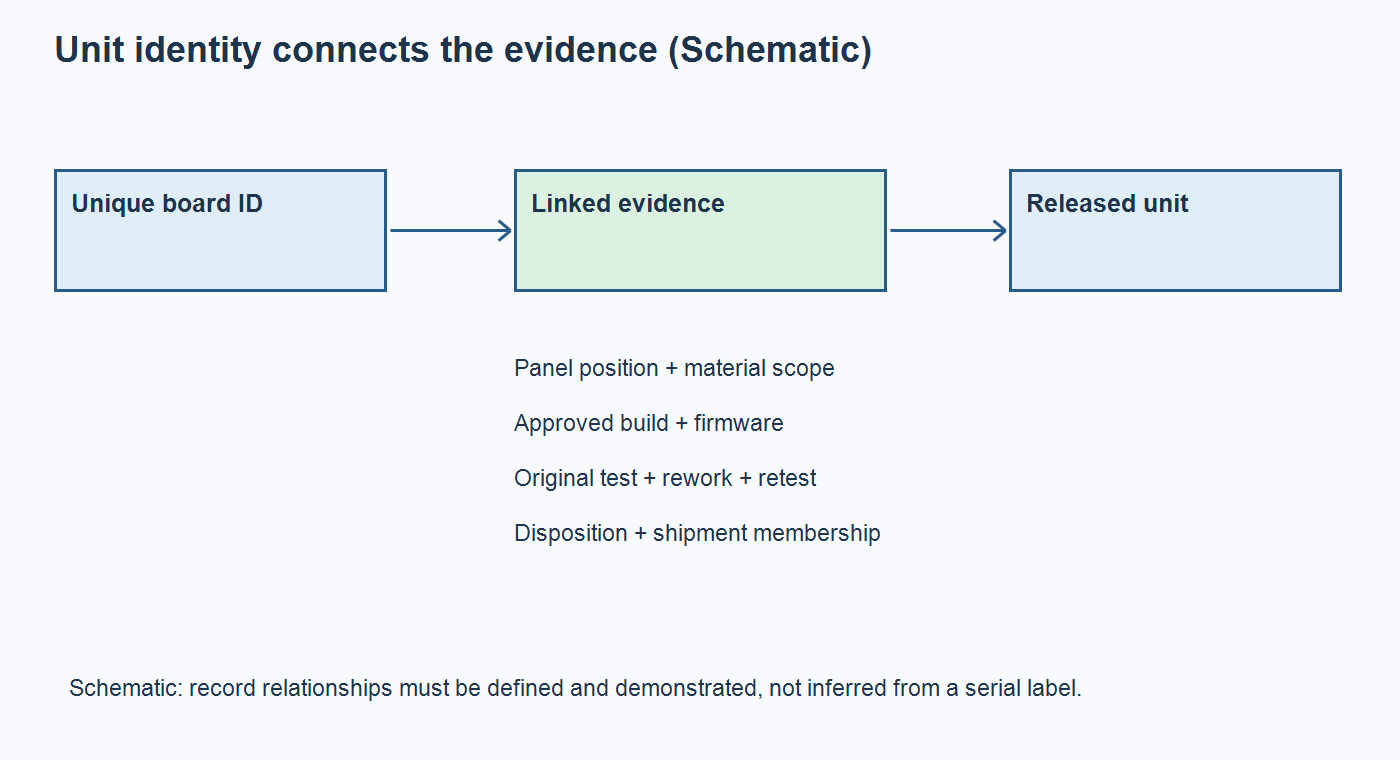
Table of Conent
Table of Conent
Labeling controller PCBA traceability should connect each shipped board to its approved build configuration, material records, programming history, and release evidence. A serial number provides an identity; it does not establish those relationships by itself. For an OEM investigating intermittent encoder inputs or a suspect component lot, the useful question is whether the records identify the affected units and explain what was installed when each unit left production.
Define the required traceability scope before ordering assembly. Unit-level component genealogy requires a reliable link between material consumption and individual boards; a work-order material issue alone may support only a larger candidate population. Rework must retain earlier failures while identifying the final approved configuration and retest. The following method separates those evidence levels and turns them into purchasing requirements. The unit codes and event examples are hypothetical, not OrinewPCB production records or a claim that every assembly order includes this capture depth.
Define the unit and the traceability boundary
Choose an identity that survives the manufacturing and service steps you need to investigate. A panel identifier, a finished PCBA serial number, and the labeling machine serial number describe different objects. Record their relationships rather than treating them as interchangeable.
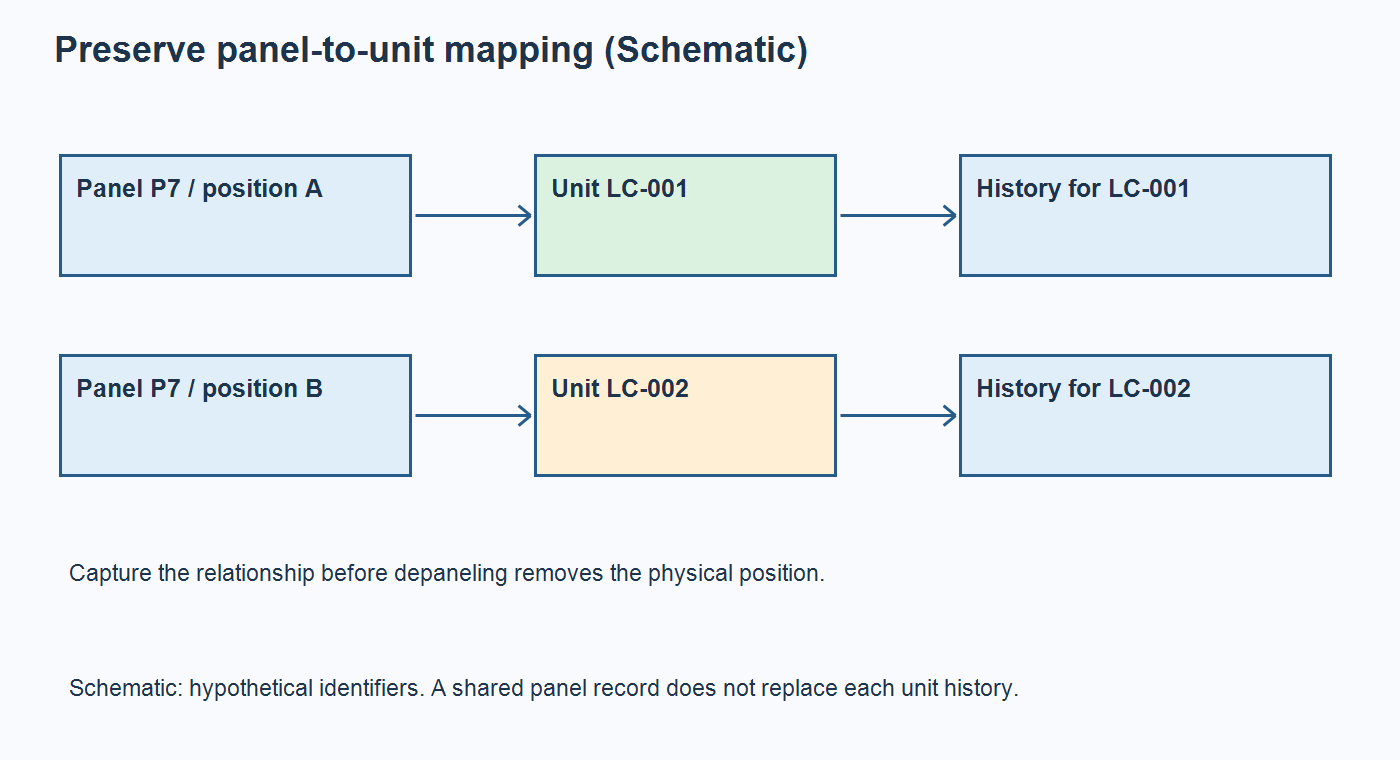
For example, map panel P7 position A to board LC-001 and position B to LC-002 before depaneling removes the positional evidence. Specify how the unit identity remains readable after cleaning, coating, enclosure assembly, and service. If a physical board is replaced, issue an appropriate new board identity and retain its relationship to the removed board and host machine; reusing the old identity can conceal a configuration change.
The public contents of IPC-1782B, September 2023, distinguish material and process traceability and include risk assessment, user agreement, programming, and repair/rework topics. That contents document is not the complete standard. Agree the applicable contractual edition, boundaries, and deliverables; citing a standard name does not establish a particular capture level or prove conformance.
Keep product-label data separate from controller manufacturing history. A labeling machine may print product batch codes, but that does not automatically identify the material lots, firmware, or tests associated with its own controller board.
Link panel, material, and configuration records
Require explicit relationships between identifiers and retained evidence, with a stated resolution for each relationship. A file containing many serial numbers is less useful than a smaller record set whose joins and limitations can be demonstrated.
| Investigation question | Required relationship and evidence | Boundary to specify |
|---|---|---|
| Which design was built? | Unit to released PCB revision, BOM revision, approved substitutions, and assembly instructions | Distinguish planned baseline from approved as-built differences |
| Where did this unit originate? | Panel and position to unit identity, plus fabrication and assembly lot references | Preserve the mapping before depaneling or relabeling |
| Which units may contain a suspect part? | Manufacturer part number and material lot to consumption records and candidate units | State whether evidence resolves individual placements, panels, or work orders |
| What software and tests applied? | Unit to programmed artifact identifier, programming result, test procedure revision, limits, and result records | Separate a file version name from an independently identifiable binary |
| What was delivered? | Released unit to packing list, shipment, customer order, and later service changes | A carton identity needs a retained unit membership list |
For test evidence, define the board identity, fixture or station identifier, procedure revision, relevant measurements, limits, disposition, and record location. The labeling PCBA inspection and test coverage guide explains why AOI, X-ray, and electrical tests answer different defect questions. Traceability preserves their evidence; it does not make an incomplete test detect more faults.
A controlled export should include stable keys and a field dictionary, not just screenshots from a supplier dashboard. Identify which records the OEM receives, which remain at the assembler, and how the references can be retrieved after a system migration.
Preserve uncertainty at material-lot changes
Do not report exact unit-to-component genealogy when the capture method supports only a candidate population. A reel-change timestamp and a board completion timestamp are not necessarily enough to prove which lot supplied a particular placement.
Suppose lot A and lot B of the same encoder-interface device were issued to one work order. The records show a reel change, but do not link individual placements or feeder consumption to board identity. Buffers, partially completed panels, and off-line rework may break a simple time-based join. Both lots may therefore remain candidates for the units within the uncertain boundary.
When deciding between work-order and unit-level evidence, submit the proposed lot-to-unit capture requirements with the BOM, planned quantities, and containment questions to OrinewPCB so the manufacturing review can confirm the recording scope and quotation assumptions.
Containment should use the defensible candidate set until additional evidence narrows it. Record why a unit was included or excluded, the applicable part number and reference designators, the process boundary, and any unresolved uncertainty. If exact per-unit attribution is necessary, specify the required capture and reconciliation method before production; software cannot reconstruct a relationship that was never recorded.
Record rework, programming, and retest as events
Keep the sequence of changes and results, then derive the released configuration from that sequence. Replacing an earlier failure with the latest pass loses evidence needed to understand recurring faults and repair effectiveness.
| Event | Recorded change or observation | Release implication |
|---|---|---|
| E01: initial test | Encoder-input test fails under procedure T3; original measurements retained | Unit remains on hold |
| E02: authorized rework | U13 removed; replacement part and lot recorded against the approved instruction | Original and replacement material relationships remain distinguishable |
| E03: programming | Approved firmware artifact identifier and programming/verification result recorded | Identify the configuration used for subsequent testing |
| E04: retest | Applicable tests pass under the recorded procedure and limits; linked to E02 and E03 | Supports release review without deleting E01 |
| E05: disposition | Authorized release identifies accepted configuration and linked evidence | A pass alone is not the entire release record |
Record the time the operation occurred separately from the time a system received its record, using unambiguous time-zone information. A delayed upload must not silently reorder the physical history. Keep the event identity, responsible role, authorization reference, and evidence location sufficient for the agreed review.
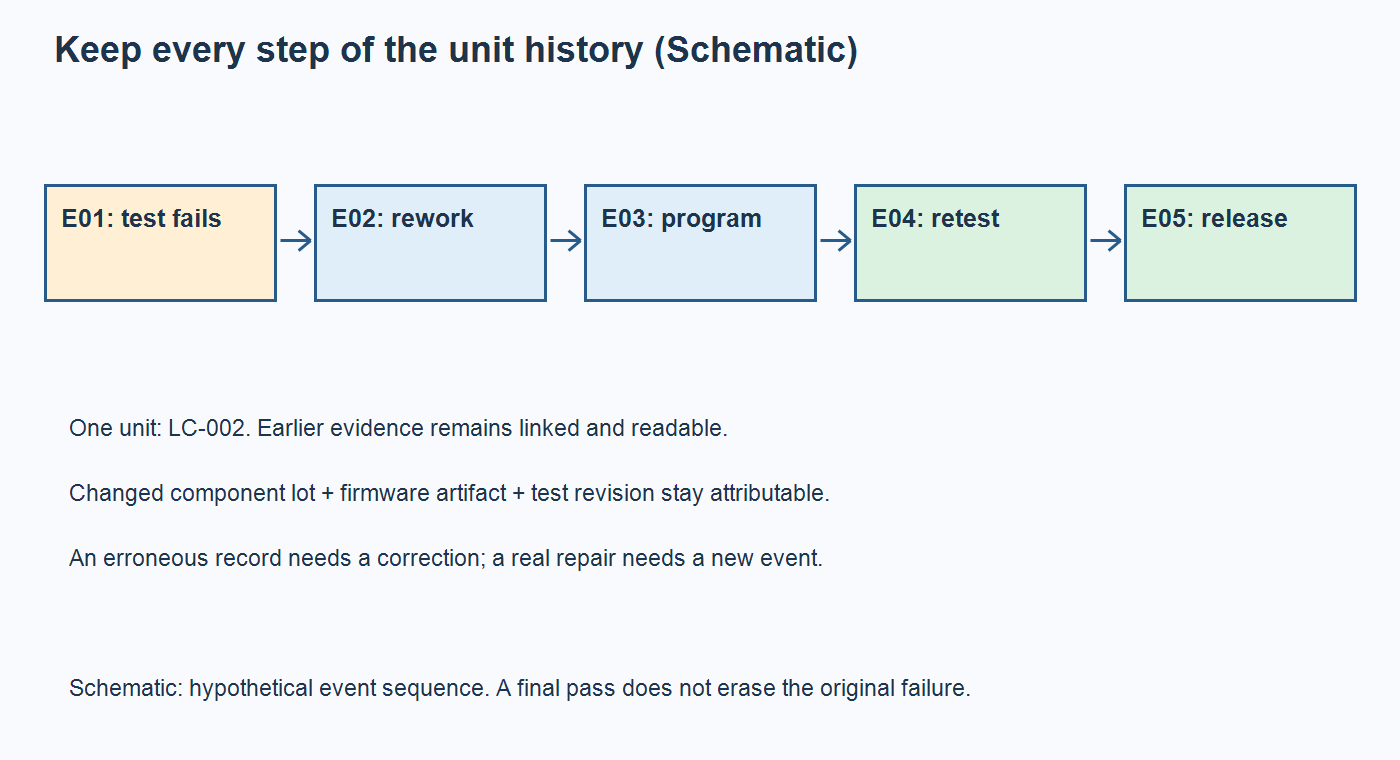
Correcting an erroneous record is different from performing a repair. GS1 EPCIS, Release 2.0, June 2022, provides an example of preserving earlier assertions while identifying errors and corrective events. This is a useful design principle, not a requirement to deploy EPCIS or a claim that this example implements its schema. A real component replacement belongs in the operational history; a mistyped lot code needs an attributable correction linked to the original record.
Prove the record chain with two retrieval challenges
Test both directions of the relationship before accepting the reporting scope. A successful serial-number lookup does not prove that a supplier can identify all units associated with a suspect material lot.
First, choose a released unit, preferably one with authorized rework. Retrieve its panel relationship, baseline revisions, material scope, substitutions, firmware artifact, original failure, repair, retest, and release evidence. Check that the final configuration agrees with the shipment record and that earlier configurations remain interpretable.
Second, select a material lot and retrieve its candidate unit population, including units that received the material during rework. Distinguish units that originally contained the lot, units from which it was removed, and units believed to contain it at shipment. Those populations answer different containment questions. Reconcile unused stock and consumption exceptions separately rather than treating every issued component as installed.
Agree measurable retrieval criteria with the supplier: the test dataset, output format, access owner, response window, treatment of missing data, and pass/fail conditions. Do not select an arbitrary universal retention period. Tie retention and post-contract access to service needs, customer obligations, and the negotiated agreement. Retest the retrieval method when identifier rules or data systems change. Preserve the agreed field definitions with each exported record set.
Specify traceability outputs before the assembly order
Include the traceability deliverable in the assembly scope so its cost, responsibilities, and limitations can be reviewed alongside the build. Separate basic lot records from individual placement genealogy, detailed test exports, and long-term retrieval services.
The labeling controller release package provides the design and interface baseline to which these records attach. OrinewPCB’s full turnkey PCB assembly service provides a route for reviewing fabrication, sourcing, and assembly together; specialized traceability depth and record delivery still need explicit agreement.
A useful unit history preserves identity, uncertainty, and change. It shows both the approved shipped configuration and the evidence that led to release, while supporting a defensible reverse search when a material concern arises. That is the difference between attaching a code and purchasing an investigation capability.
For a complete controller build assessment, send the assembly files and traceability acceptance package to OrinewPCB with Gerbers, BOM, placement data, firmware/test requirements, quantities, and the two retrieval challenges so sourcing, assembly, recording responsibilities, and quotation scope can be reviewed together.
Latest Blog
Contact Info
Phone: +86-755-82882936
Email: [email protected]
WhatsApp: +86-13570802455
Wechat: +86-13570802455
Address: 2nd floor,D Bldg.,Electric Link Technology Bldg.,Gongming,Guangming New Dist.,518106 Shenzhen, China