
RoHS 3 for PCBs: Build Material Evidence Before Assembly Release
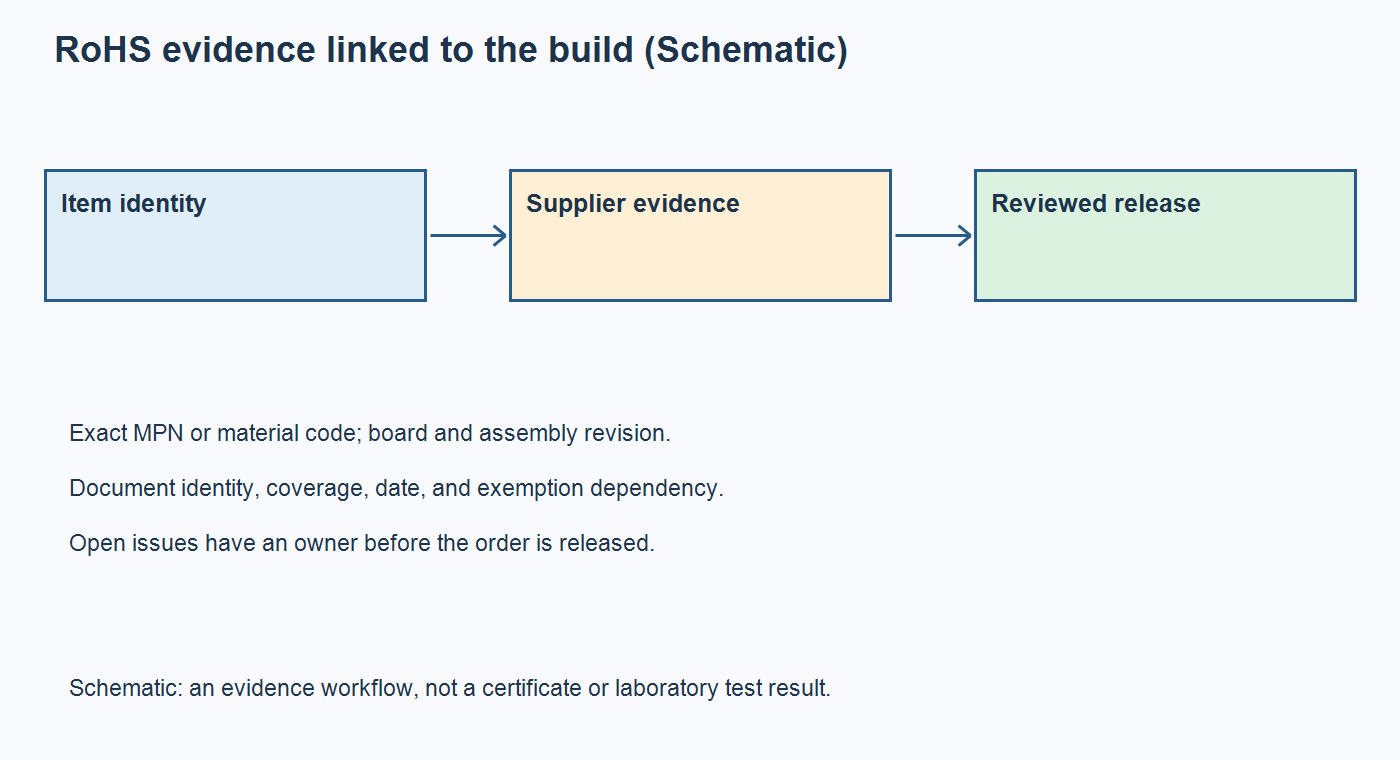
Table of Conent
Table of Conent
RoHS evidence for a PCB or PCBA must identify the materials and parts in the released build, the applicable substance limits, and any exemption being relied on. A lead-free solder process or a compliant surface finish covers only part of that question. Do not average a restricted substance across the whole board, and do not assume a bare-board supplier statement establishes conformity of the completed equipment.
For an OEM buying assemblies for an EU product, the practical deliverable is a revision-linked evidence file: exact component and material identities, supplier declarations or other supporting records, an exemption assessment where needed, and a process for reviewing changes. This guide uses the EU RoHS framework and sources checked on October 22, 2026. The product owner must establish the equipment’s scope and application; the purchasing worksheet below helps communicate that decision through fabrication, sourcing, and assembly.
Use the homogeneous-material limit, including the lower cadmium limit
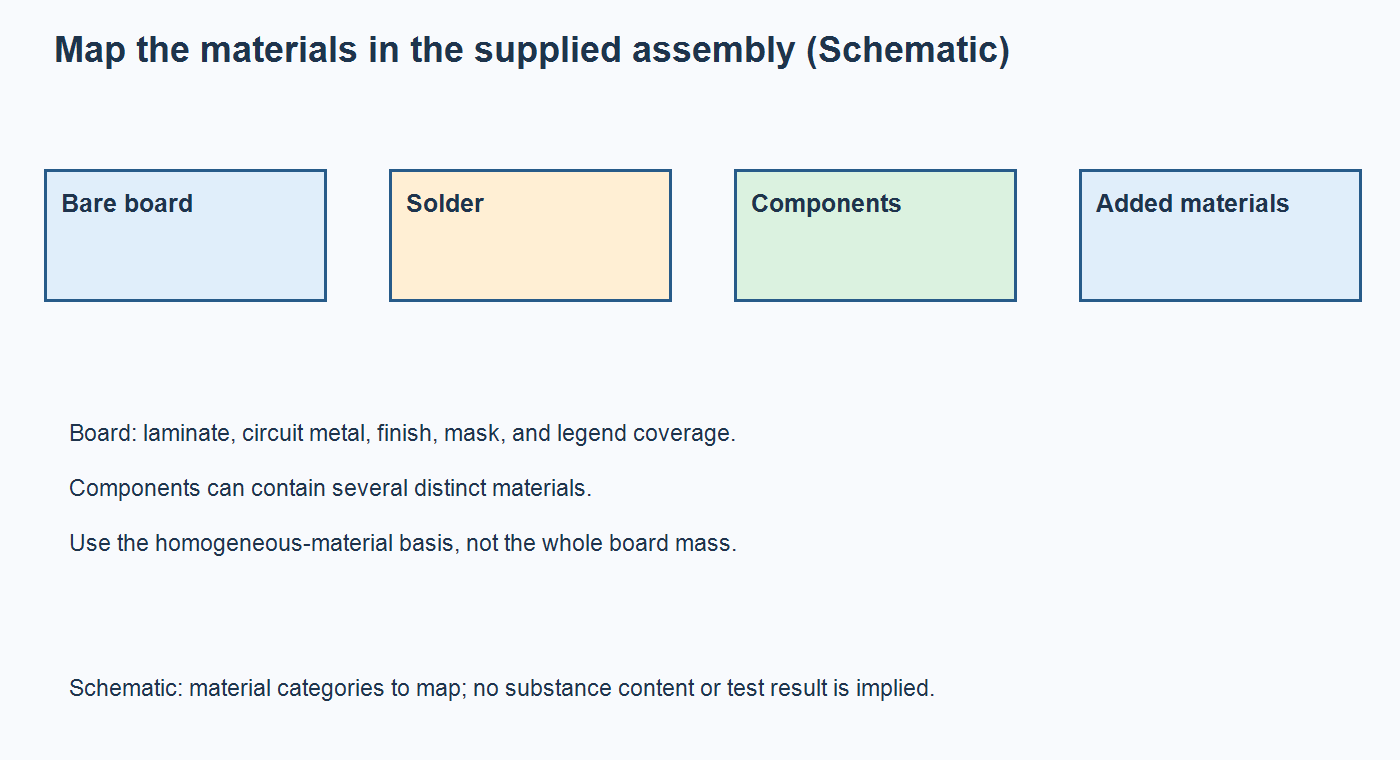
The concentration basis is the individual homogeneous material, rather than the mass of the assembled board. A homogeneous material is compositionally uniform, or cannot be mechanically separated into different materials. A component can therefore contain several materials that need consideration.
The July 2026 consolidated RoHS text, Article 4 and Annex II, gives the following maximum values by weight. One percent equals 10,000 ppm, so the cadmium limit is 100 ppm, while the other listed limits are 1,000 ppm. These limits are subject to the applicable scope and exemption provisions.
| Substance or substance group | Maximum by weight | Equivalent ppm |
|---|---|---|
| Lead | 0.1% | 1,000 |
| Mercury | 0.1% | 1,000 |
| Cadmium | 0.01% | 100 |
| Hexavalent chromium | 0.1% | 1,000 |
| Polybrominated biphenyls (PBB) | 0.1% | 1,000 |
| Polybrominated diphenyl ethers (PBDE) | 0.1% | 1,000 |
| Bis(2-ethylhexyl) phthalate (DEHP) | 0.1% | 1,000 |
| Butyl benzyl phthalate (BBP) | 0.1% | 1,000 |
| Dibutyl phthalate (DBP) | 0.1% | 1,000 |
| Diisobutyl phthalate (DIBP) | 0.1% | 1,000 |
RoHS 3 is commonly used for the addition of four phthalates through Directive (EU) 2015/863 to the RoHS framework. It is more useful in a purchase specification to identify the applicable directive and amendments than to request an unexplained RoHS 3 certificate. The European Commission’s RoHS overview identifies all ten restricted substances.
As a procurement example, a connector may have a metal contact, contact finish, and polymer housing. A declaration should clearly cover the ordered connector, rather than only its housing resin. Adding that connector’s mass to the PCB mass does not provide a valid way to dilute a material-level result.
Map the evidence to what the assembler will actually build
Build an evidence index around exact purchased identities. A supplier logo, a generic green-product statement, or a finish name is difficult to assess if it cannot be connected to the laminate, board specification, component part number, or assembly material in the order.
For the bare board, identify the approved construction and specified finish, and ask which supplier record covers the supplied board. For assembly, identify the installed component MPNs, solder materials, and any specified adhesives, coatings, wires, or hardware included in the deliverable. This is a coverage map, not a claim that every material is problematic or that a separate laboratory report is always needed for each item.
| Purchased item | Evidence link to request | Decision when incomplete |
|---|---|---|
| Bare PCB | Board revision, material/finish specification, supplier declaration and its stated coverage | Clarify which supplied construction the statement covers |
| Electronic component | Exact manufacturer part number, manufacturer material or compliance record, applicable exemption if used | Keep an unassessed substitute outside the released BOM |
| Assembly material | Approved product identity for solder, coating or other included material, with supporting supplier record | Resolve undocumented material changes before use |
| Exempt application | Entry, use, equipment category where relevant, dates/status and owner assessment | Hold the claimed exemption until applicability is established |
| Shipped configuration | Assembly revision, actual substitutions, authorized rework and retained evidence index | Reconcile the physical build with the reviewed file |
If evidence coverage is unresolved, share the BOM and material evidence gaps with the board specification, planned quantity, and required documentation so sourcing and assembly assumptions can be assessed before the order is fixed.
Review an exemption by application and status
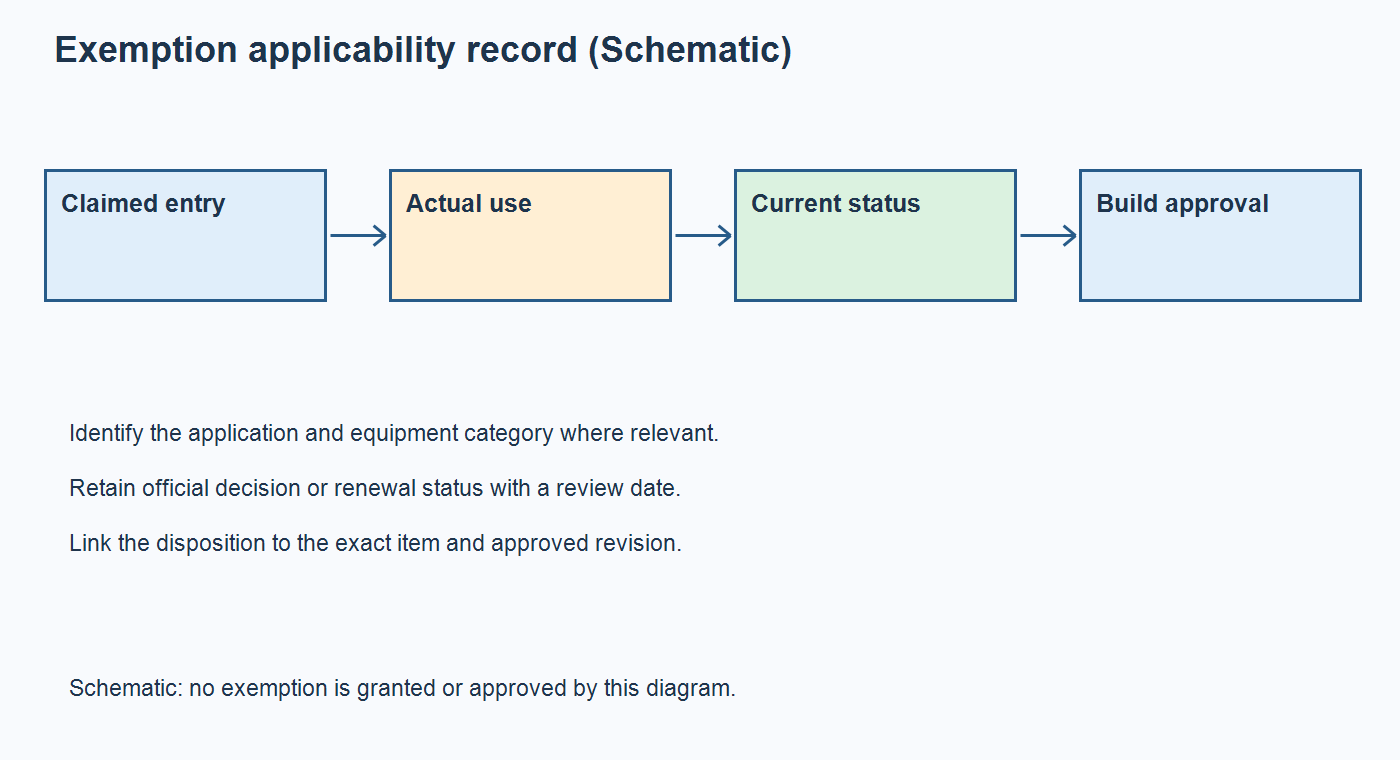
An exemption is permission for a specified application under stated conditions, not a blanket approval of every use of a component or material. Record the entry being claimed and why the actual product application fits it.
Ask the supplier whether its declaration relies on an exemption. Then have the responsible product team check the entry’s wording, relevant equipment category, dates, and later decisions. The Commission’s exemption implementation guidance distinguishes renewal of an existing exemption from a request for a new one. A timely renewal can preserve an existing exemption pending a decision; a newly requested exemption is not automatically available merely because an application has been submitted.
Do not decide from a calendar date copied into an old spreadsheet alone. Preserve the official status source and review date alongside the supplier’s claim. If the scope or status is unresolved, mark it as an open assessment with an owner and a required decision. Do not silently convert missing evidence into either a compliance pass or a confirmed failure.
A useful exemption record also identifies the affected BOM lines, expected purchasing horizon, and replacement strategy. That lets procurement ask for updated evidence before another order rather than discovering a dependency after material has been purchased. The responsible team should review official changes applicable to its actual market placement and use.
Keep documentation attached to the approved revision
Technical evidence is useful only when it represents the supplied item. Record the document issuer, identifier, date or revision, product coverage, relevant declaration basis, and reviewer disposition. Retain the link between that evidence and the build definition.
IEC 63000’s documentation scope concerns the technical documentation used by manufacturers to declare conformity with applicable substance restrictions. Its public summary supports a documentation-led approach; it is not a substitute for assessing the actual evidence or the applicable legal requirements.
For example, an approved capacitor alternate may meet the electrical requirements while having a different material declaration or exemption dependency. The BOM alternate approval workflow should therefore include the required material review alongside circuit and assembly checks. Keep proposed replacements separate from released alternates, and identify which order or board revision the decision covers.
Use the same discipline for a changed laminate, finish, solder product, coating, connector, or rework material. A repeated commercial description does not prove that the underlying supplied material is unchanged. For populated variants, the PCB assembly variant-control guide helps align the BOM, placement file, and assembly drawing with the evidence index.
At receiving, compare the delivered identity with the approved purchase record before closing the documentation item. A packing slip can establish what arrived, while the supplier evidence addresses substance content; retain both links where the project requires them. If a discrepancy appears, identify the affected stock and ask for disposition before mixing it with an approved lot. This is an original purchasing control, not a prescribed RoHS sampling rule.
Resolve a testing question before ordering a generic screen
Testing should answer a defined material and substance question. Specify the item and material being investigated, sample identification, relevant substances, method, reporting basis, and acceptance interpretation with the responsible assessment team and laboratory.
A report for a different component family, an unidentified board, or a whole-product sample with an unclear material basis may not close the actual gap. Ask whether the result covers the ordered identity and the specific uncertainty. Keep a screening result, a supplier declaration, a material composition record, and the product’s conformity decision distinct in the evidence file.
A functional test or optical inspection has a separate purpose: it can check specified electrical behavior or visible build features, but it does not quantify the ten restricted substances. Similarly, lead-free soldering capability does not establish the substance status of every component, coating, or cable included in a build. Define additional analysis when the available evidence and assessment warrant it; this guide does not prescribe a universal test for every lot.
Release a complete assembly scope with visible open issues
Release the order when the build identity, documentation deliverables, exemption dependencies, and unresolved decisions have explicit owners. A short open-item list is more actionable than an unqualified request for RoHS certification.
Send the fabrication data, board specification, BOM and approved alternates, placement file, assembly drawings, quantities, and documentation requirements as one controlled package. State who supplies consigned components and added materials, who assesses exemption applicability, and which records must accompany delivery. The full-turnkey PCB assembly scope coordinates fabrication, component sourcing, assembly, and agreed testing; confirm the material evidence and reporting deliverables for the actual project with OrinewPCB.
RoHS readiness depends on evidence for the materials actually supplied and a controlled path for changes. Once the product requirements are established, provide the released build package and documentation requirements so the team can review sourcing exceptions, manufacturing scope, and the records needed for the assembly order. Keep the finished equipment’s conformity decision with its responsible manufacturer rather than treating a PCB supplier document as the whole product file.
Latest Blog
Contact Info
Phone: +86-755-82882936
Email: [email protected]
WhatsApp: +86-13570802455
Wechat: +86-13570802455
Address: 2nd floor,D Bldg.,Electric Link Technology Bldg.,Gongming,Guangming New Dist.,518106 Shenzhen, China