
Laser Coder Controller Boards: Compare Turnkey, Split and Hybrid Sourcing
Table of Conent
Table of Conent
A laser coder controller board can be sourced through one turnkey PCBA supplier, through separate PCB fabrication, component purchasing, and assembly suppliers, or through a hybrid model. The right choice is the model that assigns each risk to the party best able to control it. Turnkey usually reduces handoffs and schedule coordination; split sourcing can preserve specialist relationships or buyer leverage; hybrid sourcing works when a few critical parts must remain customer-controlled while the manufacturer manages the rest.
Do not choose from unit price alone. Compare the same released data, component assumptions, inspection scope, test coverage, ownership rules, and delivered quantity. For a laser coder controller, the decision should also account for motor or scanner drive, power conversion, timing-sensitive control, communications, safety interlocks, firmware loading, and the test fixture needed to prove that the assembled board works as intended.
What the three sourcing models actually mean
Turnkey sourcing places PCB fabrication, component procurement, assembly, and the agreed inspection or test scope under one commercial owner. The buyer still owns the design and acceptance requirements, but one supplier coordinates fabrication data, BOM questions, material arrival, assembly release, and shipment. This is most useful when cross-supplier handoffs create more risk than the buyer can efficiently manage.
Split sourcing assigns the bare PCB, electronic parts, and assembly to different suppliers. It can make sense when an OEM already has an approved fabricator, holds component contracts, or needs a specialist assembly process. The buyer becomes the integration point: it must control revisions, delivery dates, shortages, storage, incoming inspection, liability for supplied material, and investigation when a defect could have originated at more than one supplier.
Hybrid sourcing deliberately divides responsibility. An OEM might consign the processor, laser-driver module, secure element, or long-lead connector while the PCBA supplier buys standard passives and manages fabrication, assembly, and test. Hybrid is not a vague compromise. It needs a line-item responsibility matrix, approved alternates, date-code and traceability rules, shortage handling, excess-material ownership, and a single released build package.
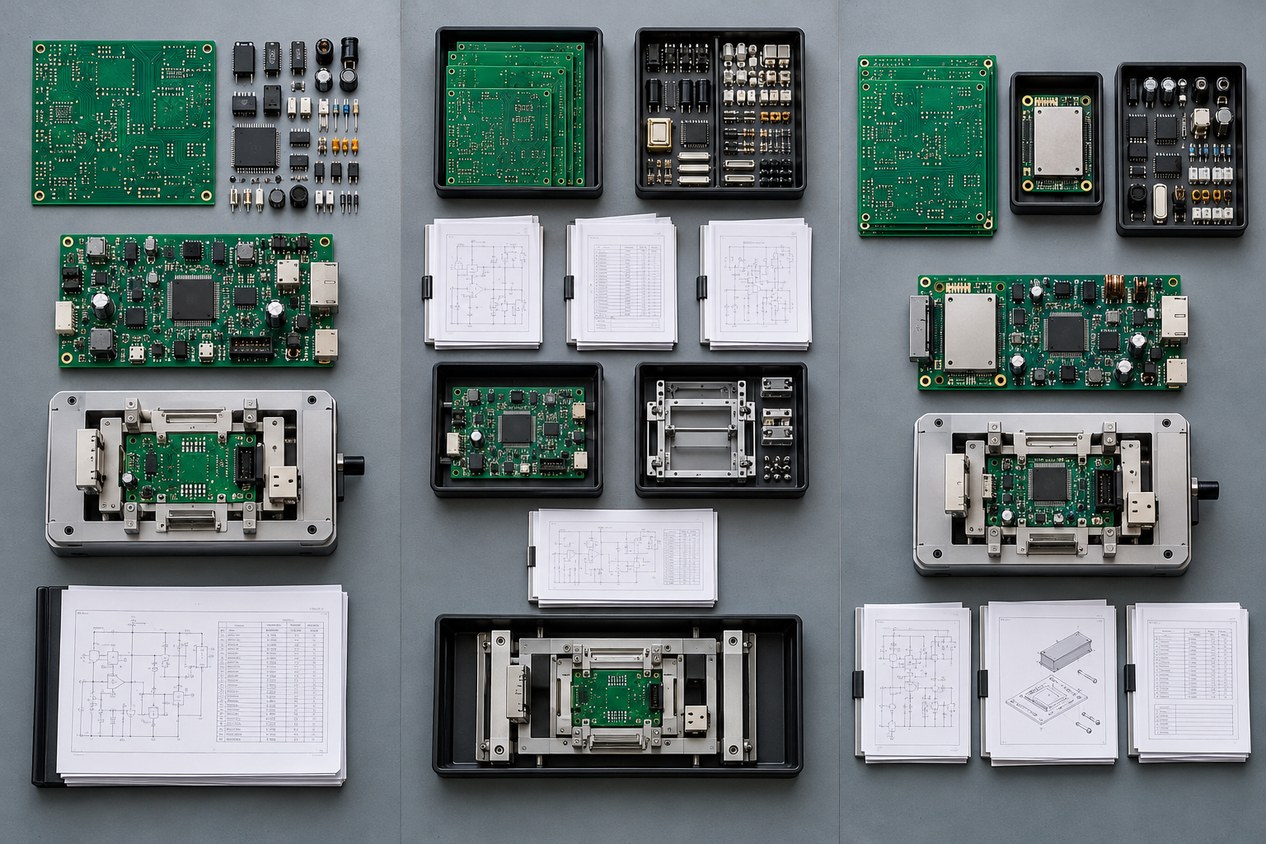
Start with controller-board risk, not a preferred purchasing model
A laser coder controller may combine fast digital control with electrically noisy loads. Power stages can switch motors, scanners, solenoids, fans, or other actuators while sensor inputs and communications must remain stable. Connector placement, isolation boundaries, thermal paths, grounding, shielding, and firmware configuration can all affect system behavior. The sourcing model should preserve the feedback loop between these design risks and the people responsible for fabrication, assembly, and test.
Classify the BOM before requesting quotes. Separate critical or sole-source parts from ordinary passives; identify programmable devices, lifecycle risks, calibration-sensitive items, safety-related components, and parts whose package or finish changes the assembly process. A disciplined BOM alternate approval process prevents an unreviewed substitution from becoming an electrical, thermal, regulatory, or firmware problem.
Do the same for the PCB. Identify controlled impedance, high-current copper, fine-pitch devices, thermal vias, press-fit or edge connections, special materials, surface finish, and any dimensional interface with the coder mechanism. Resolve data conflicts through a documented PCB DFM review before procurement locks the supplier split.
When turnkey sourcing is the stronger choice
Full turnkey PCB assembly is strongest when schedule coordination, revision control, and accountability matter more than preserving separate supplier relationships. One owner can sequence PCB fabrication, purchased parts, stencil and tooling, assembly, programming, inspection, and functional test against one build release. That structure can reduce idle time caused by material arriving before boards, boards arriving under the wrong revision, or incomplete kits blocking a production slot.
The commercial benefit is not automatically the lowest component price. It is the reduction of unmanaged handoffs and the ability to price the delivered assembly with a defined test and documentation package. The article on comparing PCB quotes by tooling, test scope, and delivered cost explains why identical unit-price columns may hide different NRE, scrap, freight, inspection, and yield assumptions.
Turnkey is not “hands off.” The OEM must still approve the AVL, substitutions, fabrication notes, test limits, deviation process, and ownership of excess or noncancelable material. It should also define what happens when a component shortage forces a schedule or design decision. If the laser-coder design is ready for a coordinated build review, share the Gerber or ODB++ data, BOM, placement file, assembly drawing, quantities, and test requirements for one fabrication-and-assembly scope check.
When split sourcing earns its extra coordination cost
Split sourcing is justified when a specialized supplier provides a material, technology, contractual position, or approved status that cannot be replaced without meaningful risk. Examples include a qualified PCB fabricator for an unusual construction, a negotiated semiconductor allocation, or an assembly partner with a validated test platform. The benefit must be explicit enough to outweigh additional logistics and root-cause ambiguity.
The buyer needs an interface plan for every handoff. Define shipping terms, packaging, moisture-sensitivity handling, incoming inspection, acceptable overage, shortage reporting, damaged-material ownership, and the evidence required to release supplied boards or parts to assembly. Confirm that the assembler can reject nonconforming customer-supplied material without absorbing responsibility for the upstream defect.
Revision control is especially important. IPC-2581 defines an intelligent manufacturing description format that can carry PCB and assembly information for tooling, manufacturing, and inspection. Whether the project uses IPC-2581, ODB++, Gerber plus supporting files, or another controlled package, every supplier must receive the same product revision and change record. Email attachments with similar filenames are not a configuration-control system.
How to make hybrid sourcing deliberate rather than accidental
Hybrid sourcing works when the exception list is short and valuable. Keep customer-supplied items limited to parts with a clear reason: allocation, security, calibration, proprietary programming, regulatory control, or a purchasing agreement that materially changes availability or cost. Let the manufacturing supplier manage standard material when it can consolidate demand, resolve packaging quantities, and align deliveries with the production schedule.
Build a responsibility matrix at BOM-line and process level. For each item, name the purchasing owner, approved manufacturer and part number, authorized source rules, required certificates, traceability level, alternates, forecast quantity, supplied quantity, attrition allowance, delivery location, and excess disposition. For the process, identify ownership of PCB release, stencil, programming files, fixtures, golden units, test software, calibration, failure analysis, and engineering changes.
IPC-1782 frames manufacturing and supply-chain traceability around risk agreed between user and supplier. The practical lesson is that traceability should be specified, not assumed. Decide which lot, date-code, supplier, process, operator, inspection, programming, and test records are necessary for the product. More data is not automatically better if it cannot be connected to the shipped serial number or used during a failure investigation.
Use one comparison sheet for all three quotes
A valid comparison normalizes scope before comparing price. Use one matrix that shows who owns each deliverable and which costs are included.
| Decision area | Turnkey | Split | Hybrid |
|---|---|---|---|
| PCB and BOM data control | One manufacturing release | Buyer synchronizes multiple releases | One release plus controlled exceptions |
| Material purchasing | Supplier-managed under approved rules | Buyer or specialist suppliers | Shared by defined BOM lines |
| Schedule integration | Supplier coordinates dependencies | Buyer coordinates all handoffs | Supplier coordinates except consigned constraints |
| Incoming material liability | Defined within one scope | Can cross supplier boundaries | Must distinguish purchased and consigned material |
| Change and shortage response | One escalation path | Buyer reconciles proposals | Responsibility follows the approved matrix |
| Best fit | Integrated delivery and accountability | Strong specialist or contractual advantage | A few critical buyer-controlled items |
Compare fabrication, components, assembly, NRE, fixtures, programming, inspection, functional test, certificates, packaging, freight, tariffs where applicable, scrap assumptions, excess material, and expected delivered quantity. A PCBA quote breakdown helps separate recurring production cost from one-time and conditional charges.
Then compare management cost. Count the engineering approvals, supplier meetings, shipment transactions, incoming checks, kit audits, and failure-analysis loops that the OEM must own. These are not reasons to reject split sourcing; they are costs that need an owner and a realistic schedule allowance.
Define acceptance and failure ownership before the purchase order
All three models require clear acceptance criteria. State the applicable PCB fabrication and assembly standards, workmanship class, special notes, inspection sampling, programming verification, and functional-test limits. Define the test load, interfaces, firmware version, golden-unit control, measurement equipment, result format, and disposition of failures.
A laser-coder controller should be checked under representative power and I/O conditions rather than only for shorts and opens. Depending on the design, verification may cover boot behavior, rail sequencing, motor or scanner drive, sensor inputs, interlocks, communications, watchdog recovery, outputs, thermal behavior, and programmed identity. Do not claim full product validation when the supplier performed only AOI, X-ray, or an unpowered visual inspection.
Failure ownership should follow evidence. A fabricator may own a verified bare-board defect; an assembler may own a placement or soldering defect; the buyer may own an incorrect released footprint, unsuitable alternate, or incomplete test limit. In split sourcing, the OEM needs a method to preserve samples and data across suppliers. In turnkey sourcing, the supplier still needs transparent records rather than a generic pass statement.
Decision checklist for a laser coder controller
- Is there a genuine specialist, allocation, security, or contractual reason to split responsibility?
- Who owns each BOM line, PCB release, tooling item, programming file, fixture, and test limit?
- Can every supplier identify the authoritative revision and approved change record?
- Are substitutions prohibited, preapproved, or subject to documented engineering approval?
- Who absorbs shortages, attrition, nonconforming supplied material, and excess inventory?
- Which traceability records must connect to each lot or serial number?
- Does the quotation include the same inspection, programming, functional test, packaging, and delivery scope?
- Who leads root-cause analysis when evidence crosses a supplier boundary?
Conclusion
Turnkey, split, and hybrid sourcing can all work for a laser coder controller board. Turnkey is usually the clearest path when the priority is integrated scheduling and one accountable build scope. Split sourcing is appropriate when a specialist or commercial advantage is strong enough to justify buyer-owned coordination. Hybrid sourcing is effective when a limited set of critical items must remain under OEM control and every exception is documented.
Make the decision from a normalized scope, not from the headline price. Release one controlled fabrication-and-assembly package, assign material and process ownership, define traceability and acceptance, and compare delivered cost with the same assumptions. When the sourcing model is selected, provide the released design package, sourcing responsibility matrix, build quantities, approved alternates, and functional-test definition for final engineering and quotation review. OrinewPCB can then evaluate the agreed PCB fabrication, component sourcing, assembly, programming, and test boundaries as one documented production scope.
References
Latest Blog


Contact Info
Phone: +86-755-82882936
Email: [email protected]
WhatsApp: +86-13570802455
Wechat: +86-13570802455
Address: 2nd floor,D Bldg.,Electric Link Technology Bldg.,Gongming,Guangming New Dist.,518106 Shenzhen, China