
Choosing an EMS for a Servo Palletizer: Ten Engineering Questions
Table of Conent
Table of Conent
The best EMS partner for a servo palletizer controller is not necessarily the bidder with the lowest unit price or the longest equipment list. It is the supplier that can turn the released design into a repeatable industrial control assembly, document material and process history, test the interfaces that can stop the machine, and manage changes without silently altering the product. Ten engineering questions expose that capability more reliably than a generic factory presentation.
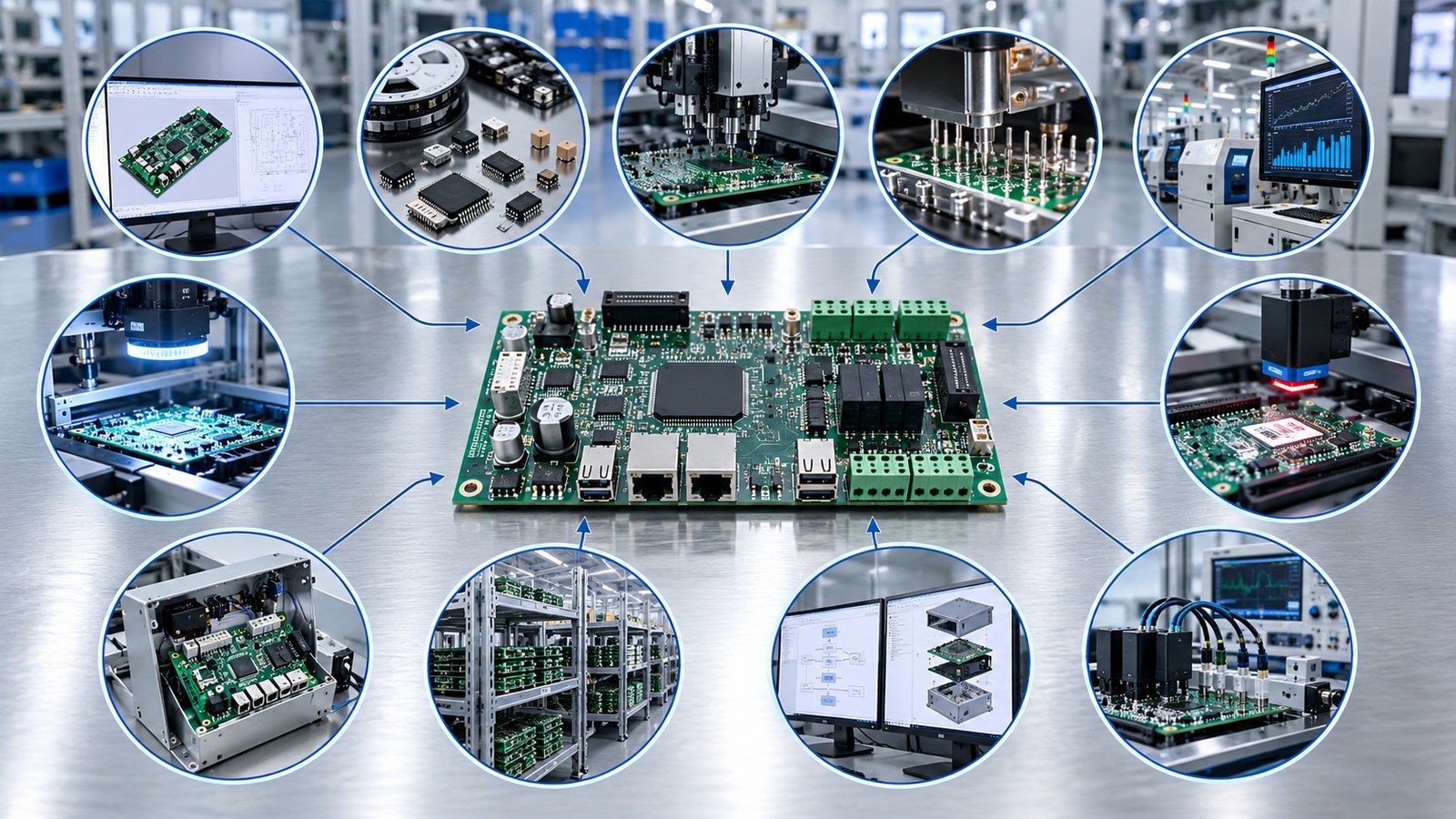
Use the questions below during sourcing, request written evidence, and score the answers against the controller’s actual risk. A palletizer PCBA may combine dense SMT logic, isolated communications, motor-control interfaces, safety signals, relays, high-current connectors, and a fitted enclosure. The evaluation therefore needs to cover the entire route from DFM and components through mixed-technology PCB assembly, test, traceability, and box build.
1. How will you review the controller before production?
A credible supplier should describe a product-specific DFM and NPI review, not promise that “the files look fine.” Ask who checks the fabrication package, BOM, centroid data, assembly drawings, schematic, programming files, test requirements, and enclosure constraints. The review should identify inconsistent revisions, missing polarity information, unavailable parts, insufficient clearances, panel risks, tooling needs, and test access before material is committed.
Request the expected deliverable: a marked-up question list, risk register, or controlled engineering report with owners and dispositions. Clarify whether engineering changes require your written approval and how the released manufacturing package is frozen. Our guide to annular rings and fabrication DFM shows why seemingly small geometry choices need evidence tied to fabrication capability.
2. How do you control component sourcing and substitutions?
The answer should distinguish authorized distribution, customer-approved alternates, independent-market exceptions, and consigned material. Ask how the EMS validates manufacturer part numbers, date and lot codes, moisture sensitivity, storage conditions, packaging, and incoming inspection. A brokered part is not automatically unacceptable, but it needs an explicit risk decision, appropriate authentication, and customer approval.
Servo controllers often remain in service longer than consumer electronics, so lifecycle risk matters. Ask for a process that reports end-of-life notices, allocation, lead-time changes, and proposed alternates before they affect a build. The sourcing model should also define who owns excess material, minimum-order quantities, and unused custom parts. Compare the tradeoffs in our article on turnkey, split, and hybrid component sourcing.
3. Which assembly processes will this exact board use?
Do not accept a list of machines as the process plan. Ask the supplier to map each component family to stencil printing, SMT placement, reflow, through-hole insertion, selective or wave soldering, hand-solder exceptions, cleaning, coating, and final assembly. Large connectors, relays, magnetics, and terminals can change thermal and mechanical conditions substantially.
The manufacturing route should identify profiles, fixtures, pallets, inspection gates, and rework limits. IPC describes J-STD-001J and IPC-A-610J as complementary standards for soldering process requirements and post-assembly acceptance in its 2024 J-revision announcement. Your purchase documentation still needs to state the agreed product class, applicable revision, customer requirements, and precedence when criteria conflict.
4. What process evidence will be captured and reviewed?
Ask which variables are controlled, how limits are established, and what happens when a trend moves toward a limit. Useful evidence may include solder-paste inspection, placement verification, reflow profiles, first-article results, automated optical inspection, X-ray where hidden joints require it, selective-solder parameters, cleanliness checks, and defect or rework records.
Good process control separates prevention from final inspection. A board that passes electrical test can still contain a weak connector joint or an uncontrolled material change. Request sample travelers and quality records with confidential product information removed. They should show timestamps, equipment or line identity, result disposition, and linkage to the lot or serial number rather than an isolated “pass” screen.
5. How will traceability match the product’s risk?
Traceability should be agreed, not assumed. Define whether you need records by purchase order, material lot, production lot, panel, board serial number, firmware version, operator, equipment, or process result. IPC-1782 establishes risk-based levels for manufacturing and supply-chain traceability; IPC’s document revision table lists IPC-1782B as the current revision.
Ask how the EMS retrieves records during a field investigation and how long it retains them. A polished database is not enough if serial numbers cannot be connected to component lots, process history, test results, and approved deviations. If you are preparing supplier comparisons, include the proposed traceability level and retention period in the quotation scope rather than treating them as free administrative details.
For a project-specific review, submit the BOM, Gerbers, centroid file, assembly drawings, expected volumes, applicable standards, traceability needs, and test concept through our manufacturing package review form. The engineering review can identify missing inputs and align the quotation with a defined process and evidence set.
6. How will you test the interfaces that matter in the palletizer?
“100% tested” is incomplete without a test definition. Ask which faults each stage can detect. Automated optical inspection checks visible assembly features; in-circuit or flying-probe methods can detect selected opens, shorts, and component conditions; programming verifies device loading; functional test should exercise the controller’s relevant electrical behavior.
For a servo palletizer, the functional plan may need representative power rails, digital and analog I/O, safety-chain signals, encoder or sensor inputs, fieldbus or Ethernet communications, actuator commands, relay outputs, fault reporting, and firmware identity. The EMS does not need the entire machine when a documented fixture can simulate interfaces safely. Define limits, loads, dwell, fixture calibration, data capture, and failure disposition. A golden sample is useful only when its revision and acceptance basis are controlled.
7. What happens when a defect or escape is found?
Evaluate the response system before an urgent failure. Ask how nonconforming material is segregated, how suspect lots are contained, who authorizes rework, and when the EMS requests a deviation. The supplier should distinguish repair of an isolated workmanship defect from correction of a systemic process issue.
Request an anonymized corrective-action example. A strong response defines the problem and affected population, contains risk, identifies root cause with evidence, implements corrective and preventive actions, and verifies effectiveness. Replacing a failed part without explaining why it failed is not root-cause closure. The expected response time, communication path, and return-material process should be documented in the quality agreement.
8. How are revisions, firmware, and process changes controlled?
A controller can fail configuration control even when every solder joint is acceptable. Ask how the EMS links PCB revision, BOM revision, assembly drawing, firmware file, programming recipe, test program, enclosure drawing, and label data. Production should stop when released inputs conflict rather than letting an operator choose the most convenient file.
Also ask which supplier changes require notification or customer approval: component alternate, stencil revision, solder paste, flux, factory location, equipment family, subcontracted operation, test limits, or repair method. ISO explains that ISO 9001:2026 retains a structured quality-management framework, but certification alone does not define your product-specific change rules. Review the EMS’s actual procedure and contract language.
9. Can the supplier scale without changing the risk profile?
Capacity is more than available placement speed. Ask how the EMS moves from prototype to pilot and recurring production, which processes or sites change, and what evidence must be repeated. A prototype built by an engineering cell may not predict a volume line that uses different fixtures, ovens, operators, or inspection equipment.
Request realistic material and production lead-time assumptions, minimum economic lot sizes, constraint management, and surge limits. Separate quoted capacity from reserved capacity. Review the commercial model using tooling, test development, programming, fixtures, excess material, freight, quality documentation, and delivered cost—not only unit price. Our framework for comparing PCB quotes by tooling, test scope, and delivered cost helps normalize proposals that include different work.
10. Can the EMS deliver the tested controller assembly you actually need?
If the purchasing unit is a programmed PCBA mounted in an enclosure with cables, connectors, labels, and a test record, evaluate that complete scope. Ask whether the EMS owns enclosure procurement, hardware control, torque requirements, cable fabrication, grounding, thermal interfaces, labeling, firmware loading, final functional test, packaging, and serial-number association.
Splitting PCBA and box build across suppliers can work, but responsibilities and fault isolation must be explicit. One integrated route can reduce handoffs when the EMS has the required controls. Our controller box-build acceptance-test guide shows how PCB, enclosure, wiring, and test evidence should converge at one release gate.
Turn the answers into an auditable selection
Score each question against evidence, not presentation quality. Record the requirement, supplier response, supporting document, open risk, owner, and due date. Weight test, change control, traceability, and process capability according to the consequence of a palletizer failure. A supplier can remain a candidate with open actions when the risks and closure plan are visible; vague assurances should not receive the same score as demonstrated controls.
A suitable EMS should make the manufacturing route clearer before the first purchase order. It should explain what it will build, how it will control materials and processes, what it will test, what it will record, and how changes will be approved. When you are ready to compare that evidence with a buildable scope, send the release files, quantities, lifecycle expectations, test requirements, and box-build boundaries through our servo controller PCBA evaluation form. The resulting review can support a quotation with defined assumptions, engineering questions, and acceptance evidence.
Latest Blog
Contact Info
Phone: +86-755-82882936
Email: [email protected]
WhatsApp: +86-13570802455
Wechat: +86-13570802455
Address: 2nd floor,D Bldg.,Electric Link Technology Bldg.,Gongming,Guangming New Dist.,518106 Shenzhen, China