
Food-Line Metal Detector Boards: Choose Conformal Coating or Potting
Table of Conent
Table of Conent
For most food-line metal detector controller boards housed in a properly sealed enclosure, conformal coating is the better starting point because it adds humidity and contamination protection while preserving inspection, connector access, and repairability. Potting is justified when the assembly faces severe condensation, chemical ingress, vibration, tampering, or direct exposure that the enclosure and coating cannot control. The choice must follow a documented environmental and serviceability assessment, not a belief that more polymer automatically means more reliability.
Neither material turns a poorly designed controller into washdown-ready equipment. The enclosure, cable glands, seals, drainage, grounding, thermal path, board cleanliness, material compatibility, and inspection plan still determine whether the electronics will survive. A food-processing installation also needs the equipment owner to define cleaning chemicals, concentration, temperature, spray pressure, exposure duration, humidity cycles, and required service life.
Start with the actual exposure path
The protection decision should begin at the machine boundary. Determine whether the controller sits inside a gasketed stainless enclosure, near an opening, in a remote cabinet, or directly under a washdown zone. Identify paths for water, vapor, detergent, salt, fat, dust, and condensation through seams, vents, cable entries, connectors, and pressure changes. A board that never sees liquid may still experience high humidity and condensation during temperature cycling.
Separate routine exposure from fault exposure. If a failed gland can direct a water jet onto the PCB, the primary corrective action may be mechanical. Coating can reduce the consequence, but it should not replace enclosure control. If the electronics must operate temporarily after an enclosure breach, define that requirement explicitly and test it under representative conditions.
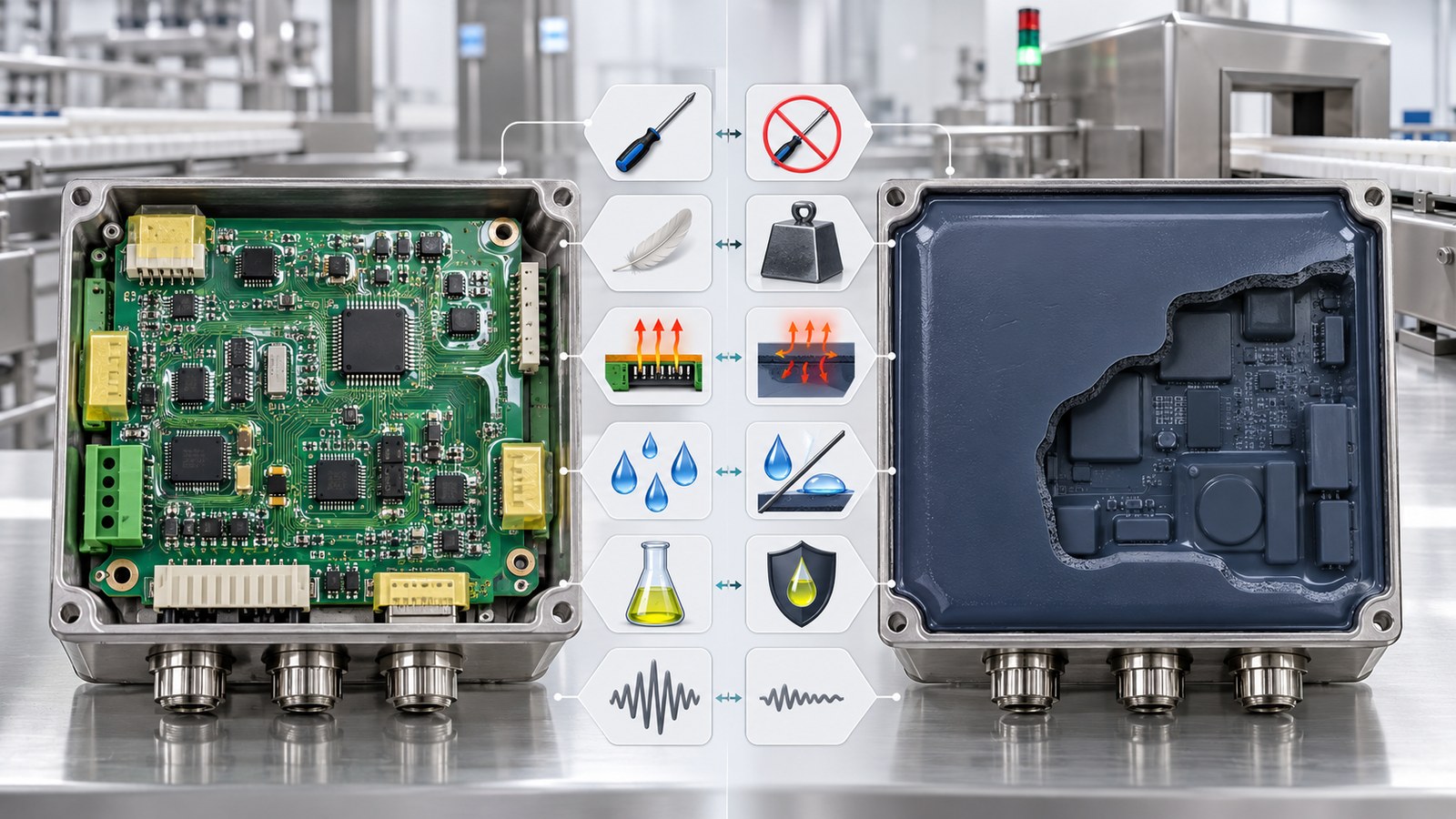
What conformal coating does well
Conformal coating is a thin polymer film applied over selected surfaces of the assembled PCB. IPC’s IPC-HDBK-830A describes typical coating thicknesses from 12.5 to 200 micrometers and emphasizes selecting and validating the material for the end-use environment. The film can reduce leakage, corrosion, arcing risk, and contamination effects when surface preparation and coverage are controlled.
For a metal detector controller, coating is attractive when technicians may need to inspect, probe, update, or repair the board. Connectors, test points, heat sinks, adjustment features, switches, relays, and mating surfaces can be masked. The assembly remains relatively light, and defects such as poor wetting, bubbles, voids, or missed areas can often be inspected with appropriate lighting or fluorescence.
Coating has limits. Sharp leads and component edges can create thin coverage. Capillary action can draw material into connectors or under components where it is unwanted. Some chemistries provide limited resistance to particular cleaners or long immersion. A film also cannot fill large gaps or immobilize heavy components the way an encapsulant can. Material qualification and application control are different questions: a qualified coating can still fail if the board is dirty, the mask is wrong, the film is too thin, or cure is incomplete.
What potting changes
Potting fills a housing or defined cavity with resin so that the electronics are substantially or completely encapsulated. Henkel’s overview of potting compounds describes one- and two-part materials designed to fully encapsulate electronic assemblies. The greater material volume can improve resistance to moisture paths, shock, vibration, and tampering when the material and process are appropriate.
The same volume introduces engineering consequences. Cure exotherm can heat components. Shrinkage and differences in thermal expansion can load solder joints, components, wires, and the PCB. The resin changes heat transfer and may trap heat around power devices unless the thermal path is designed. Added mass affects mounting and vibration. Voids, incomplete fill, contamination, mix-ratio errors, and poor adhesion can remain hidden after cure.
Potting also restricts diagnosis and repair. A failed connector, protection device, or communication transceiver may require replacement of the whole module. Rework methods can damage adjacent parts and may not restore the original protection. These costs are defensible only when the environmental or security benefit outweighs the loss of access.
Use five decision factors instead of one protection label
1. Chemical and moisture exposure
List the actual cleaners, sanitizers, lubricants, and contaminants rather than specifying “chemical resistant.” Compatibility can depend on concentration, temperature, dwell, rinse, and repeated cycles. Ask material suppliers for data relevant to the exposure, then qualify the applied assembly. Potting generally creates a thicker barrier, but interfaces around wires, connectors, and enclosure walls can still provide ingress paths.
2. Thermal behavior
Measure or model heat sources, ambient temperature, duty cycle, enclosure dissipation, and hot spots. A coating usually has a smaller thermal effect, while potting can either help conduct heat or insulate it depending on formulation and geometry. “Thermally conductive” is not enough; verify conductivity, bond lines, heat-sink contact, cure, and component-temperature limits in the final enclosure.
3. Mechanical load
Potting can support components and wires under vibration, but rigid materials can transfer stress rather than absorb it. Flexible coating offers limited mechanical reinforcement. Heavy relays, transformers, terminal blocks, and harnesses may still require brackets, staking, strain relief, or enclosure support. Protection material should complement mechanical design, not replace it.
4. Inspection and service strategy
Define what must remain visible and accessible. If field service expects board-level diagnosis, conformal coating normally preserves more options. If the business model replaces sealed modules and the failure consequence demands maximum encapsulation, potting can be appropriate. Our article on when industrial controller PCB repair is safe provides a useful framework for deciding whether rework evidence can support continued service.
5. Manufacturing and lifecycle cost
Compare tooling, masking, material, dispense time, cure time, inspection, scrap, repair, module replacement, weight, shipping, and end-of-life handling. Coating can require detailed masking and coverage verification. Potting can simplify exposed-area coverage but consume more material and create higher scrap cost when the process fails. The lower initial process price may not produce the lowest lifecycle cost.
For a product-specific review, send the enclosure drawing, PCB files, BOM, cleaning environment, temperature limits, service strategy, annual volume, and required tests through our environmental-protection manufacturing review. The engineering response can identify masking, cleanliness, material, fixture, cure, inspection, and test assumptions before they are embedded in a quotation.
Cleanliness comes before polymer
Coating or potting over contamination can trap an electrical reliability problem rather than solve it. Flux residues, salts, oils, fingerprints, and cleaning residues can affect adhesion and surface insulation resistance. The acceptable cleanliness process depends on the flux, board design, material system, voltage, spacing, environment, and reliability requirement.
Define the cleaning method, drying, handling controls, time between cleaning and protection, and verification evidence. Our guide to ionic cleanliness testing for PCB assemblies explains the difference between broad process monitoring and more specific analytical evidence. IPC’s TM-650 test-method index includes moisture and insulation resistance methods associated with conformal coating, but the correct qualification plan must reflect the product and material system.
Design masking and keep-out areas into the release package
The assembly drawing should identify coated or potted boundaries, material specification, cure requirements, thickness or fill requirements, and every exclusion. Typical keep-outs include connector contacts, test pads, programming headers, switches, adjustment points, mating surfaces, grounding areas, fasteners, and heat-sink interfaces. Vague notes such as “coat board” transfer critical decisions to production.
Masking needs a repeatable fixture or defined consumable method, plus an inspection step before and after material application. Consider whether temporary masks can leave residue, whether plugs fit connector geometry, and whether demasking can tear the coating. Our article on conformal-coating control tooling illustrates why the fixture belongs in the process plan.
Validate the applied assembly, not only the datasheet
Material certification is useful, but process and product validation close different risks. IPC’s document revision table lists IPC-CC-830C for coating qualification and IPC-HDBK-850 for potting and encapsulation guidance. Procurement documents should identify the intended standard, revision, customer requirements, and any product-specific tests.
A validation plan may include visual or UV inspection, coverage and thickness measurement, cure confirmation, adhesion, insulation resistance, thermal cycling, humidity, chemical exposure, vibration, shock, ingress simulation, and functional test. Apply conditions representative of the metal detector controller: powered or unpowered state, cable and connector configuration, enclosure seals, operating load, and realistic recovery periods. A coupon proves material behavior under defined conditions; it does not automatically prove that complex board geometry was protected.
Control the enclosure and PCBA as one system
The controller’s protection boundary includes the box, glands, connectors, seals, PCB, polymer, harness, mounting hardware, and thermal interfaces. A change to any one can invalidate prior evidence. Link the coating or potting material batch and cure record to the assembly lot or serial number. Control firmware and functional-test results alongside the mechanical build.
When the deliverable is a sealed controller rather than a bare PCBA, define enclosure assembly, torque, cable routing, grounding, labeling, leak or ingress checks, and final functional test. The same integration principle appears in our controller box-build acceptance-test guide. AssyPCB’s PCB assembly service can align board assembly, protective-material processing, programming, test, and enclosure work under one controlled manufacturing route when those requirements are included in the release package.
Choose the least complex protection that passes the evidence
Use conformal coating when a sealed enclosure controls most exposure and the product benefits from low mass, inspectability, and service access. Use potting when severe ingress, vibration, tampering, or module-replacement strategy justifies full encapsulation and the thermal and mechanical consequences have been validated. Some products use selective combinations, but overlapping materials require compatibility and process proof.
The decision is complete only when the environmental profile, material, drawing, masking, cleanliness, cure, inspection, test, repair policy, and change-control rules agree. To turn those requirements into a manufacturable scope, submit the Gerbers, BOM, assembly and enclosure drawings, exposure details, quantities, and acceptance tests through our metal detector controller project evaluation. The resulting review can separate necessary protection from unnecessary material and define the evidence required before release.
Latest Blog
Contact Info
Phone: +86-755-82882936
Email: [email protected]
WhatsApp: +86-13570802455
Wechat: +86-13570802455
Address: 2nd floor,D Bldg.,Electric Link Technology Bldg.,Gongming,Guangming New Dist.,518106 Shenzhen, China