
REACH for PCB Assemblies: Map SVHC Evidence to Article 33 and SCIP
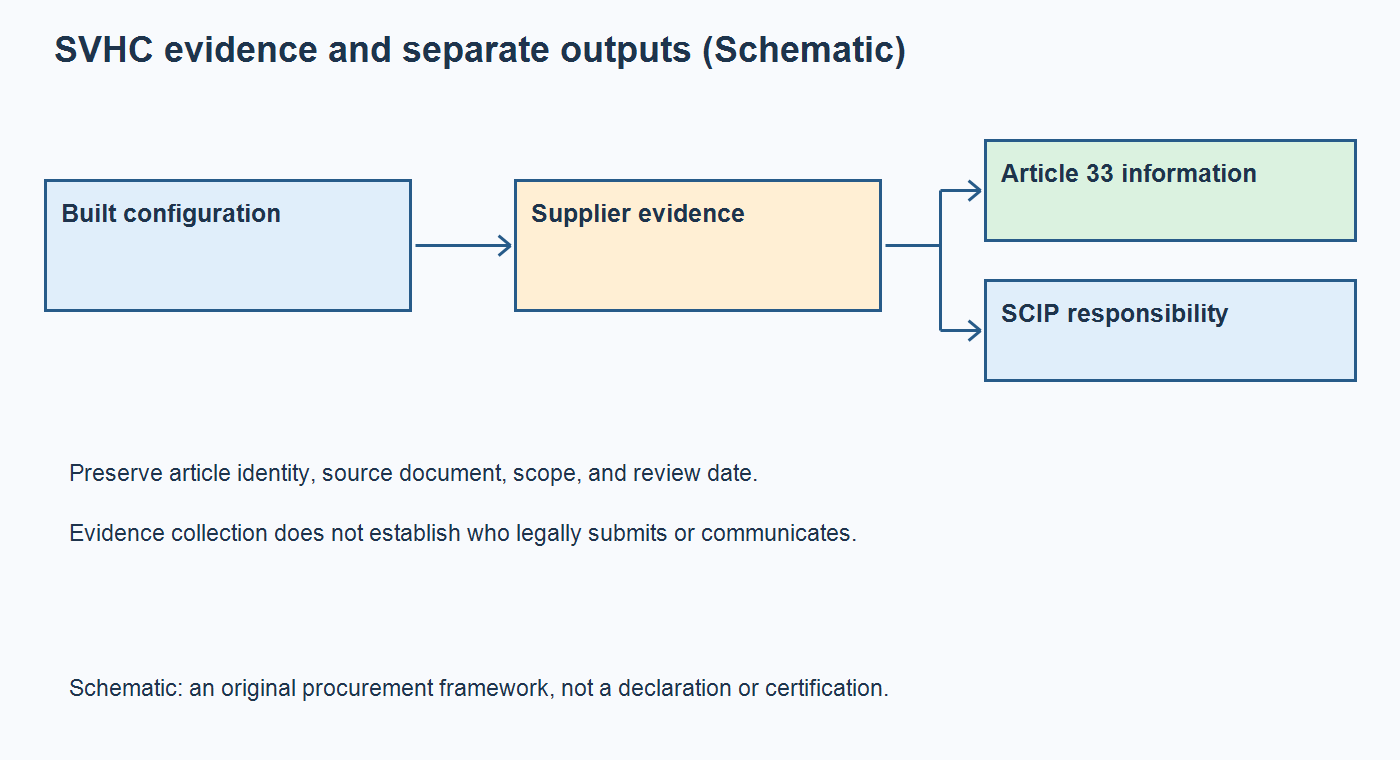
Table of Conent
Table of Conent
REACH evidence for a PCB assembly should identify the actual articles supplied, the Candidate List substances they contain, and the product configuration the evidence covers. Where a Candidate List substance exceeds 0.1% weight by weight in a relevant article, assess Article 33 communication and the applicable SCIP submission duty separately. A supplier statement, a RoHS declaration, and a SCIP reference answer different questions; none should be treated as a universal electronics compliance certificate.
Start with an article-level assessment and a controlled BOM, then connect supplier evidence to the approved build. Keep unknown composition, outdated coverage, and declared substance presence as distinct review states. This guide focuses on that engineering and procurement handoff for EU-bound PCB assemblies. The responsible compliance team must determine the applicable legal roles and any additional REACH obligations for the actual product and supply route.
Use the article boundary, not the assembled-board mass
Assess a Candidate List substance against the relevant article boundary. Do not dilute a constituent article’s concentration by dividing its substance mass by the weight of the entire populated board or finished machine.
The Court of Justice explanation of Case C-106/14, dated September 10, 2015, describes how the REACH article definition and threshold apply within complex products. Classification depends on whether an object’s shape, surface, or design determines its function more than its chemical composition. Constituent objects that retain article status are not simply absorbed into one whole-product concentration calculation.
A BOM is a useful starting index, but one BOM row is not automatically one legal article. A purchased component or subassembly can require a more detailed hierarchy. Added solder, coatings, adhesives, and other materials also need an explicit assessment rather than being casually assigned the same boundary as a separately manufactured article.
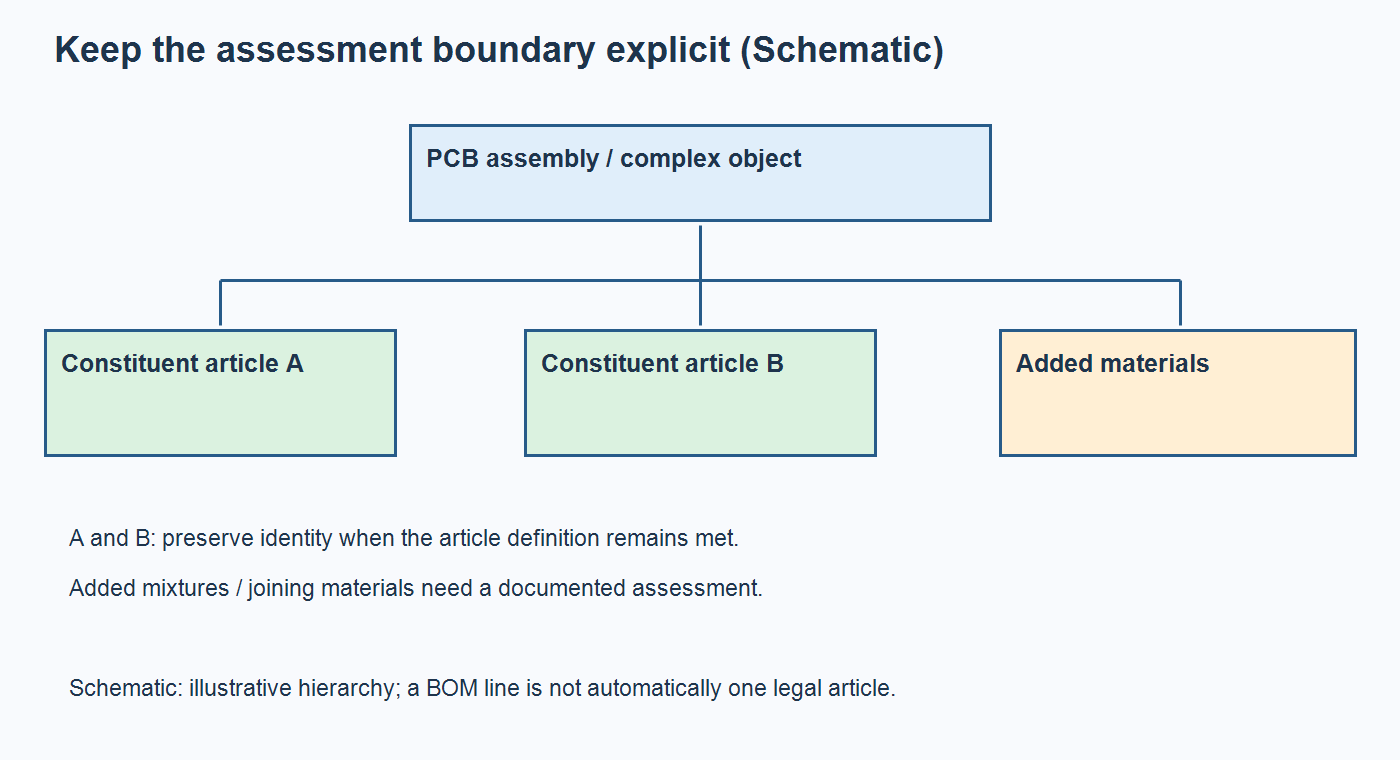
For a hypothetical calculation, assume an object has already been assessed as a constituent article and weighs 1 g. If it contains 2 mg of a Candidate List substance, its concentration is 0.2% w/w. Installing it on a 100 g assembly would produce a whole-assembly average of 0.002%, but that average does not replace the relevant constituent-article assessment. The example illustrates the denominator; it does not classify a particular electronic part.
Keep this assessment separate from the homogeneous-material basis discussed in the RoHS material-evidence guide. A familiar RoHS spreadsheet should not silently become the REACH article hierarchy.
Keep Article 33 communication separate from SCIP
Article 33 concerns information passed to recipients and consumers; SCIP concerns information submitted to ECHA under the Waste Framework Directive. Prepare a distinct output and owner for each applicable duty.
ECHA’s Article 33 communication guidance, reviewed October 22, 2026, explains that suppliers of articles containing a Candidate List substance above 0.1% w/w must provide recipients enough information for safe use, including at least the substance name. Recipients here are industrial or professional users and distributors. Consumers can request similar information, which must be supplied within 45 days, free of charge.
A purchasing team should therefore distinguish a professional-customer information handoff from a consumer-request response. The consumer response period is not a general permission to wait 45 days before providing information to a business recipient.
ECHA’s SCIP overview explains the separate database obligation for qualifying articles placed on the EU market, applying from January 5, 2021. Matching substance evidence may feed both processes, but an email to a customer does not itself submit a SCIP notification. Likewise, a database reference should not replace the actual safe-use information required in the supply chain.
Turn supplier declarations into a configuration evidence map
Connect every evidence item to the exact supplied configuration and its assessment scope. A document that says only “REACH compliant” leaves the purchasing team unable to tell which parts, Candidate List coverage, or assembly revision were evaluated.
If the build is being priced while evidence remains incomplete, share the BOM and supplier evidence gaps, identifying the assembly variant and quantity, so sourcing assumptions and documentation responsibilities can be reviewed alongside the quotation. Keep the compliance disposition with the designated product owner.
| Record | Question it resolves | Action when unclear |
|---|---|---|
| Exact MPN, material code, and supplied variant | Does the document cover the purchased item? | Obtain an explicit identity match before relying on it |
| Article or complex-object hierarchy | Which object and concentration basis were assessed? | Ask the responsible assessor to resolve the boundary |
| Candidate List coverage and document date | Which substance scope supports the statement? | Identify additions or scope gaps needing review |
| Substance finding and safe-use information | What must the downstream information package contain? | Request the named substance and applicable information |
| Evidence owner and approved build revision | Who accepts the evidence for this order? | Keep the unresolved decision visible in the release record |
This matrix is an original procurement aid, not a legally prescribed declaration format. Preserve the underlying supplier file, its revision or issue date, and the relationship to the ordered part. A distributor’s catalog badge may help locate evidence, but it does not explain an ambiguous assessment scope.
Resolve unknowns before approving a sourcing change
A part substitution changes the evidence question even when it preserves electrical function. Review the candidate’s own substance information before extending the original device’s documented status to it.
Use the BOM alternate approval workflow to separate a purchasing proposal from an authorized alternate. Retain the exact manufacturer and orderable part number, affected references, approved configurations, and the evidence used for the decision. Do not let a shortage email silently amend the material-information package.
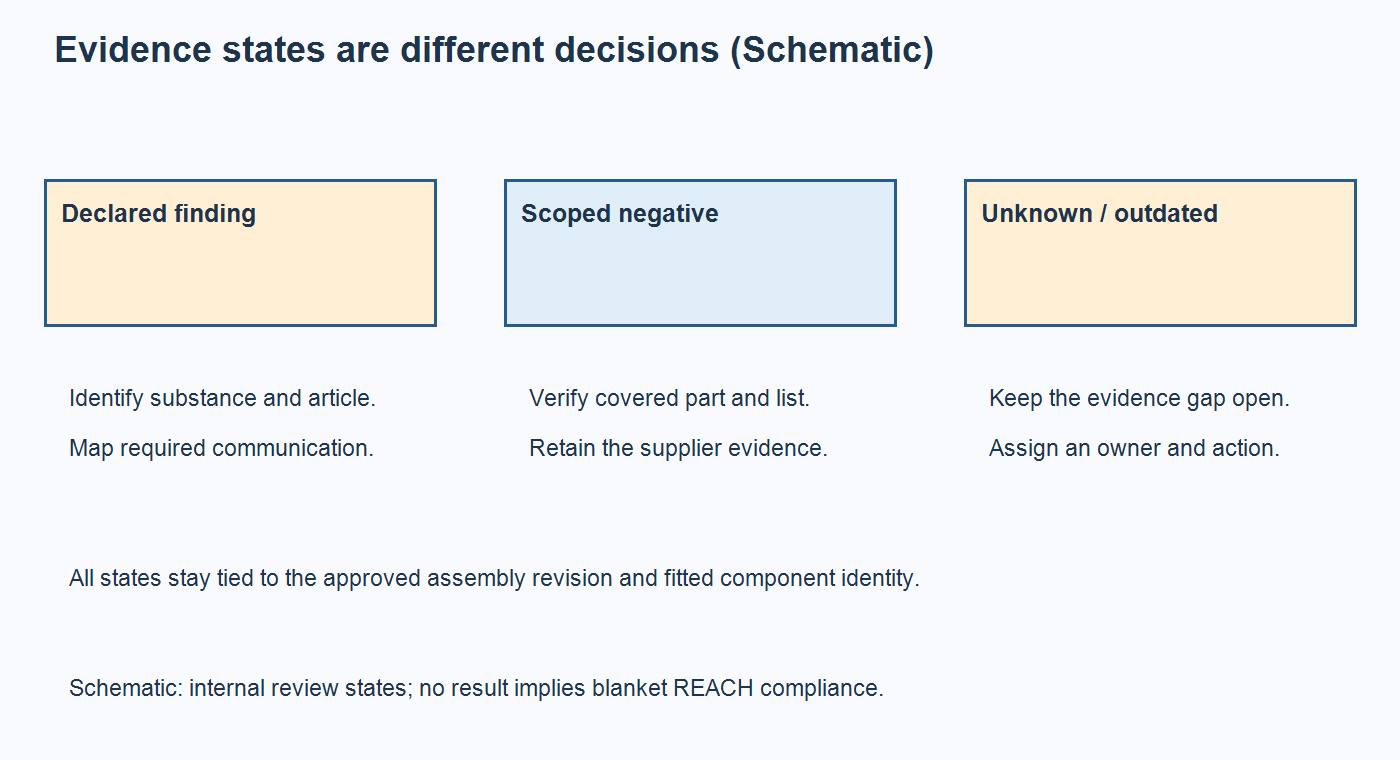
Distinguish a supported negative statement from an unresolved gap. For example, a supplier response covering a previous Candidate List may remain useful for its stated scope while leaving later additions unassessed. Request an update or targeted clarification rather than changing its date or converting the missing scope into “not present.”
If analytical work is needed, agree the substance question, assessed object, sampling boundary, method, reporting limits, and intended use of the result with the responsible specialist. Retain the interpretation as well as the report. A test commissioned without a defined question can leave the same procurement decision open.
For an example of evidence indexing, one declaration may cover several exact part numbers while another covers only a named product family. Record that difference before assigning either document to BOM rows. If family coverage is unclear, retain the supplier question and answer with the item mapping instead of silently assuming all package or material options are included.
For repeat orders, check whether the actual sourced part, material, finish, coating, or assembly option changed. Reusing the last order’s document bundle is appropriate only when its identity and coverage still support the current configuration.
Assign the submission and customer-information handoffs
Determine the actual supply-chain role before assigning SCIP work. An overseas assembler can provide product and substance data without automatically becoming the EU party responsible for the submission.
ECHA’s suppliers-of-articles guidance identifies EU producers and assemblers, EU importers, and EU distributors and other relevant market-supply actors as duty holders for qualifying articles. It excludes retailers and other actors supplying directly and exclusively to consumers from the SCIP information-submission obligation. That specific exception should not be generalized into an exemption from every REACH communication duty.
| Workstream | Practical evidence package | Responsibility to name |
|---|---|---|
| Supplier data collection | Item identity, assessed hierarchy, substance statement, document scope, and open gaps | Person collecting and reviewing supplier responses |
| Article 33 communication | Applicable substance identity and information for safe use tied to the supplied article | Supplier responsible for the recipient or consumer response |
| SCIP submission assessment | Relevant product hierarchy and supplier data mapped to the proposed submission | Actual duty holder, with any service support separately agreed |
When a supplier provides a SCIP reference, verify which article or complex object it identifies and whether that identity matches the supplied item. Preserve any agreed reference or submission method with the responsible party’s review. The existence of a number alone does not establish that a different assembly configuration is covered.
Release the assembly with evidence that can be maintained
A useful release package keeps the approved configuration, evidence scope, information outputs, and unresolved responsibilities consistent. Treat that package as maintained product data rather than a one-time attachment to a purchase order.
Record who reviews Candidate List changes, supplier updates, and approved alternates, and which product configurations each change affects. Keep previous decisions traceable. Define how a newly affected article reaches customer communication and, where applicable, the submission workflow instead of assuming that a software flag completes both.
The full-turnkey PCB assembly scope brings fabrication, sourcing, and assembly planning together. State documentation deliverables and data responsibilities explicitly for the project. Do not interpret a manufacturing service description as proof of legal representation, a universal REACH certification, or automatic SCIP submission.
REACH readiness for a PCB assembly rests on the correct article boundary and evidence that follows the actual build. For an OrinewPCB project, provide the controlled fabrication and assembly package with BOM, placement data, quantities, approved alternates, evidence requirements, and the designated compliance contact, so manufacturing, sourcing, documentation scope, and quotation can be aligned.
Latest Blog


Contact Info
Phone: +86-755-82882936
Email: [email protected]
WhatsApp: +86-13570802455
Wechat: +86-13570802455
Address: 2nd floor,D Bldg.,Electric Link Technology Bldg.,Gongming,Guangming New Dist.,518106 Shenzhen, China