
Mode S Transponder PCB Sourcing: Control Parts and Changes
Table of Conent
Table of Conent
Mode S transponder PCB sourcing is a controlled configuration problem, not a search for “certified components.” Start with the equipment owner’s released design and rank each BOM item by its effect on RF performance, timing, power, interfaces, and build continuity. Buy through an approved source, preserve manufacturer part number and lot evidence, and route any product-change notice, end-of-life alert, or proposed alternate to the design authority before use. A supplier can assemble and document a board to the agreed package; the responsible applicant determines which changes affect the approved equipment and what additional verification is needed. For civil aviation equipment, a FAA Technical Standard Order authorization concerns the authorized article and does not by itself approve its installation on an aircraft. It is therefore misleading to infer that an individual IC, a PCB lot, or an ordinary EMS process is “Mode S certified.”
What makes a Mode S board sourcing decision different?
The bill of materials has to be read against the actual transponder function and approved configuration. Mode S equipment receives interrogations at 1030 MHz and transmits replies at 1090 MHz, as described in EASA CS-ACNS Issue 3. Those frequencies identify the equipment context; they do not prescribe a universal board architecture or a particular RF component. Some products partition RF, processing, power and interfaces across separate assemblies. Others combine them. Ask the OEM for the released schematic, assembly drawing, BOM and interface description before assigning criticality to a line item.
Separate three questions in every sourcing review: Can the part be obtained with an acceptable chain of custody? Does it match the released configuration, including approved alternates? If a change is proposed, who decides its effect on performance and the approval basis? Price and lead time matter only after those questions have an owner. The risk of a low-cost oscillator or logic device can exceed its purchase value if replacing it changes reply timing, RF margin, programmed behavior or the evidence needed to keep production continuous.
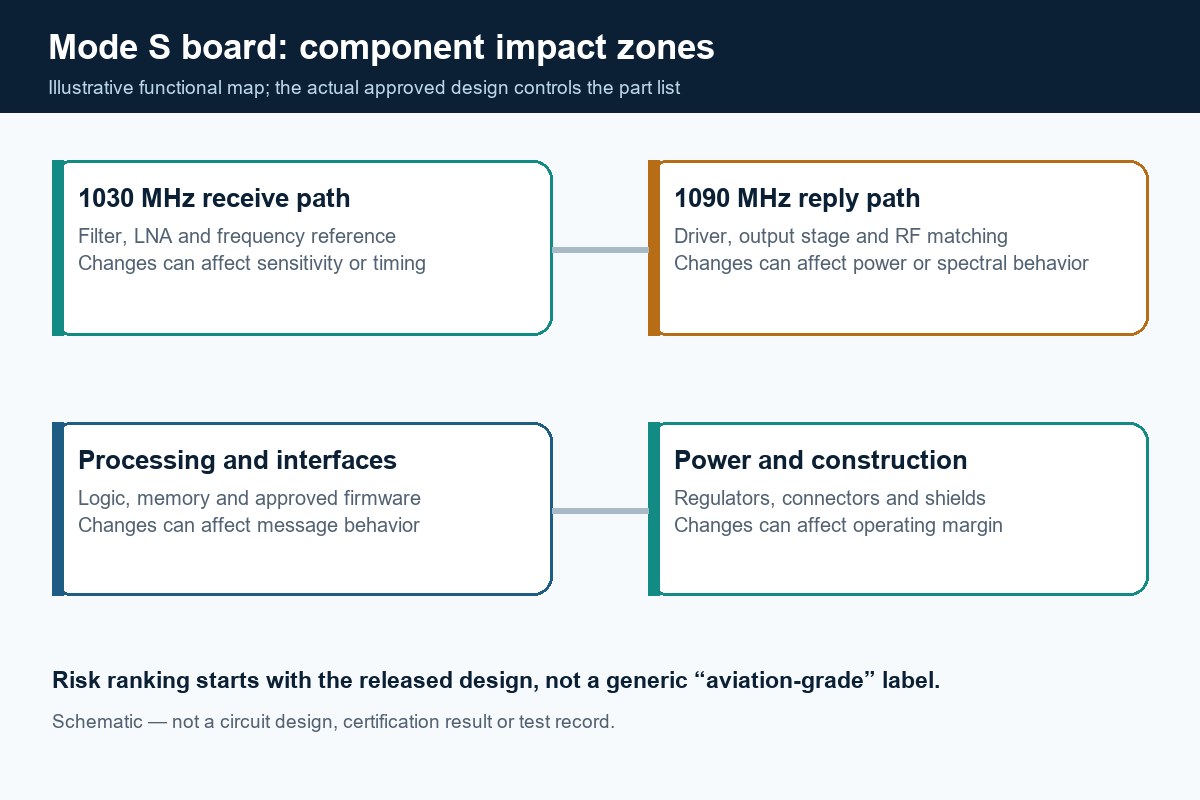
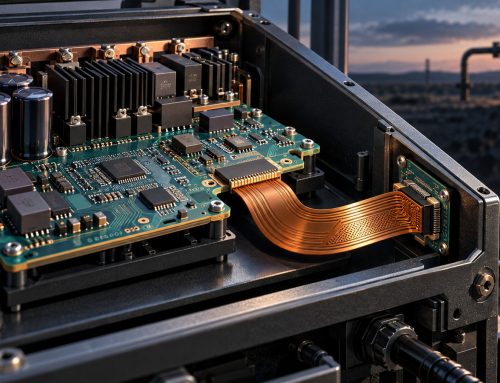
The following schematic identifies possible areas for first-pass review. It is a functional illustration, not a circuit diagram or a description of an OrinewPCB product.
Which BOM lines deserve the earliest risk review?
Prioritize parts whose loss or alteration may change a controlled function or block a qualified build. Use the actual schematic and approved test plan to refine the ranking. A generic “aviation-grade” label is not evidence that a part is approved for a specific transponder. Likewise, a distributor stock flag is not evidence of the design authority’s approval.
| Functional group, if present | Supply or change risk to ask about | Evidence and decision owner |
|---|---|---|
| RF filters, low-noise stages and frequency references | Manufacturer change, package change or unapproved alternative may alter sensitivity, frequency stability or timing margin. | Record exact MPN, revision and source. OEM identifies affected RF measurements and approves any substitute. |
| Reply driver, output stage and matching parts | Part loss or variation may affect output power, spectral behavior, thermal margin or matching. | Preserve source and lot data; compare against the released RF design and OEM-defined tests. |
| Processing, memory and programmed devices | Silicon revision, memory density or image change may alter message processing or the production load procedure. | Control hardware MPN and programmed-image identifier separately. Equipment owner approves behavior changes. |
| Power conversion, protection and connectors | Alternate ratings, pinout or construction may affect operating margin or aircraft interface fit. | Check actual derating, mechanical and environmental requirements, then disposition the change. |
| Bare PCB, shielding and assembly materials | Stackup, laminate, finish or shield change can alter RF paths, solderability or reliability. | Match fabrication and assembly records to approved drawings; request an OEM decision on deviations. |
This screen is intentionally qualitative. The equipment owner must set numerical limits, test conditions, environmental categories and acceptance criteria for the actual design. A controlled-impedance net, for example, requires a specified stackup, geometry, reference plane and measurement plan; our impedance-controlled PCB RFQ guide explains what to put in the fabrication request. Do not carry a generic tolerance or an automotive datasheet grade into an avionics acceptance rule without program review.
How should the buying channel and lot evidence be controlled?
Buy from sources with an unbroken, acceptable pedigree where possible, and define a separate exception process for unknown-origin stock. SAE AS5553 addresses counterfeit electronic-part avoidance, reliable sources, authenticity and disposition. SAE AS6171 addresses risk-based testing of suspect parts when the chain of custody is unknown. Its scope cautions that testing alone cannot prove authenticity without known provenance. Invoke the applicable customer and contract requirements instead of casually claiming that every purchase “meets AS5553.”
At purchase order release, specify the approved manufacturer part number and revision or approved alternate, permitted seller class, date/lot-code and packaging records, certificate or trace documentation required by the program, and rules for split lots. Receiving should reconcile the paperwork, package markings and order, quarantine mismatches, and record who resolved them. The assembler should be able to connect a populated board or build lot to the source records that the contract requires. For a regulated aircraft-parts receiving context, FAA AC 20-154A describes a receiving-inspection approach; it is guidance, not a blanket legal rule for every purchased resistor.
When a program requires a joint review of PCB fabrication, parts sourcing and assembly, share the approved BOM and sourcing constraints for assessment with target quantities, traceability level and substitution authority. The quotation review can identify long-lead items and the evidence expected from each supplier before build assumptions are locked. Any aviation-specific approval remains with the responsible OEM or applicant.
If an authorized-channel part is unavailable, do not silently buy an apparent equivalent from a broker. First ask whether the approved BOM permits an alternate, whether stock with acceptable provenance exists, and whether the design authority wants a last-time buy, redesign or risk-controlled exception. A cheaper substitute that needs a new test campaign may have a higher total program cost.
What should a PCN or end-of-life notice trigger?
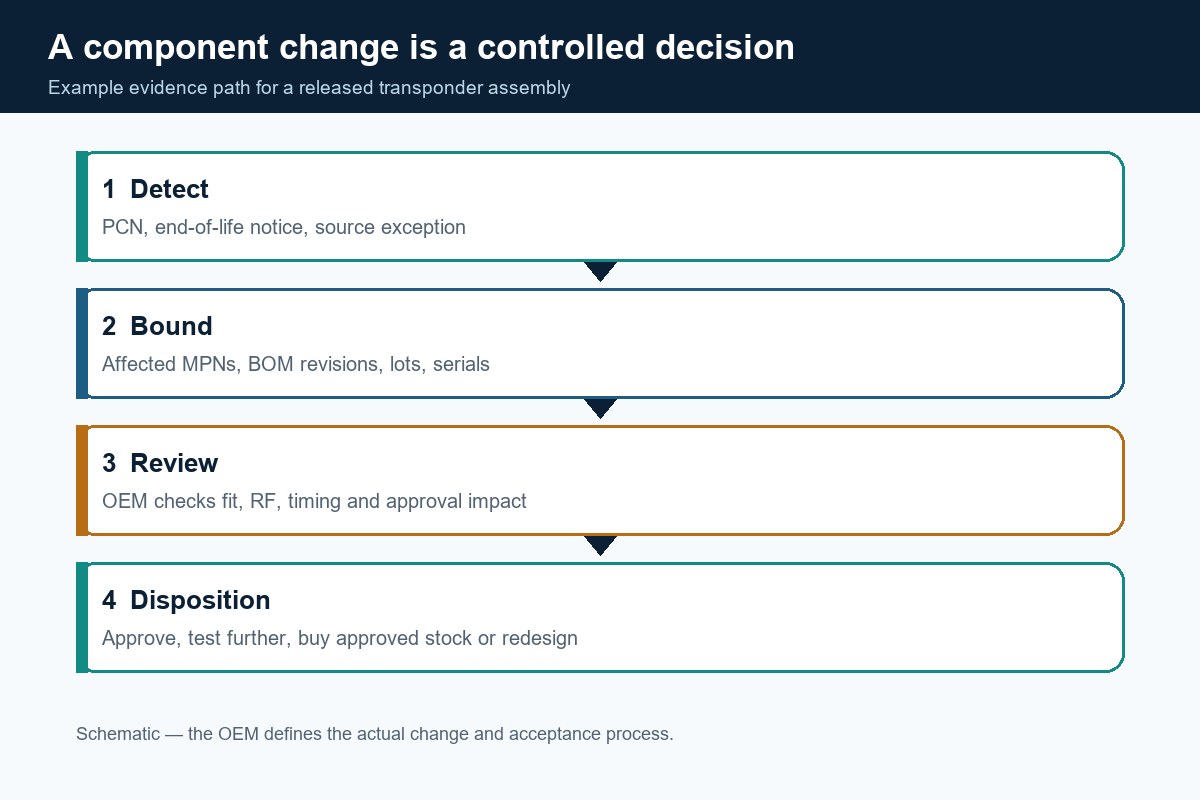
A notice should start an impact assessment tied to actual boards, not an automatic purchasing substitution. Manufacturer PCNs can affect materials, processes or manufacturing locations; discontinuance notices may set last-order and delivery dates. Texas Instruments’ published PCN and withdrawal policy is an example of the information a supplier may provide. Its dates and schedule describe TI’s policy, not a universal promise for every part maker or every device.
Log the notice identifier, affected MPN and revision, approved BOM revisions, open purchase orders, on-hand date/lot codes, boards already assembled, and future build forecast. Then have engineering determine whether the proposed part or process differs in fit, electrical performance, RF behavior, thermal margin, assembly profile or test coverage. An unchanged ordering code is not necessarily an unchanged manufacturing baseline. The OEM decides whether existing verification is adequate, whether comparative tests are needed, or whether the approved configuration must change.
| Finding | Immediate purchasing action | Engineering and record action |
|---|---|---|
| Approved original part remains available with acceptable pedigree. | Reserve the documented quantity and check shelf-life or storage conditions where applicable. | Preserve lot-to-build traceability and monitor the next notice. |
| PCN changes the original part or manufacturing process. | Segregate old and changed lots until their use is decided. | Compare the change with controlled requirements; document OEM approval and any repeat tests. |
| Original part is discontinued; proposed alternate exists. | Do not insert the alternate into the build merely because it fits the footprint. | Approve the new MPN, BOM revision and impact evidence before placement. |
| Only unknown-pedigree stock is offered. | Hold purchase or quarantine stock under the program’s exception route. | Escalate source risk and required verification to the responsible customer authority. |
Our BOM alternate approval guide covers the general fit-function-release logic. For the transponder program, add the RF and approval-impact questions that the generic alternate workflow cannot answer. The same principle applies to a change in PCB fabricator, laminate, assembly site or inspection method. If the contract invokes first-article requirements, determine whether a full or partial repeat is necessary under the applicable controlled standard and customer procedure; do not assume every change forces the same test set.
What evidence must follow the board through assembly and test?
The record should connect the released configuration to the physical lot and the contracted acceptance result. A practical crosswalk ties PCB revision and fabricator lot, component MPN and source/lot where specified, assembly revision, traveler, serial or batch identifier, programmed-image identifier if loading is in scope, inspection status, test-fixture and software revision, measured results and approved deviations. Define retention and trace granularity in the purchase agreement. A generic “passed test” label does not show which limits or hardware version were used.
Distinguish board acceptance from equipment or installation approval. A PCBA supplier can provide the specified bare-board tests, assembly inspection, electrical checks, programming records or functional test results if those tasks are contracted and feasible. The equipment owner must decide which system-level Mode S, environmental and installation evidence applies. The FAA’s TSO explanation makes the article-versus-installation boundary explicit. The board’s RF test points and acceptance limits should be taken from the released design, not invented from 1030/1090 MHz alone. For continuing programs, production-change reliability monitoring can help identify whether later material or process changes merit more than routine lot acceptance.
Document deviations before the product moves: what was different, which units or lots are affected, who authorized the disposition, and whether rework or retest restored conformance. A supplier should not represent a passing assembly inspection as proof of airborne eligibility. Conversely, the OEM should not withhold manufacturing requirements and expect a supplier to infer the applicable approval plan.
What belongs in the manufacturing and sourcing RFQ?
Submit one controlled package that lets the supplier quote a defined build and return defined evidence. Include the released Gerber or ODB++ fabrication output and stackup, drill and outline files, assembly drawing and pick-and-place data, approved BOM with allowed alternates, quantities, sourcing restrictions, lot-trace requirements, programming responsibilities, board-level inspection and test scope, acceptance limits, and delivery or storage constraints. Name who can approve a deviation or substitute. If the files are export-controlled or otherwise restricted, arrange an authorized transfer path before sharing them; a generic quote form is not automatically suitable for controlled data.
Where appropriate, a turnkey PCB assembly scope can coordinate fabrication, parts procurement and assembly under one quoted manufacturing package. That scope does not certify the transponder or transfer the OEM’s design authority. Once the controlled files and acceptance owner are identified, send the released board, BOM and test scope for evaluation with build quantity and required source records. The resulting review can separate fabrication, component sourcing, assembly and test costs while calling out open part or approval decisions.
The governing decision is simple: source only against an approved configuration, retain a traceable chain from purchased part to board, and resolve each change before it reaches production. That approach protects build continuity and gives the avionics owner usable evidence without confusing a manufacturing record with equipment approval.
Latest Blog


Contact Info
Phone: +86-755-82882936
Email: [email protected]
WhatsApp: +86-13570802455
Wechat: +86-13570802455
Address: 2nd floor,D Bldg.,Electric Link Technology Bldg.,Gongming,Guangming New Dist.,518106 Shenzhen, China