
ECSS Space PCB Standards: Design and Procurement Evidence

Table of Conent
Table of Conent
ECSS space PCB standards address different parts of a hardware build. Establish the project-approved design baseline, verify that the proposed PCB technology and manufacturing source fall within the required qualification scope, and define the records needed for the delivered lot. Evaluate assembly requirements separately. A standard number on a drawing does not answer all four questions.
For procurement, the useful output is an evidence matrix linking each requirement to a controlled document, responsible organization and acceptance decision. This article explains how to organize that matrix and review changes before ordering boards or PCB assemblies. The examples are practical purchasing recommendations, not an exhaustive compliance checklist. The program’s approved standards, tailoring and authorities determine the actual requirements. General manufacturing photos illustrate evidence boundaries and do not identify space-qualified products.
Freeze the standard editions and board definition first
Begin with a controlled requirements baseline that identifies the exact editions the project invokes. An RFQ that says only “ECSS PCB” leaves suppliers to make different assumptions about design rules, technology qualification and deliverable records.
The active ECSS page identifies ECSS-Q-ST-70-12C Rev.1, dated April 30, 2025, as the PCB design-rules standard. Its applicability includes several PCB constructions, including rigid, flexible and high-density interconnect boards. Confirm the applicable clauses and approved tailoring for the actual construction. A search result containing an older revision or a draft is not enough to establish the contractual baseline.
As a working method, put the drawing revision, stackup, material designation, copper construction, finish, hole structures and controlled electrical requirements under the same release identity. For RF routing, the controlled-impedance fabrication requirements should state the intended construction and verification conditions. A nominal impedance value alone leaves the fabricator without a complete acceptance definition.
Resolve contradictions before a supplier prices the build. For example, a drawing and stackup may specify different dielectric constructions even though both files carry the same project name. Record which controlled document governs and obtain the necessary approval. Keep open questions visible instead of allowing a quote assumption to become an undocumented design change. This also makes competing quotations easier to compare. Ask bidders to list assumptions against the same revision index and identify any proposed alternative construction explicitly, so reviewers can distinguish a price difference from a scope difference.
Match qualification evidence to the proposed PCB technology
Evaluate the manufacturing source and technology scope against the board being ordered. A general company quality certificate cannot establish that a particular PCB construction is covered by the required qualification.
ECSS-Q-ST-70-60C Rev.1, dated April 30, 2025, addresses PCB qualification and procurement. It assigns requirements across the PCB manufacturer, procurement authority and qualification authority. Treat these as distinct responsibilities when identifying who supplies evidence, who reviews it and who can accept a gap.
The following organization is a recommended starting point for an RFQ review. The project can add documents, tests and approval gates according to its requirements. Each entry needs an identifier or a recorded open action; an unchecked “compliant” box gives the reviewer little to evaluate.
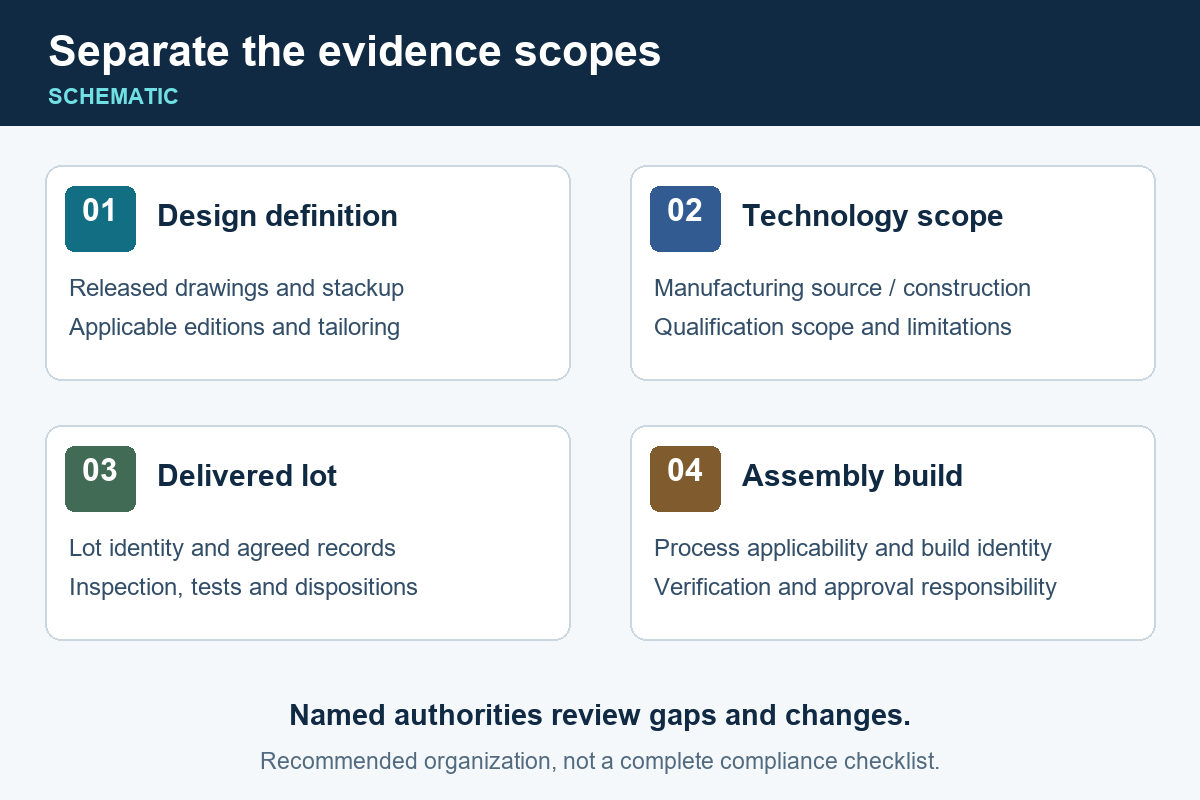
| Review question | Evidence to identify | Decision to record |
|---|---|---|
| What board definition is being quoted? | Released drawings, stackup, fabrication data and applicable standards list | Design owner closes conflicting revisions or requirements |
| Does the proposed source and technology fit the required qualification scope? | Relevant qualification references, construction scope and limitations | Assigned authorities resolve coverage before source acceptance |
| What will identify and support the delivered lot? | Agreed lot identification, inspection/test records and disposition documents | Procurement defines the delivery acceptance package |
| What remains an assembly responsibility? | Assembly specification, process applicability and verification plan | Assembly and product-assurance owners close interface gaps |
During PCB assembly planning, share the board definition and evidence responsibilities with the BOM, quantities and approved-source restrictions for manufacturing-scope review. Confirm capability, exclusions and document availability before accepting a quotation; submitting an RFQ does not establish ECSS qualification.
Keep assembly and inspection evidence within their actual scope
Bare-board evidence and assembly evidence answer different acceptance questions. Carry the PCB lot identity into the assembly records so reviewers can trace the installed board to its source without treating the assembly inspection result as a substitute for PCB qualification.
The official ECSS-Q-ST-70-61C page, dated April 8, 2022, describes high-reliability assembly for surface-mount and through-hole connections. Its stated exclusions include lead-free soldering and equipment qualification or acceptance testing. Check applicability before assigning this standard to a proposed solder system or assuming it covers the complete equipment verification program.
For a purchasing review, separate the observable result from the required conclusion. An optical inspection image can support a finding about a visible feature. It cannot, by itself, establish internal interconnect integrity, environmental performance or the approval status of the assembly process. Specify the inspection method, coverage, acceptance basis and record required for each question.
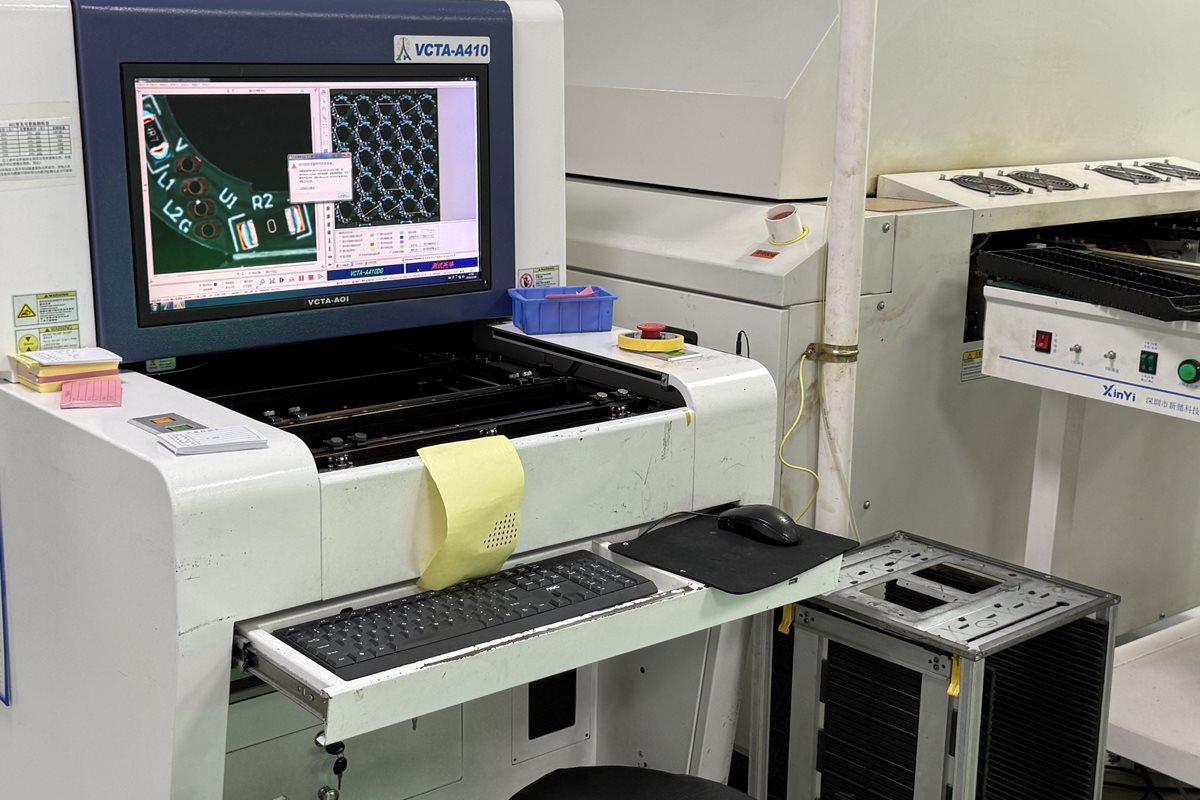
A requirement-to-test acceptance record helps define which observation closes each requirement. Include the test configuration and the authority responsible for any deviation. A test report with no link to the board revision or tested assembly configuration may be difficult to use even when the measurements are valid.
Discuss repair, rework and nonconformance handling before production. Identify who can authorize a disposition and how the affected serial or lot identity stays connected to it. This is especially useful when bare boards, assembly, inspection and equipment testing are performed by different organizations. Shared file access alone does not establish approval responsibility.
Review manufacturer and material changes before release
A source or material change needs a technical disposition before purchasing treats it as an interchangeable supply option. Compare the proposed build against the configuration supporting the qualification and equipment evidence, then identify what must be reviewed again.
For flight-model and qualification-model PCB procurement, ECSS-Q-ST-70-60C Rev.1, clause 6.14 addresses changes of PCB manufacturer or material. It requires procurement-authority analysis of their effects, including electrical, mechanical and thermal performance, assembly approval status and the PCB definition dossier. It recommends using the same manufacturer for the qualification and flight boards. Do not turn that recommendation into an invented blanket prohibition.
The table below translates that boundary into review prompts. These are original examples, not prescribed test plans. The responsible authority determines whether existing evidence is sufficient and what additional work is necessary.
| Proposed change | Reconcile before release | Purchasing consequence |
|---|---|---|
| Different PCB manufacturer | Technology scope, board definition and relevance of existing performance evidence | Obtain a documented source-change disposition |
| Different laminate or dielectric construction | Electrical, mechanical and thermal effects and drawing/stackup revisions | Resolve material identity and affected evidence before ordering |
| Changed assembly process or solder system | Applicable assembly requirements and existing approval assumptions | Assign assembly review separately from bare-board acceptance |
| Changed inspection or test configuration | Coverage, limits, revision identity and comparison with earlier records | Agree how the new records will support acceptance |
Consider an illustrative case: a qualification build used one laminate construction, while the proposed flight build uses a substitute described as “equivalent.” Start by asking what changed in the controlled material and stackup definition. Route the electrical, mechanical, thermal and assembly implications to the appropriate reviewers. The material trade name or a supplier’s equivalence statement cannot close every interface automatically.
Keep the approved disposition with the purchase release and affected build records. If the review remains open, label it as an unresolved condition in the quote comparison. This prevents a shorter quoted lead time from hiding unplanned qualification or verification work.
Build an RFQ around responsibilities and acceptance records
A useful ECSS-related RFQ makes scope gaps visible before the order is placed. Separate the board price, assembly work, evidence deliverables and authority decisions so the buyer can compare the same manufacturing and acceptance assumptions.
For a complete assembly project, include released fabrication data, assembly drawings, BOM and substitution restrictions, placement data, quantities by build stage, and the approved standards baseline. Add the evidence matrix, required records, test responsibilities and any source restrictions. Identify whether bare boards are customer supplied or procured within the assembly scope.
The full-turnkey PCB assembly scope provides a way to discuss coordination of board procurement, components and assembly. Project-specific qualification and approval requirements still need explicit capability review. Do not infer flight-hardware eligibility from the general service description.
Compare supplier responses against unresolved questions as well as price. Ask which documents will exist at quotation, production release and delivery, and who accepts exceptions at each point. Where evidence is unavailable, record the limitation and its effect on the project decision. This creates a clearer basis for selecting a source than an unsupported statement of complete compliance.
ECSS PCB procurement becomes manageable when the design baseline, technology scope, delivered-lot evidence and assembly responsibilities remain traceable. Changes then have a defined route for review instead of becoming assumptions passed between organizations.
When those boundaries are defined, submit the controlled PCB assembly package with the BOM, build quantities, sourcing restrictions and acceptance responsibilities for a manufacturing assessment. Confirm the feasible scope and any exclusions before proceeding to a project quotation.
Latest Blog






Contact Info
Phone: +86-755-82882936
Email: [email protected]
WhatsApp: +86-13570802455
Wechat: +86-13570802455
Address: 2nd floor,D Bldg.,Electric Link Technology Bldg.,Gongming,Guangming New Dist.,518106 Shenzhen, China
