
OSP vs Immersion Tin: Compare Assembly, Shelf Life and Total Cost
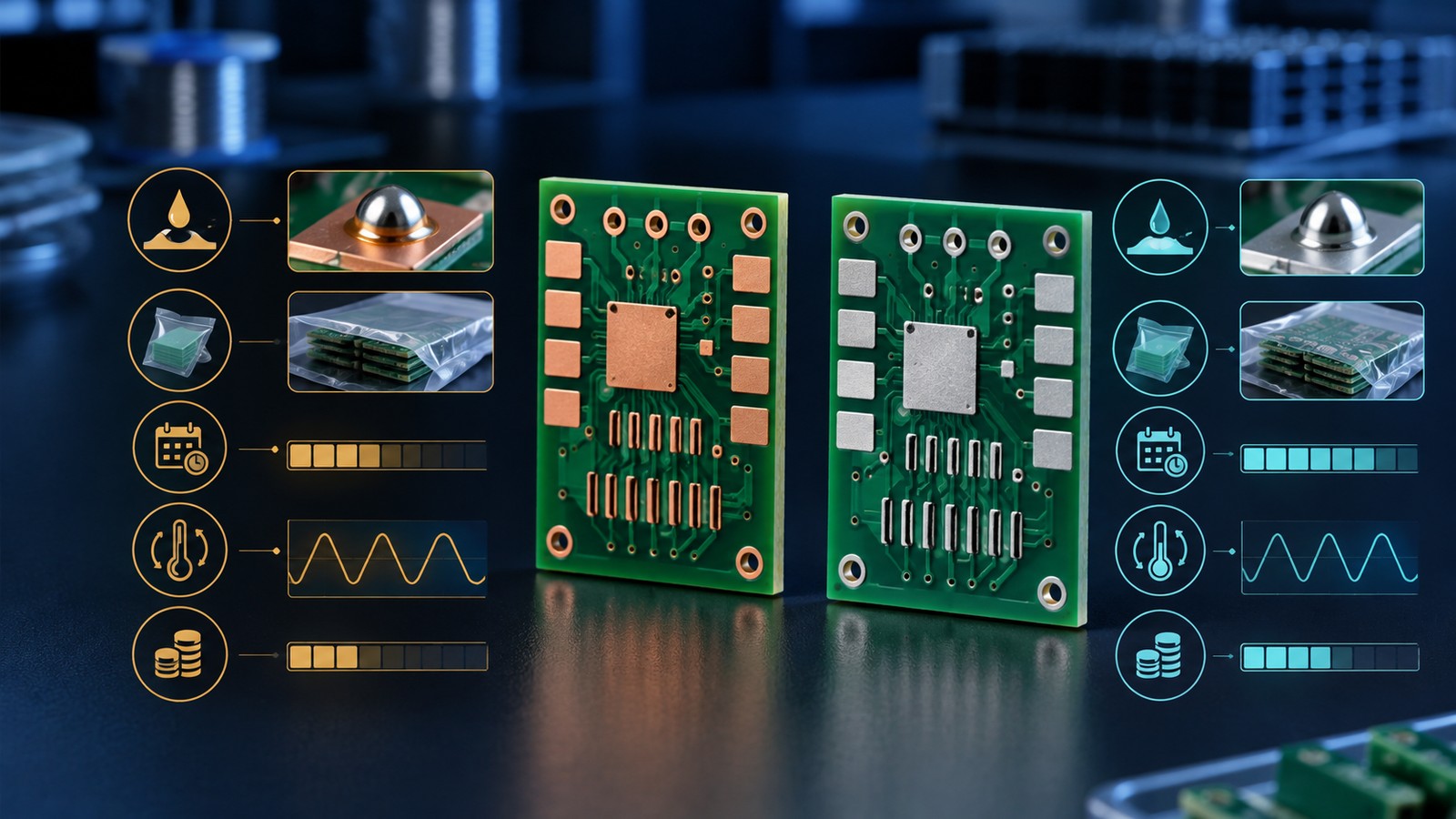
Table of Conent
Table of Conent
OSP and immersion tin can both provide flat, solderable copper surfaces, but they manage storage, handling, repeated thermal exposure, inspection, and special contact requirements differently. OSP is often attractive when a simple organic protection layer and low process cost fit a controlled assembly flow. Immersion tin is a metallic finish that can support soldering and selected contact applications, but copper-tin intermetallic growth, deposit control, and storage history require disciplined management.
The correct choice depends on the complete build, not the board price alone. Compare assembly sequence, fine-pitch geometry, number of heat cycles, expected storage time, packaging, test or connector interfaces, rework, supplier control, and the cost of a delayed or failed build.
What OSP and immersion tin actually protect
OSP applies an organic solderability preservative to exposed copper. The coating limits oxidation until flux and heat remove or disrupt it during soldering. The finished pad remains flat because the protection is thin and does not add a substantial metallic layer. That flatness can suit fine-pitch printing and component placement when the fabrication and assembly processes are controlled.
Immersion tin deposits tin directly over copper through a displacement reaction. The IPC-4554 scope describes immersion tin as a solderable surface finish for printed circuit boards and notes that it has also been used for press-fit and zero-insertion-force interfaces. The same source explains that copper and tin diffuse into each other over time, directly affecting usable shelf life and finish performance.
IPC’s current revision table lists IPC-4555 for high-temperature OSP and identifies IPC-4554 with Amendment 1 for immersion tin while marking the latter as no longer maintained. Procurement specifications should name the exact finish, applicable document revision, supplier controls, and acceptance evidence instead of writing only “OSP” or “tin.”
Compare the assembly process first
Both finishes can support surface-mount and through-hole soldering, but the process window depends on actual finish quality, age, packaging, flux chemistry, paste, atmosphere, component terminations, and thermal history. A finish name alone does not guarantee wetting after storage or multiple heat exposures.
OSP is sensitive to handling because contamination or abrasion can damage the organic layer or expose copper. Repeated reflow, long dwell, aggressive cleaning, and extended queues between operations can reduce the margin available for later soldering. This does not make OSP unsuitable for multi-step assembly, but it makes process qualification and queue control important.
Immersion tin provides a metallic surface, yet its condition evolves as copper-tin intermetallic compounds form. IPC-4554 connects deposit thickness, diffusion, and shelf life, and specifies measurement and solderability considerations. The fabricator must control the deposit and the assembler must respect the qualified storage and handling window.
For either option, define the expected sequence: first-side reflow, second-side reflow, selective or wave soldering, press-fit insertion, hand operations, cleaning, coating, and rework. Then qualify the finish through that sequence rather than assuming a single fresh-board solder test represents production.
Flatness, fine pitch, and paste printing
OSP and immersion tin are both commonly considered flat finishes compared with hot-air-leveled surfaces. That can help stencil gasketing and paste-volume consistency on fine-pitch pads. However, pad flatness is only one input to printing. Stencil thickness, aperture design, board support, paste condition, separation speed, and pad cleanliness also determine transfer efficiency.
For QFN and other bottom-termination components, surface finish should be reviewed with exposed-pad stencil design and voiding controls. The QFN solder-voiding process guide explains why paste segmentation, thermal profile, via design, and inspection criteria must be managed together. Changing the finish will not correct an unsuitable aperture or thermal design by itself.
Storage and packaging are part of the specification
Do not assign a universal shelf-life number to either finish without supplier evidence and defined storage conditions. Usable life depends on finish chemistry, process control, deposit condition, packaging, humidity, temperature, contamination, board construction, and the acceptance test. A quoted period is meaningful only when those conditions and the clock start are clear.
Specify packaging and traceability at purchase. Useful requirements include lot identity, finish date, sealed barrier packaging where applicable, desiccant and humidity indication where agreed, storage limits, reseal instructions, and a method for disposition after the package is opened or the date limit is exceeded. Boards should remain protected from fingerprints, sulfur-bearing materials, condensation, dust, and uncontrolled shop exposure.
Incoming inspection should verify the label, packaging integrity, quantity, board revision, finish callout, certificate or test evidence, and visible condition. Visual appearance is not a complete solderability assessment. Use an agreed test and sampling plan when age, packaging damage, or process history creates doubt. The PCB solderability testing guide covers methods, conditions, and the evidence to request from a supplier.
If the project has uncertain storage or several planned thermal operations, share the fabrication notes, assembly sequence, quantities, and storage expectations before locking the finish. The review should connect finish selection with board fabrication, stencil design, paste, reflow, through-hole operations, inspection, and delivery timing.
Where immersion tin needs additional attention
Immersion tin brings finish-specific concerns that must be addressed by the supplier and end user. Copper-tin intermetallic growth consumes the available pure tin and can change solderability over time. Deposit thickness measurement must distinguish the relevant tin condition. IPC-4554 also calls out tin-whisker risk for some applications and states that the end user must determine the reliability impact.
Do not extend immersion-tin use automatically to every contact interface. The standard discusses specific uses and limitations, including zero-insertion-force edge connections and concerns for other contact surfaces. Connector wear, contact resistance, insertion force, mating cycles, and environmental exposure need their own qualification.
Ask the fabricator for the process specification, thickness and measurement method, solderability evidence, storage conditions, and any restrictions on assembly time or thermal cycles. If the supplier cannot connect the delivered lot to controlled evidence, a nominal finish callout is not enough.
Where OSP needs additional attention
OSP performance relies on preserving the organic film until soldering. Control direct contact, abrasion, wash chemistry, and time between operations. If ICT, probing, wire bonding, contact pads, or exposed copper test features are involved, confirm that the interface is compatible with the finish and the required number of contacts.
Assembly planning should define whether boards can be re-baked, cleaned, or reprocessed without compromising the finish. Do not copy a component moisture-bake instruction onto a bare-board finish without supplier agreement. The thermal and atmospheric exposure that protects one risk may create another.
OSP is often chosen for cost and flatness, but savings disappear if boards need expedited use, special requalification, or replacement after uncontrolled storage. Treat the finish, packaging, and assembly schedule as one system.
Compare total cost, not finish price
The fabrication quote captures only part of the economic decision. Total cost includes finish processing, inspection, packaging, storage controls, incoming testing, line scheduling, paste and flux compatibility work, yield loss, rework, scrap, and the schedule impact of a rejected lot.
| Decision factor | OSP questions | Immersion tin questions |
|---|---|---|
| Assembly sequence | How many heat and handling steps were qualified? | How does age and intermetallic growth affect the final step? |
| Storage | What packaging and open-package controls protect the organic film? | What deposit evidence and usable-life conditions apply? |
| Fine pitch | Are pads clean, flat, and compatible with the stencil process? | Is the deposit uniform and within the controlled specification? |
| Contacts | Are probing and non-solder contacts compatible? | Is the specific press-fit or ZIF interface qualified? |
| Risk cost | What happens if handling damages the coating? | What happens if age or deposit condition reduces solderability? |
| Supplier evidence | Which OSP specification, process, and tests apply? | Which IPC-4554 revision, measurements, and tests apply? |
Compare quotes using the same finish specification, board quantity, panel assumptions, packaging, testing, and delivery terms. The PCB quote total-cost framework helps separate scope differences from apparent unit-price differences. A cheaper finish on an incomplete scope is not a valid comparison.
Qualification and release checklist
- Name the finish and applicable specification revision on the fabrication drawing and purchase order.
- Define assembly steps, thermal cycles, flux and paste family, cleaning, rework, and expected queues.
- State storage conditions, packaging, date coding, open-package handling, and expired-material disposition.
- Request supplier evidence for deposit or coating control and agreed solderability testing.
- Review fine-pitch, bottom-termination, press-fit, ZIF, test-contact, and exposed-pad applications separately.
- Run a representative build when the finish, supplier, process, or storage condition changes materially.
- Record lot, board revision, finish, dates, line conditions, defects, rework, and inspection results.
During production, control paste as carefully as the board finish. The solder-paste storage and handling guide shows how temperature history, thawing, mixing, and traceability affect printing and soldering evidence. A finish investigation is incomplete if paste condition and thermal history are unknown.
For a build decision, provide the Gerber or intelligent fabrication data, BOM, centroid file, finish callout, assembly sequence, quantities, storage window, and test requirements. The PCB assembly team can then review the finish as part of fabrication, sourcing, stencil, SMT/THT assembly, inspection, testing, and delivery planning.
Select the finish for the controlled process
Choose OSP when its flat copper protection, process economics, handling controls, and qualified assembly window match the product. Choose immersion tin when its metallic surface and specific interface advantages are useful and the supplier can control deposit condition, intermetallic growth, storage, and application risks. In both cases, base the choice on documented production conditions and total cost. The best surface finish is the one that remains solderable and verifiable through the actual build and delivery chain.
Technical references: IPC-4554 with Amendment 1, IPC document revision table, IPC final-finish specifications review, and IPC immersion-tin soldering paper.
Latest Blog

Contact Info
Phone: +86-755-82882936
Email: [email protected]
WhatsApp: +86-13570802455
Wechat: +86-13570802455
Address: 2nd floor,D Bldg.,Electric Link Technology Bldg.,Gongming,Guangming New Dist.,518106 Shenzhen, China