
Satellite Communication PCB Manufacturing: A Controlled Handoff
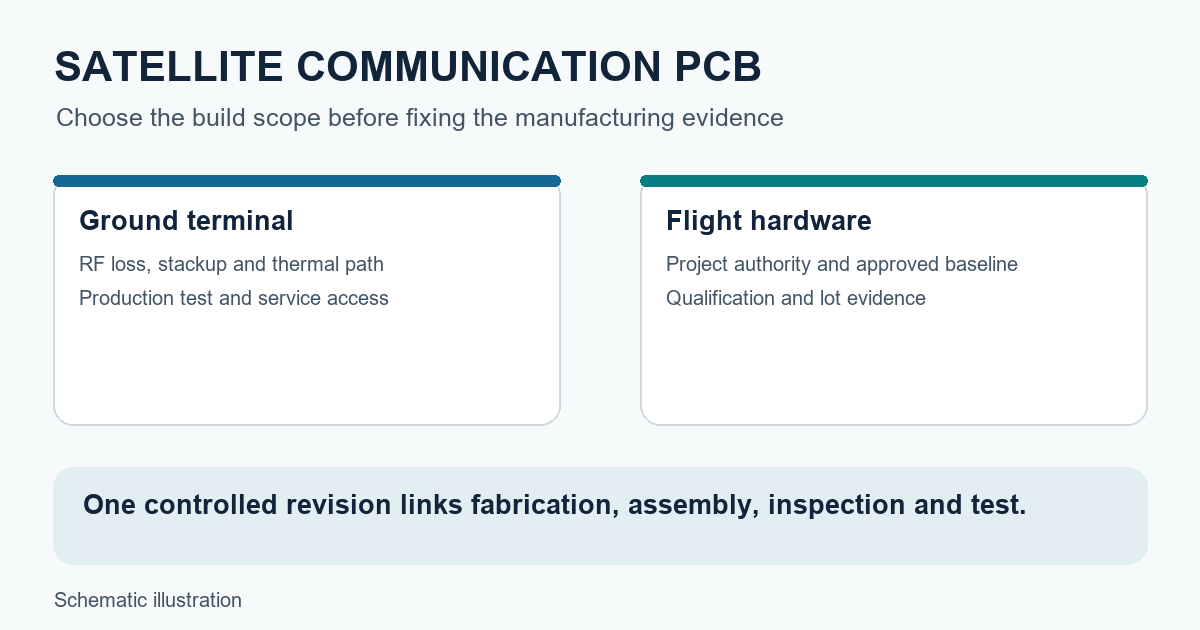
Table of Conent
Table of Conent
Satellite communication PCB manufacturing should start with a controlled baseline, not a stackup guess or a generic “space grade” label. First identify whether the board belongs to a ground terminal, a qualification unit, or flight hardware. Then release the board drawing, RF stackup, material and finish requirements, assembly data, and acceptance plan as one revision. A fabrication or component change can alter RF loss, impedance, thermal behavior, or the evidence needed for acceptance even when the copper artwork looks unchanged. For flight use, the program authority must define the applicable qualification and traceability requirements; a commercial RF PCB quote alone does not establish flight suitability.
Define the hardware scope before requesting a build
Ground equipment and flight hardware may share RF design problems, but they do not automatically share the same procurement evidence. A ground terminal designer may prioritize measured RF performance, repair access, production yield, and field service. A flight program may also require an approved supplier and material baseline, controlled changes, lot traceability, and mission-specific acceptance records. The program’s drawing and quality authority must set those requirements; a manufacturer should not infer them from the word “satellite” in an RFQ.
NASA’s quality discipline overview describes mission-specific PCB materials, construction, coupon evidence, and supplier assessment. That is a useful reason to ask for the customer’s governing specification and acceptance plan rather than promise a universal space PCB process. For a ground unit, the same question still improves the quote: it reveals whether the customer needs an RF bare board, an assembled and tested board, or a complete integration package.
The first release gate is a written scope statement: installation environment; prototype, qualification, or production role; owning design authority; applicable project requirements; and who approves substitutions. Without it, two suppliers can price very different evidence packages against the same Gerber data.
Freeze the RF construction together with the board drawing
An RF layout only becomes a reproducible manufacturing instruction when its dielectric construction and measurement references are specified. The released package should identify laminate and bondply by approved designation, layer order and target thicknesses, copper and finish, controlled-impedance structures, RF launch geometry, reference planes, via treatment, and the locations at which an impedance or RF result will be judged. The designer should state which values are design targets and which require supplier confirmation.
A supplier’s manufacturability review can expose conflicts between a nominal trace width and an available construction. The response should propose a controlled stackup and identify affected nets before any change is accepted. Our impedance-controlled PCB RFQ guide explains the fabrication data needed to quote an impedance target; the RF and high-frequency PCB guide gives background on material and layout choices. For this satellite communication use case, the extra handoff step is to tie the chosen construction to the exact hardware revision and acceptance record.
For example, a proposed bondply substitution may preserve nominal thickness but change dielectric properties, loss, or processing behavior. The engineering response is to review the affected RF path and qualification scope, then issue an approved revision and any required retest instructions. Calling the substitution “equivalent” without this review would hide the decision that matters.
Use one release matrix for fabrication, assembly, and acceptance
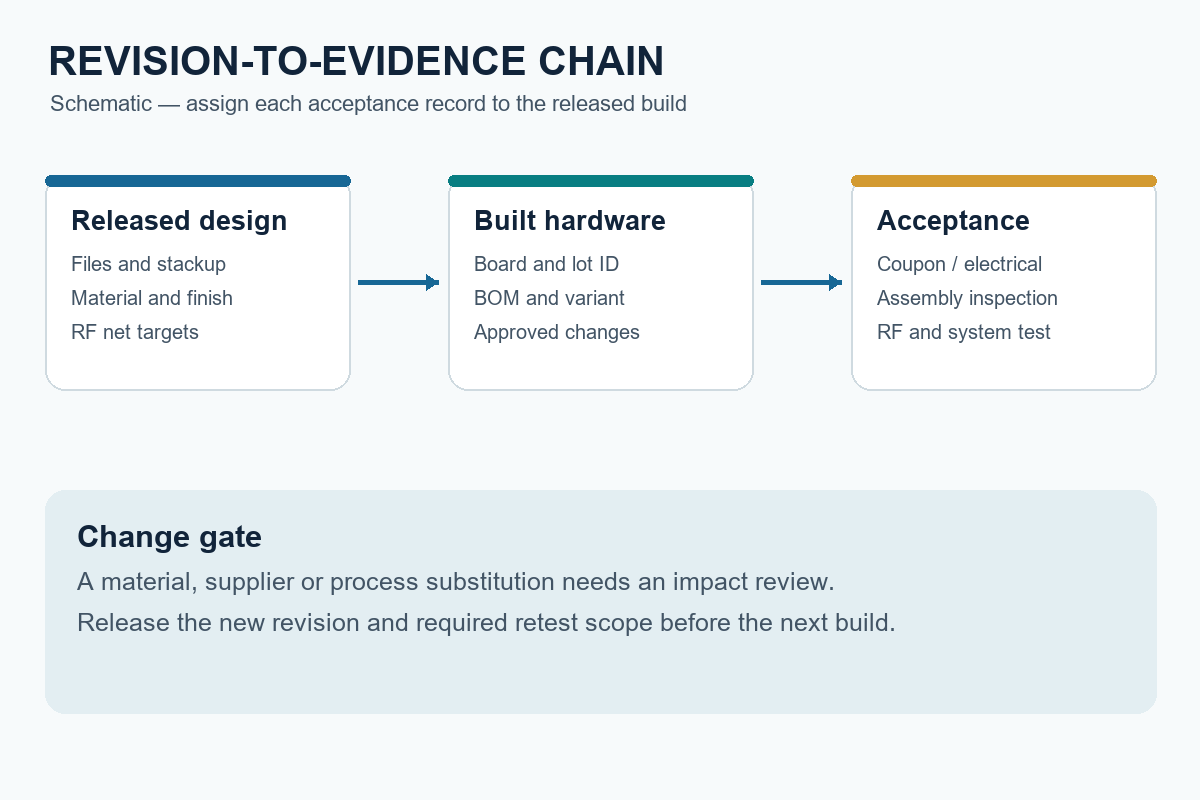
A release matrix prevents the fabricator, assembler, and test team from working to different baselines. Assign each deliverable an owner, a revision, and a specific record that will demonstrate acceptance. The matrix below is a starting point for procurement discussion; the project authority should add its contractual requirements.
| Build decision | Release to supplier | Evidence to request | Stop and review when |
|---|---|---|---|
| RF construction | Approved stackup, material designations, impedance and RF launch targets | Supplier stackup confirmation and agreed coupon or RF measurement report | A material, thickness, copper, or process substitution is proposed |
| Bare-board fabrication | Drawing, fabrication files, finish, inspection and lot-identification rules | Inspection results and traceable lot or coupon records named by the contract | The drawing and data package show different revisions |
| Assembly | Approved BOM and alternates, placement data, assembly drawing, process and handling requirements | As-built BOM, assembly inspection and rework/deviation records as required | A component alternate, footprint, or process change affects the approved build |
| Test and delivery | Test limits, fixtures, reference planes, environment and acceptance authority | Results linked to board or lot ID and the released design revision | A measurement fails or the test setup differs from the approved plan |
This table is most useful when the purchaser fills the evidence column before award. A low bare-board price that omits a required coupon, serialized record, or assembled test can become a higher total project cost after a purchase order is placed.
Make a substitution decision before procurement changes the build
Substitutions are engineering decisions when a board’s RF or qualification evidence depends on the selected material, supplier, finish, or component. The buyer should capture the proposed change, its reason, affected design parameters, impacted lots, and the approval authority. Engineering can then decide whether analysis, a coupon, a first-article build, RF retest, or a new qualification step is required. The answer depends on the project requirements and the magnitude of the change.
A useful comparison is “same drawing, different laminate” versus “same approved construction, new delivery lot.” The former can change electrical behavior and the scope of accepted evidence; the latter still needs lot control but may not require the same engineering action. Do not let an unchanged Gerber file substitute for a configuration review.
If you have a candidate stackup and a proposed alternate, send the drawing revision, RF targets, approved material list, and planned test evidence through the PCB assembly quote intake. Ask for a fabrication and assembly scope review that identifies the changes requiring your approval before a price or schedule is committed.
Connect assembly records to RF test results
RF performance is assessed on assembled hardware, so the as-built BOM and board identity matter alongside bare-board measurements. Confirm reference planes, calibration approach, connector or launch configuration, power conditions, and the environmental state for each test. A number without those conditions may not be comparable between a prototype and a later production lot.
Where the program calls for conformal coating, staking, cleaning limits, or special handling, specify them on the assembly release and define how they will be inspected. Their use and acceptance must come from the project, rather than from an assumed “space” recipe. Our PCB test planning article shows how to state test boundaries, methods, and records; for this project, add the RF setup and hardware revision to each record.
The production question is not simply whether a board passed. It is whether the result belongs to the intended serialized unit or lot, the approved build revision, the correct test setup, and the stated limit. If any link is missing, the customer may need to reconstruct the evidence before release.
Compare offers by the evidence they include
Two quotations for the same artwork can cover different deliverables. Before comparing unit price or lead time, align the scope of fabrication, component sourcing, assembly, inspection, and test. The buyer should request a list of included documents and exclusions, especially when a program needs controlled alternates or traceable acceptance.
| Quote difference | Procurement question | Practical decision |
|---|---|---|
| Stackup is marked “supplier choice” | Who approves RF construction and verifies the target? | Hold award until a reviewed construction and measurement plan are named. |
| Assembly price excludes component alternates | Who decides and records substitutions? | Define an approval gate and an as-built BOM deliverable. |
| Test is listed as “functional” | Which RF conditions, limits, IDs, and reports are included? | Supply a test schedule and compare the priced evidence, not just the test label. |
OrinewPCB describes its turnkey PCB assembly service as an integrated fabrication, sourcing, and assembly path. That can simplify coordination for a ground-system project when the inputs and acceptance boundaries are clear. The service page alone is not evidence of a flight-qualified process, and flight program requirements must be reviewed separately.
Release a complete package for engineering review
Prepare a package with the latest fabrication files and drawing, controlled stackup, BOM and approved alternates, assembly drawing and placement data, expected quantity, target delivery, RF performance and test conditions, inspection requirements, and the change-approval contact. If the hardware is for qualification or flight, include the governing project specification and the required traceability and evidence schedule. Mark assumptions and unresolved decisions rather than letting a supplier silently fill them in.
NASA’s small spacecraft knowledge resource on PCB materials explains why material and environmental requirements can affect both a board design and its schedule. Use that principle to review the package early, but let the project authority decide the actual material qualification and acceptance criteria.
Before release, verify that the PCB drawing, fabrication data, stackup, BOM, assembly drawing, and test plan carry a consistent revision or an explicit cross-reference. The result is a quote and build discussion about a defined article of hardware, with deviations visible before procurement commits to them.
When the package is ready, submit the build files for a combined PCB assembly review. Include the RF construction, BOM, placement files, intended ground or flight scope, and required acceptance records so the team can identify manufacturability questions and quote the defined work. Any flight qualification claim remains subject to your program’s separate approval and evidence review.
Latest Blog
Contact Info
Phone: +86-755-82882936
Email: [email protected]
WhatsApp: +86-13570802455
Wechat: +86-13570802455
Address: 2nd floor,D Bldg.,Electric Link Technology Bldg.,Gongming,Guangming New Dist.,518106 Shenzhen, China