
Flexo Press PCB Finish: Match Surface Treatment to Assembly and Service
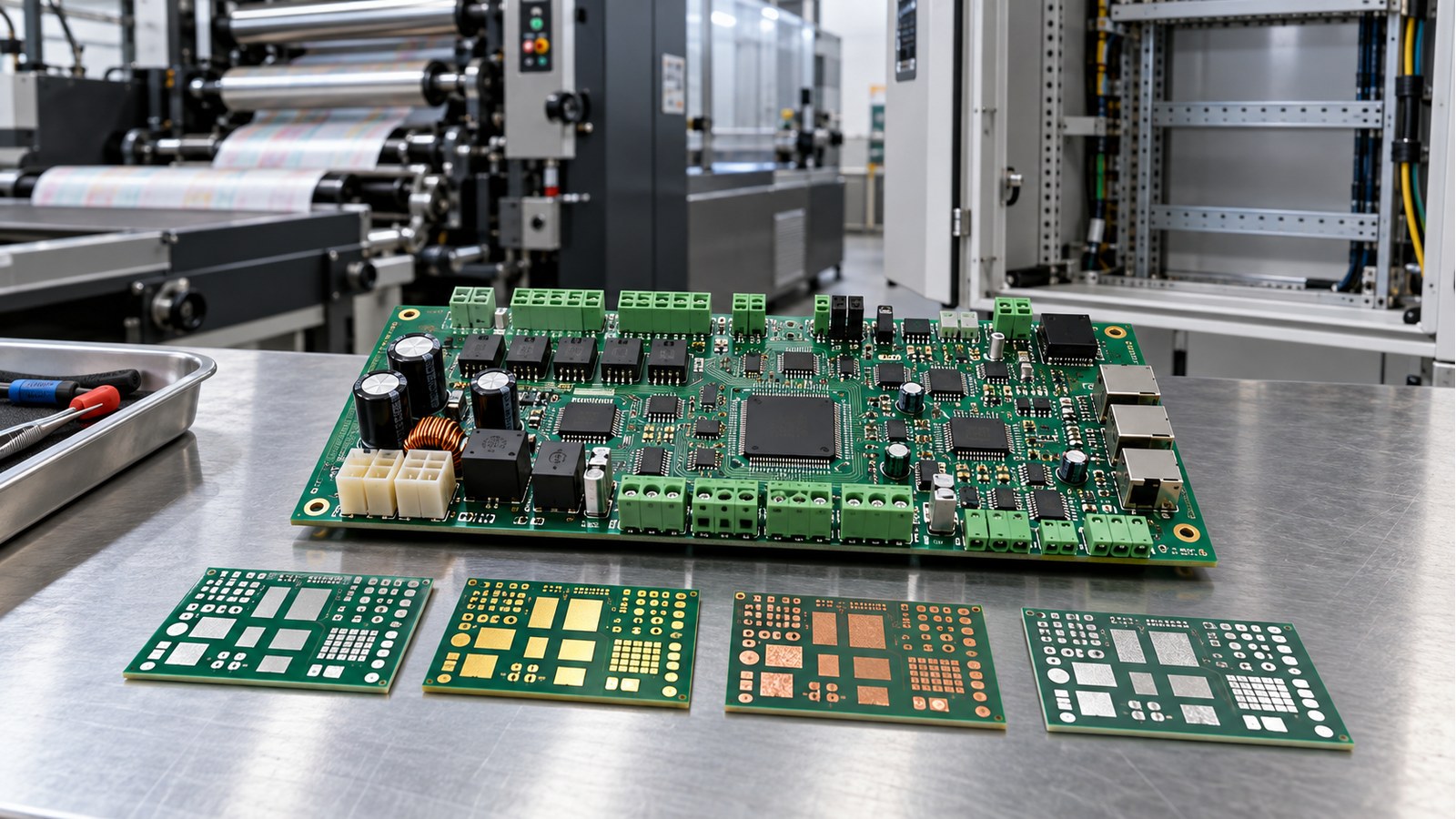
Table of Conent
Table of Conent
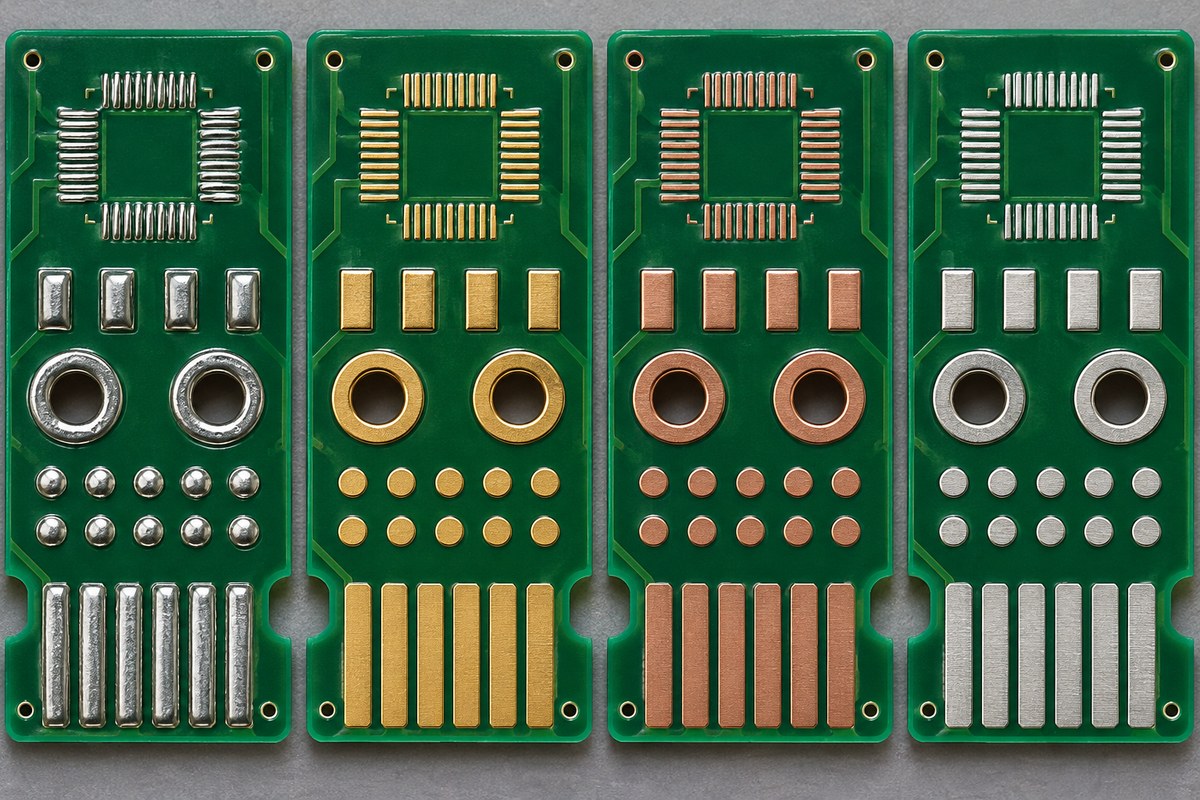
A flexo press control board should not receive a surface finish simply because that finish is familiar or inexpensive. The right choice depends on pad geometry, component termination, soldering sequence, storage time, rework exposure, connector use, and the environment the finished controller will see. ENIG often suits flat fine-pitch pads, lead-free HASL can be practical for less demanding mixed-technology layouts, OSP preserves pad flatness with tighter handling limits, and immersion tin or silver can solve specific assembly needs. Select the finish from the released assembly and service plan, then specify the governing standard and evidence.
The finish protects exposed copper before assembly and creates the interface that soldering, press-fit, probing, or contact features must use. It does not replace laminate selection, solder-mask design, cleaning, conformal coating, enclosure sealing, or corrosion control. A finish that solders well on a fresh coupon can still be a poor system choice if the board waits too long, passes through too many thermal cycles, or uses contacts the finish was never intended to support.
Start with assembly features, not a finish name
The control board layout determines which finish attributes matter. Fine-pitch QFPs, QFNs, and small passive components benefit from a flat land surface. Through-hole terminal blocks may tolerate more topography. Press-fit pins need a compatible hole finish and controlled insertion evidence. Edge contacts, membrane switches, wire bonding, and test pads each introduce different wear, contact-resistance, or bonding requirements.
Map every exposed copper feature to its function before choosing one finish for the whole board. Some designs need selective finishes: a solderable surface across most pads and a different plated system for durable connector fingers. Do not call ordinary immersion gold a wear surface. Hard electrolytic gold and ENIG serve different functions and require different drawings, fabrication controls, and acceptance criteria.
Compare finishes by the risks they control
IPC’s document revision table lists final-finish specifications including IPC-4552 for ENIG, IPC-4555 for high-temperature OSP, and IPC-4556 for ENEPIG. It also identifies the current or maintenance status of older immersion silver and immersion tin documents. The applicable revision and customer requirements should be written into procurement documentation rather than assumed from an acronym.
| Finish | Useful strengths | Planning concerns | Typical decision trigger |
|---|---|---|---|
| Lead-free HASL | Established solderable coating and broad availability | Pad topography, thermal exposure, tight-pitch coplanarity | Cost-sensitive mixed technology with geometry that tolerates leveling |
| ENIG | Flat surface, good solderability, useful storage and probing characteristics when controlled | Nickel corrosion control, thickness, supplier process capability, unsuitable assumptions about wear | Fine-pitch SMT, BGAs, or flat contact/test surfaces |
| OSP | Very flat copper surface and simple metal stack | Handling, storage, contamination, repeated thermal excursions, exposed copper after damage | Well-controlled assembly flow with limited delays and suitable reflow history |
| Immersion tin or silver | Flat solderable surface for selected applications | Finish-specific storage, handling, corrosion or intermetallic risks, and supplier controls | Documented compatibility with the product and assembly route |
| ENEPIG | Flat multilayer finish with broader bonding options in appropriate designs | Cost, thickness control, process qualification | Mixed soldering and wire-bonding requirements that ENIG cannot satisfy |
This table is a screening framework, not a material approval. Finish chemistry, thickness, age, packaging, storage, solder alloy, flux, component termination, and thermal profile all affect the result. A supplier designation without measurable requirements cannot support incoming acceptance or failure analysis.
When ENIG is the practical default
ENIG is often selected for dense industrial controllers because its pads are flat and compatible with fine-pitch placement. MacDermid Alpha’s overview of ENIG surface finishes emphasizes solderability, corrosion resistance, pad coplanarity, and control to IPC-4552. Those benefits still depend on a qualified fabrication process and the thickness and corrosion limits required by the applicable revision.
ENIG is not automatically the most reliable choice for every pad. The nickel layer changes the interfacial system, and poor process control can create nickel-corrosion defects. A gold appearance does not prove acceptable nickel condition or solderability. If the flexo controller uses edge contacts that mate repeatedly, specify a contact finish designed for wear rather than assuming ENIG will behave like hard gold.
When HASL can remain appropriate
Lead-free hot-air solder leveling can be economical and solderable for boards whose pad geometry tolerates its surface shape. It may fit controllers dominated by larger SMT parts, through-hole connectors, relays, and terminal blocks. The decision should account for the board’s thermal robustness and the effect of finish topography on paste printing and small-component placement.
Do not dismiss or approve HASL based on age or price alone. Review minimum pitch, bottom-terminated packages, via structures, hole dimensions, panel support, expected rework, and the fabricator’s capability. Our guide to sequencing SMT and through-hole assembly explains why the complete thermal route matters when a controller combines reflow, selective soldering, and manual operations.
When OSP rewards a controlled supply chain
OSP produces a flat surface by protecting copper with an organic film. It can support fine-pitch assembly without introducing a metal leveling layer, but its value depends heavily on handling and time. Abrasion, contamination, poor packaging, prolonged storage, and repeated heat exposure can narrow the assembly window.
OSP is most defensible when the fabrication-to-assembly route is short and controlled, packaging and storage are specified, and the expected number of thermal excursions is known. If the board will sit as a spare for an extended period, move between suppliers, or undergo uncertain rework, the program should compare that lifecycle against alternatives rather than relying on initial material cost.
For a product-specific decision, provide the Gerbers, stackup, BOM, package list, soldering route, expected storage, annual quantity, rework policy, and contact requirements through our surface-finish and assembly-route review. The engineering review can identify flatness, thermal, contact, packaging, and test assumptions before the finish is frozen in the fabrication notes.
Use immersion tin or silver only with finish-specific controls
Immersion tin and immersion silver provide flat solderable surfaces, but they are not interchangeable with each other or with ENIG. IPC’s IPC-4554 immersion tin scope describes the finish as a chemical displacement deposit applied directly over copper and notes that copper-tin diffusion affects usable shelf life. The document also discusses application boundaries such as contact surfaces and interfaces.
Atotech’s official final-finishing portfolio shows ENIG, ENEPIG, immersion tin, and OSP as distinct process families. That distinction matters in procurement: call out the exact finish, standard, thickness or performance requirement, approved process, packaging, and shelf-life controls. Avoid a generic note such as “immersion finish.”
For immersion silver, contamination and tarnish control deserve explicit attention. For immersion tin, intermetallic growth and the intended storage and contact application require review. The fabricator’s process data and product-specific qualification matter more than a broad claim that one finish is universally superior.
Match the finish to service and rework
A flexo press controller can face heat, vibration, paper dust, ink mist, cleaning chemicals, humidity, and long maintenance intervals. Surface finish mainly protects copper before and during assembly; after soldering, most pads are covered by joints. Exposed test pads, connectors, and unused lands remain more directly dependent on the finish and environment.
If the controller will be conformally coated, define which contacts, test points, grounds, and heat-transfer areas remain uncoated. If field repair is expected, consider whether the finish and pad construction tolerate the planned rework cycles. Finish selection cannot compensate for an enclosure leak or uncontrolled contamination, but it can support a stable assembly and service interface when the full protection system is defined.
Incoming and preassembly evidence should match the risk. Our article on PCB solderability testing separates sample preparation, conditioning, wetting evidence, and acceptance criteria. Do not use a visual gold or silver color check as a substitute for thickness, porosity, solderability, or process-control evidence.
Put the requirement in the controlled release package
The fabrication drawing should identify the finish by name, applicable specification and revision, and any product-specific thickness, selective plating, edge-contact, press-fit, packaging, storage, or certificate requirements. The assembly drawing should identify solder alloy, process sequence, special handling, cleaning, coating, and test expectations. Our PCB assembly drawing checklist helps prevent contradictions between fabrication, BOM, placement, and assembly notes.
Change control is equally important. A substitution from ENIG to OSP, or from one immersion process to another, is not a cosmetic purchasing change. It may alter paste printing, storage, reflow exposure, probe contact, rework, and qualification. The principles in our guide to controlling PCB assembly variants apply to finish alternatives as well: approved options need distinct documentation and traceability.
AssyPCB’s PCB assembly service can align fabrication notes, component sourcing, assembly, inspection, testing, and delivery when those requirements are included in one controlled release package. The scope should still identify which evidence is required rather than relying on a service label alone.
Choose the finish that preserves the entire manufacturing window
For many fine-pitch flexo controller boards, ENIG is a sensible starting point. HASL can remain appropriate for tolerant geometry and a well-understood thermal route. OSP can be effective in a tightly controlled supply chain, while immersion tin, immersion silver, or ENEPIG should be chosen for specific, documented assembly or interconnect needs. The decision is complete only when fabrication, storage, soldering, rework, contact use, environment, and acceptance evidence agree.
Before releasing the board, confirm the package mix, pitch, contact function, soldering sequence, expected storage, rework limit, surface-finish standard, and supplier evidence. If those inputs are ready, share the controlled fabrication and assembly package for manufacturing evaluation. The review can translate the finish choice into a measurable scope for fabrication, assembly, inspection, and quotation.
Latest Blog
Contact Info
Phone: +86-755-82882936
Email: [email protected]
WhatsApp: +86-13570802455
Wechat: +86-13570802455
Address: 2nd floor,D Bldg.,Electric Link Technology Bldg.,Gongming,Guangming New Dist.,518106 Shenzhen, China