
Airborne Baggage Controller PCBs: Laminate Selection by Installation and Build Risk
Table of Conent
Table of Conent
Choose laminate for an airborne baggage or cargo-loading controller PCB from the specified installation and approved build, not from the word “airborne” or a glass-transition-temperature label alone. The system owner must define the equipment’s environmental categories, enclosure, electrical loads, temperature at the board, service and storage conditions, and approval path. Engineering can then compare a named laminate and complete stackup against both operating exposure and fabrication/assembly heat. A high-Tg epoxy may be a suitable candidate; polyimide may be justified for a more demanding qualified construction. Neither material family is automatically approved for an aircraft installation.
This guide concerns an on-aircraft cargo-loading controller, not an airport terminal’s baggage conveyor PLC. It gives an OEM and PCB/PCBA buyer a way to turn equipment requirements into a material callout, supplier evidence request, and comparable fabrication-and-assembly quote. It does not assign a universal aircraft temperature, DO-160 category, flammability result, or IPC class to every cargo system.
Define the actual cargo-system installation before choosing resin
An aircraft cargo-loading system can include power drive units and local or master control panels. The location of the electronics matters: a controller in a protected panel, a board near a drive motor, and an assembly at a doorway need not see the same thermal, humidity, mechanical, or electrical conditions. TELAIR’s B767 cargo-system description shows master and local control panels as distinct system elements; it does not specify the laminate in any particular customer board.
Ask the design approval holder for the installation drawing and equipment environmental qualification plan. Record enclosure type, heat sources, cooling path, mounting points, harness and connector loads, normal and abnormal operating states, power input, maintenance access, and storage conditions. Then identify the applicable environmental test categories and pass criteria. The FAA’s AC 21-16G recognizes RTCA/DO-160 environmental qualification methods for airborne equipment; it also explains that the tests address defined conditions rather than establish service life. RTCA’s DO-160 overview describes the standard. A PCB datasheet does not substitute for qualification of the released equipment.
The first handoff is a short requirement sheet, signed off by the system owner. It should say which conditions apply to the assembled equipment and which ones the bare-board material or construction can help manage. If the owner has not selected a humidity category or established board temperature, the material buyer should mark those as open questions instead of treating a generic aerospace checklist as a specification.
Translate exposure into a testable laminate requirement
Service temperature, assembly heat, and biased moisture are different material questions. Tg is relevant to resin behavior through a temperature excursion, but it is not a continuous operating-temperature rating or a DO-160 pass result. Evaluate the supplier’s full datasheet, the actual stackup, and the fabricator’s process history against each requirement. A higher Tg alone cannot resolve a weak plated-hole construction, moisture path, or unapproved material substitution.
| Owner-provided input | Material or geometry question | Evidence to request |
|---|---|---|
| Worst-case board temperature in the released enclosure | Does the exact material construction have an appropriate continuous-use basis and thermal margin? | Measured or analyzed board temperature, supplier rating and approved limit; do not use Tg as the limit. |
| Fabrication, lead-free assembly and permitted rework profiles | Can the resin, bonds and plated holes tolerate the cumulative excursions? | Core/prepreg data, z-axis expansion and delamination indicators, representative thermal-stress or microsection evidence. |
| Credible humid exposure with electrical bias | Could insulation resistance fall across the actual conductor and hole geometry? | Voltage/spacing map, material and drill/process record, risk-based CAF test vehicle and acceptance criterion if warranted. |
| Vibration, mounting and harness load | Will board thickness, support, connectors and solder joints withstand the installed mechanical path? | Released mechanical drawing and equipment-level test configuration; material stiffness alone is insufficient. |
| Fire or flammability requirement | Does the selected material and finished equipment meet the program’s specified argument? | Exact material grade/rating plus the approval holder’s equipment or installation evidence; no automatic inference from a resin name. |
The environmental test selection guide separates credible field exposure, sample configuration, method and pass criteria. Use that logic for the full cargo controller: a bare-board coupon, a powered PCBA and a housed unit answer different questions.
Compare material candidates as complete constructions
A high-Tg FR-4 family and a polyimide family are useful comparison starting points, not a two-choice mandate. For example, Isola lists 370HR as a 180°C-Tg epoxy system, and Ventec lists VT-901 as a 250°C-Tg polyimide system. Their published typical values, IPC-4101 slash-sheet associations, processing guidance and availability differ. Those datasheets support a candidate review; they do not establish that either is qualified for a given aircraft or that every fabricator can build the same stackup with it.
| Candidate route | Why consider it | What remains to verify |
|---|---|---|
| Named high-Tg epoxy construction, such as 370HR | May meet the released electrical and build demands without introducing a different resin process. | Exact core and prepreg, finished-board temperature basis, reflow/rework history, plated-hole reliability, supplier approval and lot evidence. |
| Named polyimide construction, such as VT-901 | May provide a different high-temperature material option where the program has a justified need. | Exact grade and flammability data, material handling, lamination/desmear process, supplier capability, build lead time and qualification impact. |
| Other approved construction | The design may be governed by electrical, mechanical, procurement or program-specific constraints that the first two examples miss. | Same measured requirements, complete stackup and documented substitution approval; “equivalent Tg” is not enough. |
Isola’s 370HR technical data reports typical Tg and z-axis expansion; Ventec’s VT-901 datasheet provides its own material and processing values. Compare properties using the same test definition and the construction actually offered by the fabricator. The high-Tg material guide explains why a shorthand temperature grade is not a complete purchasing note.
Lock the stackup and substitution path before quoting
The material note should control more than resin family. IPC-4101’s published scope identifies laminate and prepreg specification sheets and its material designation system. Cite the revision and applicable slash sheet required by the customer, then define the approved product or equivalence route, core and prepreg construction, finished thickness, copper and dielectric targets, and any special properties that the design actually needs. Our PCB lamination guide explains why pressed dielectric thickness and resin fill must be reviewed against the real artwork rather than an idealized catalog stackup.
Ask the board fabricator to identify proposed core and prepreg sources before CAM release. Confirm drilling, desmear, plating, press cycle, storage and moisture controls for that material system. The critical geometry includes finished hole diameter, board thickness, inter-hole spacing and conductor voltage. A supplier’s proposed substitution should be reviewed against all controlled properties and the program’s change authority, not quietly accepted because the new datasheet advertises a similar Tg.
When the preliminary stackup, drill data, soldering profile and approved-alternative rules are ready, share the stackup, drill data and assembly profile for a joint review. That review can expose material availability, fabrication constraints and PCBA thermal exposure before the buyer compares price and schedule.
Use CAF evidence only where the failure path is credible
Humidity plus electrical bias can make an internal insulation path relevant, especially where closely spaced conductors and drilled holes interact with the glass/resin structure. That does not mean every airborne cargo controller must purchase a CAF coupon, or that a passing material test certifies the finished equipment. IPC’s IPC-9691B user-guide preview describes internal electrochemical migration and contributors including mechanical stress, laminate damage, moisture and process characteristics. Use the owner’s voltage/spacing map and real construction to decide whether a representative CAF method and test vehicle belong in the first-article plan.
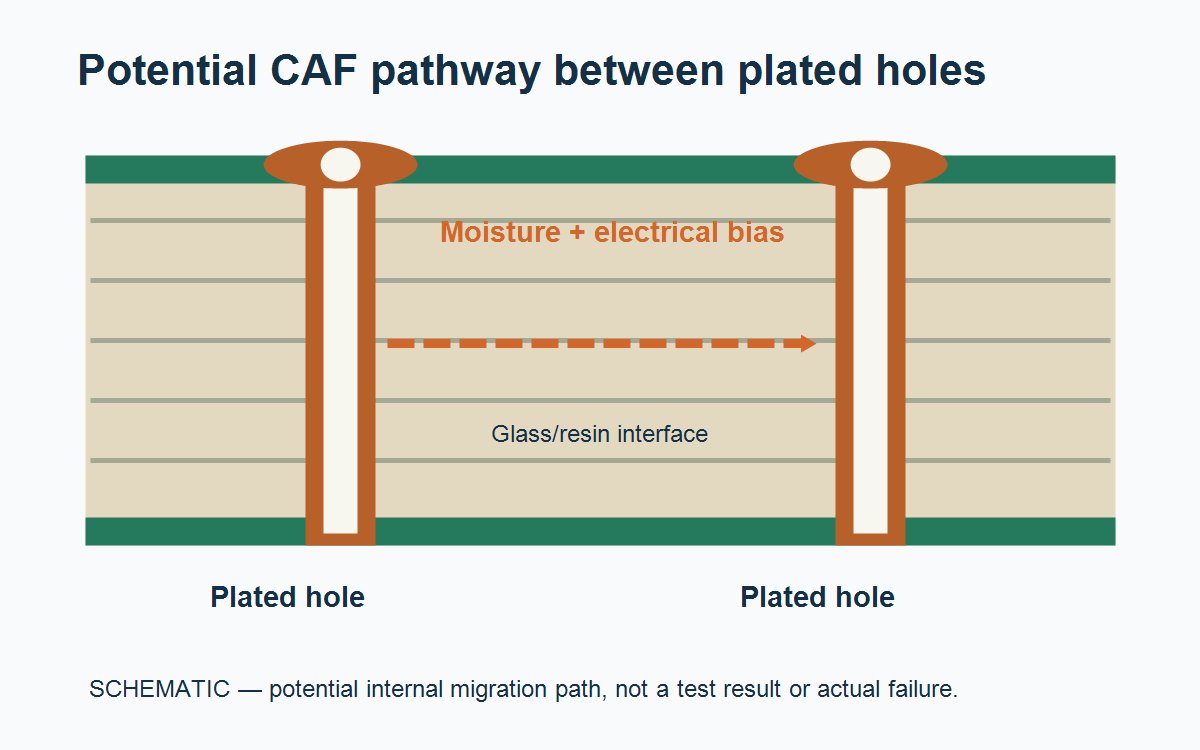
Define specimen geometry, material lot, fabricator process, electrical bias, chamber conditions, measurement interval, failure threshold and follow-up analysis before testing. Then decide which changes would trigger retest: new laminate or prepreg, new drill/desmear route, altered spacing, different lamination process or added assembly heat may change the evidence basis. The CAF testing guide gives a fuller method and interpretation framework.
Put material identity and acceptance on the purchase order
A useful purchase order ties the selected material to the released design and physical lot. The OEM controls the requirement and approves deviations; the board fabricator controls and records the actual build; the EMS partner controls component population and assembly process; the equipment owner interprets system-level qualification. The fabrication and assembly service scope helps buyers define a combined quote, but these responsibilities still need explicit agreement.
| Decision or record | Primary owner | Buyer acceptance question |
|---|---|---|
| Installation conditions and material/stackup approval | OEM or design approval holder | Which revision, categories, limits and substitutions are authorized? |
| Laminate grade, lot and fabricated-board construction | Board fabricator | Does each delivered lot match the approved core/prepreg, stackup, hole and inspection requirements? |
| Thermal profile, population and rework record | EMS provider | Was the specified board assembled within the controlled process and revision? |
| Equipment function and environmental acceptance | OEM or appointed qualification owner | Does the released enclosure, harness, firmware and PCBA meet the selected equipment plan? |
Specify which records are delivered with the first article and which are retained by lot. A raw laminate certificate, a board-fabrication record, a microsection, an assembly inspection, and an equipment test report each answer a different acceptance question. If a customer demands a particular IPC acceptance class, material listing, or aerospace quality-system status, obtain the exact contract requirement and supplier/site evidence; never infer it from a website badge or a photo.
Issue one release package for the complete assembly
The final decision is whether the quoted configuration and evidence match the intended installed equipment. Send the approved fabrication drawing and stackup, Gerbers or ODB++ data, drill files, material and substitution notes, assembly drawing, BOM with approved alternates, placement data, thermal-profile constraints, quantities, inspection and test limits, and the owner of any environmental qualification. The quote should state which party supplies the laminate, controls changes, performs each inspection, handles rework and retains records. Compare quotations on those obligations as well as unit price.
Laminate selection is defensible when the installation requirements, complete material construction, manufacturing route and acceptance evidence can be traced to one released revision. That is a stronger basis than a universal “aerospace FR-4” rule or a blanket polyimide recommendation. For a project moving from design to build, send the released fabrication and assembly package together so the team can clarify material feasibility, PCB/PCBA scope, evidence and quotation assumptions against the same configuration.
Latest Blog

Contact Info
Phone: +86-755-82882936
Email: [email protected]
WhatsApp: +86-13570802455
Wechat: +86-13570802455
Address: 2nd floor,D Bldg.,Electric Link Technology Bldg.,Gongming,Guangming New Dist.,518106 Shenzhen, China